Artificial Intelligence and the Practice of Law: A Powerful Tool, Not a Replacement for Lawyers
Artificial intelligence has quickly become part of everyday life. People use it to write emails, summarize articles, draft contracts, and increasingly, to answer legal questions. It is understandable why AI can generate a detailed response to a legal issue in seconds, often with citations, statutes, and case names that appear convincing. For many, it feels like having a lawyer available at any hour of the day.
The reality, however, is more complicated.
AI Is Not a Lawyer
Despite its impressive capabilities, artificial intelligence is not a substitute for legal counsel. Large language models are designed to predict the next most likely word based on patterns learned from enormous amounts of text. They do not reason about legal issues in the same way an attorney does, nor do they understand the underlying principles of justice, public policy, or human experience that shape the law.
Perhaps the greatest concern is that AI can “hallucinate.” In the legal context, this means it may confidently present statutes that do not exist, misstate legal standards, invent case citations, or incorrectly describe the holding of a legitimate case. Even when the information appears authoritative, it may be inaccurate or entirely fabricated.
Equally important, AI does not possess comprehensive knowledge of every jurisdiction. The law varies dramatically from state to state and between state and federal courts. A legal principle that is correct in one jurisdiction may be entirely wrong in another. Court rules, procedural requirements, statutes, and appellate decisions change constantly. Unless those sources are current and specifically available, an AI-generated answer may omit or misstate critical law.
This is particularly dangerous because legal questions rarely have simple answers. Success in litigation often depends on factual distinctions, procedural posture, burdens of proof, evidentiary issues, judicial discretion, and strategic considerations that extend far beyond reciting a legal rule.
The Practice of Law Is More Than Information
One of the most common misconceptions about artificial intelligence is that practicing law is simply retrieving the correct legal authority. If that were true, legal research databases would have replaced attorneys decades ago.
Lawyers do far more than locate cases.
An attorney analyzes competing authorities, evaluates witness credibility, anticipates opposing arguments, develops litigation strategy, understands how judges approach particular issues, and advocates for a client’s interests. Perhaps most importantly, attorneys exercise professional judgment developed through education, experience, and countless hours spent applying legal principles to unique factual situations.
Two cases can involve remarkably similar facts yet require entirely different strategies because of procedural history, evidentiary concerns, client objectives, settlement posture, or judicial discretion. Those decisions require judgment—not simply information retrieval.
AI Is an Extraordinary Tool for Attorneys
None of this means artificial intelligence lacks value. Quite the opposite.
Used responsibly, AI can significantly improve the practice of law. Attorneys can use it to organize large document productions, summarize records, identify patterns within thousands of pages of discovery, generate preliminary research outlines, compare documents, draft initial language, and automate repetitive administrative tasks.
These capabilities save time, reduce administrative burdens, and allow attorneys to devote more attention to the work that truly requires legal judgment.
Like legal research platforms before it, AI should be viewed as another tool in an attorney’s toolbox—not as the attorney itself.
The Rapid Evolution of Legal Artificial Intelligence
The pace of innovation in artificial intelligence is unlike anything the legal profession has experienced before. Technology companies are investing billions of dollars into increasingly capable AI systems, with new features and products appearing almost monthly. What seemed impossible just a few years ago—summarizing thousands of pages of discovery in minutes, identifying factual inconsistencies across hundreds of documents, or generating comprehensive research outlines—is now becoming commonplace.
Several companies have emerged as leaders in this rapidly evolving field, each taking a somewhat different approach.
Harvey has become one of the most recognizable names in legal AI. Built specifically for lawyers and law firms, Harvey focuses on legal drafting, document review, litigation support, due diligence, and transactional work. Rather than serving as a general-purpose chatbot, Harvey is designed to integrate into legal workflows and assist attorneys with sophisticated legal tasks.
CoCounsel, developed by Casetext and now part of Thomson Reuters, emphasizes legal research, document review, deposition preparation, contract analysis, and litigation support. One of its greatest strengths is combining artificial intelligence with established legal research databases, allowing attorneys to verify legal authorities rather than relying solely on AI-generated responses.
ChatGPT, developed by OpenAI, is perhaps the most widely recognized artificial intelligence platform. Although it was not built exclusively for lawyers, many attorneys use it for brainstorming, drafting preliminary language, organizing complex information, summarizing documents, explaining legal concepts, and assisting with routine writing tasks. When paired with reliable legal research and attorney oversight, it can be an exceptionally productive assistant.
Claude, developed by Anthropic, has earned a reputation for analyzing lengthy documents and producing thoughtful, well-organized summaries. Many legal professionals appreciate Claude’s ability to process extensive contracts, medical records, deposition transcripts, and discovery productions while maintaining context across substantial volumes of information.
Each of these platforms continues to evolve at an extraordinary pace. New capabilities are introduced regularly, and competition among developers is accelerating innovation. As these systems become more sophisticated, they will undoubtedly become even more valuable tools for attorneys.
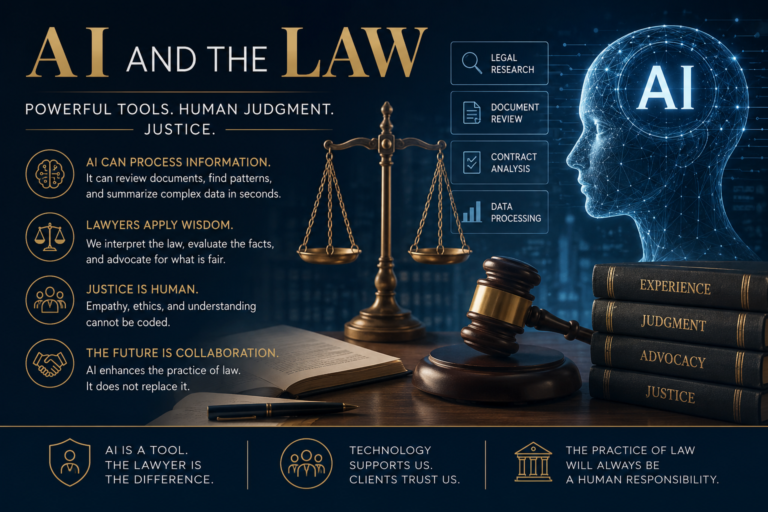
At the same time, every one of these platforms remains fundamentally an assistant. They process information remarkably well, but they do not assume responsibility for legal advice, exercise independent professional judgment, or advocate for a client’s interests. The attorney—not the software—remains responsible for verifying the law, applying it to the facts, and making strategic decisions.
Justice Cannot Be Reduced to Code
Perhaps the greatest limitation of artificial intelligence lies in something more fundamental than legal accuracy.
The law is not merely a collection of statutes and judicial opinions. It is an evolving reflection of society’s understanding of fairness, responsibility, and justice. Those concepts are inherently human.
Questions of justice involve empathy, morality, public policy, and competing social values. Courts routinely balance interests that cannot be measured objectively. Legislatures amend laws because society evolves. Appellate courts shape legal doctrine through reasoning informed by history, philosophy, and human experience.
A language model cannot genuinely experience injustice, compassion, loss, or fairness. It can recognize patterns in text discussing those concepts, but pattern recognition is not the same as judgment.
Likewise, the software engineers designing AI systems are creating sophisticated information-processing tools—not encoding a universal philosophy of law. They are building exceptional search, analysis, and language platforms. They are not replacing the independent professional judgment, ethical obligations, and human philosophy that attorneys bring to the practice of law.
Perhaps even more importantly, AI struggles to shape the law itself. The legal profession does not merely apply existing law—it challenges it, refines it, and, at times, changes it. Attorneys argue for new interpretations, persuade courts to distinguish precedent, advocate for policy changes, and push the law in directions they believe better serve justice. AI is inherently backward-looking. It synthesizes what has already been written. It cannot independently develop a philosophy of justice or advocate for what the law ought to become.
The Future Is Collaboration, Not Replacement
Artificial intelligence will undoubtedly continue to transform the legal profession. It will make lawyers more efficient, improve document review, accelerate research, and reduce the time spent on repetitive tasks. These advancements benefit both attorneys and clients.
But the practice of law has never been solely about finding the right answer. It is about applying legal principles to human problems, exercising sound judgment, advocating for another person, and pursuing justice within an imperfect legal system.
Artificial intelligence may change how lawyers practice law, but it has not changed why lawyers exist.
Clients do not hire attorneys simply to locate statutes or summarize cases. They hire lawyers to exercise judgment, advocate for their interests, and navigate some of life’s most consequential decisions. AI can make attorneys faster, more organized, and more efficient. It cannot replace the human responsibility of deciding what justice requires, developing a legal philosophy, persuading another human being, or standing beside a client when it matters most.
For the foreseeable future, the most effective attorneys will not be those who ignore artificial intelligence, nor those who blindly rely upon it. They will be those who understand its extraordinary capabilities, recognize its limitations, and use it responsibly to better serve their clients.
Technology will continue to evolve. The need for human judgment, wisdom, and advocacy will not.