
Michigan Institutional Sexual Assault Lawyer – Standing Up for Survivors
Survivors of sexual assault deserve justice, dignity, and a voice. When abuse occurs within trusted institutions—such as schools, universities, churches, hospitals, or athletic organizations—the harm extends beyond the individual to the community at large. Attorney Jonathon Homa represents survivors of institutional sexual assault, holding powerful organizations accountable for failing to protect those in their care.
Jonathon represents clients harmed in schools, detention facilities, medical institutions, residential programs, and other care settings. He handles cases involving inadequate supervision, staff misconduct, policy violations, and failures to protect vulnerable individuals from foreseeable harm. These claims are often sensitive and difficult for survivors to confront. Jonathon has experience handling these private matters discreetly and with special care to the emotional trauma that survivors suffer.
What are Institutional Sexual Assault Claims?
Institutional sexual assault occurs when abuse takes place within an organization that had a duty to safeguard its members, students, patients, or athletes. Too often, these institutions knew—or should have known—about the risks, yet chose silence or protection of their reputation over protecting vulnerable individuals. Examples of institutions where sexual abuse claims often arise include:
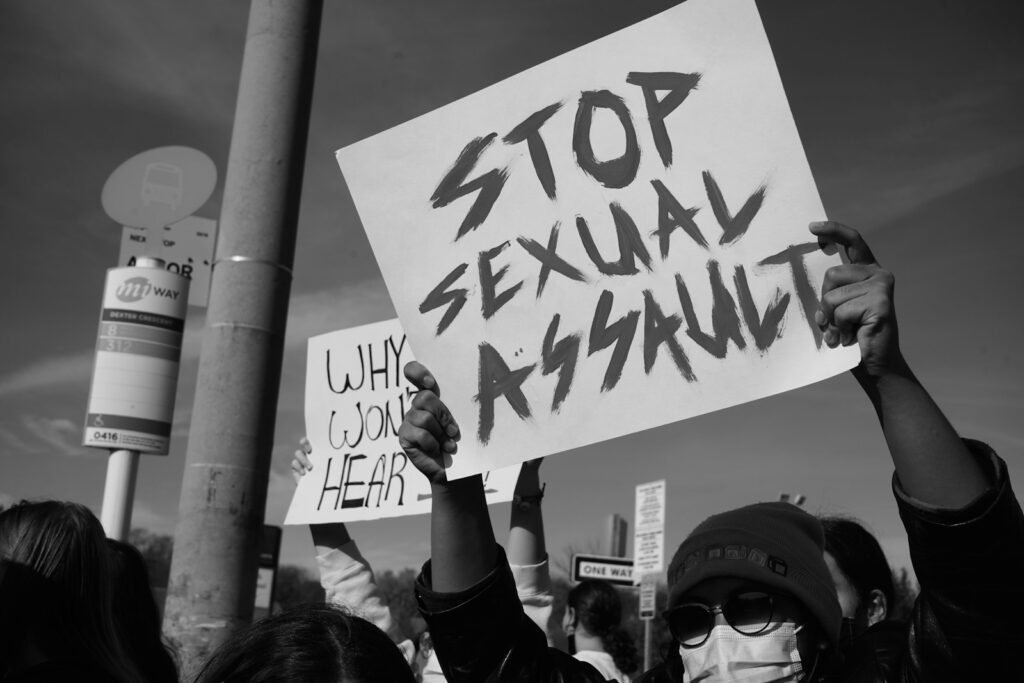
The Impact on Survivors
The effects of sexual assault can be profound and lasting. Survivors often face:
Children and young adults are particularly vulnerable, and the betrayal of trust by authority figures can leave deep emotional scars.

Accountability Under Michigan Law
Survivors may pursue claims against the institution that enabled, concealed, or failed to prevent the abuse. Institutional liability may be based on:
As a Michigan institutional sexual assault attorney, Jonathon Homa works to uncover patterns of misconduct and negligence, ensuring that institutions are held responsible for the harm they allowed to continue.
Michigan courts have repeatedly addressed how far this liability extends. In Mueller v. Brannigan Bros. Restaurants & Taverns LLC, 323 Mich. App. 566 (2018), the Court of Appeals confirmed that negligent hiring and retention are theories of the institution’s own direct liability — not vicarious liability — for knowingly placing a dangerous employee in contact with the public. But institutions are not automatically liable: in Murdock v. Higgins, 454 Mich. 46 (1997), the Michigan Supreme Court held that a prior employer owed no duty to warn a later one because the eventual victim was not a foreseeable, readily identifiable target based on what the institution actually knew. And because Michigan has declined to adopt the aided-by-agency-relationship theory of vicarious liability (Zsigo v. Hurley Medical Center, 475 Mich. 215 (2006)), most institutional sexual assault cases turn on proving what the institution itself knew or should have known — not simply that the abuser was on its payroll.
Michigan’s Child Protection Law, MCL 722.623, requires teachers, clergy, school employees, and other mandated reporters to report suspected child abuse. MCL 722.633(1) goes further and creates a private civil cause of action: a mandated reporter who knowingly fails to report is civilly liable for the resulting damages. That remedy has real limits, though — the Court of Appeals held in Marcelletti v. Bathani, 198 Mich. App. 655 (1993), that it runs only to the specific child who was not reported, not to other victims harmed later by the same unreported abuser, and in Jones v. Bitner, 300 Mich. App. 65 (2013), that it does not override governmental immunity for individual public employees.

Accountability Under Federal Law
Federal civil rights claims under 42 U.S.C. § 1983 and Title IX may arise when a public school, university, or other governmental entity commits or enables sexual assault or harassment.
A § 1983 claim allows a victim to pursue damages against government actors who, under color of state law, violate constitutional rights—such as the Fourteenth Amendment’s guarantee of bodily integrity and equal protection. Holding the school district or institution itself liable requires showing that a policy, practice, or custom of the entity — not just one employee’s misconduct — was behind the abuse, under the standard set in Monell v. Department of Social Services, 436 U.S. 658 (1978); a single failure to investigate isn’t enough, but a pattern of ignoring known or suspected abuse can be. Individual officials can also be held personally liable where they were deliberately indifferent to a known risk, though they can raise qualified immunity as a defense unless the right at issue was already clearly established at the time — a bar that courts have found students’ right to be free from sexual abuse by school employees has cleared for decades.
Similarly, Title IX—which prohibits sex-based discrimination in federally funded educational programs—provides a cause of action when an institution has actual knowledge of sexual harassment or assault by its employees or students and responds with deliberate indifference, effectively depriving the victim of access to educational opportunities. The U.S. Supreme Court set this actual-knowledge, deliberate-indifference standard in Gebser v. Lago Vista Independent School District, 524 U.S. 274 (1998), and extended it to student-on-student harassment in Davis v. Monroe County Board of Education, 526 U.S. 629 (1999); it takes only one school official with authority to act knowing about the harassment to trigger the institution’s obligation to respond.
When public schools fail to protect students from sexual abuse, both § 1983 and Title IX may provide overlapping but distinct avenues for redress, holding the institution and its officials accountable for constitutional and statutory violations.
One important limit on Title IX cases: in Cummings v. Premier Rehab Keller, P.L.L.C., 596 U.S. 212 (2022), the U.S. Supreme Court held that emotional distress damages are not recoverable under Title IX and similar Spending Clause statutes, a limitation the Sixth Circuit has since applied directly to Title IX claims. Because § 1983 is not a Spending Clause statute, it isn’t subject to that limitation — which is one reason survivors and their attorneys often pursue both theories together rather than relying on Title IX alone.
Where the abuse involved trafficking — for example, an institution that knowingly profited from or turned a blind eye to a trafficking venture — the federal Trafficking Victims Protection Reauthorization Act provides a separate civil remedy under 18 U.S.C. § 1595, with its own extended filing deadline of up to ten years after a minor victim turns 18.
Statute of Limitations for Institutional Abuse Claims
Michigan significantly extended the filing deadline for these claims in 2018. Under MCL 600.5851b(1), a survivor who was abused as a minor may file suit any time before the later of turning 28 or three years after discovering both the injury and its connection to the abuse. But that extension is not automatically retroactive: in McLain v. Roman Catholic Diocese of Lansing, 514 Mich. 1 (2024), the Michigan Supreme Court held that MCL 600.5851b does not revive a claim that had already expired under the prior limitations period before the statute took effect — a holding the Court of Appeals had reached the same way a year earlier, 346 Mich. App. 614 (2023). Before 2018, Michigan courts applied a stricter rule: in Lemmerman v. Fealk, 449 Mich. 56 (1995), the Michigan Supreme Court held that neither the ordinary discovery rule nor the insanity-tolling statute extends the filing deadline for claims delayed by repressed memory of childhood abuse. Because whether a particular claim falls under the old or new rule can decide the case before the facts are ever reached, confirming your filing deadline early is critical.
Experienced in Complex Litigation
Jonathon Homa has represented survivors in high-profile institutional sexual assault cases, including claims against schools, hospitals, and national organizations. This experience has given insight into how powerful institutions defend these cases—and how to overcome those defenses to pursue justice for survivors.
Pursuing a legal claim is not easy, but survivors do not have to face it alone. Attorney Jonathon Homa provides compassionate, confidential, and survivor-centered representation. Our mission is to amplify your voice, hold wrongdoers accountable, and secure the compensation and justice you deserve.
If you or a loved one has experienced institutional sexual assault in Michigan, know that you are not alone. Contact JKH Law, PLC, today to speak with Grand Rapids institutional sexual assault lawyer Jonathon Homa, who will stand with you every step of the way.
JKH Law, PLC
312 Fulton Street East
Grand Rapids, MI 49503
(616) 226-3762 (office)
(616) 988-6504 (fax)
Personal Injury Practice