
Contract Disputes & Breach of Contract Claims
Contracts form the foundation of nearly every business and personal relationship — from service agreements to leases, construction projects, and professional partnerships. When one party fails to uphold their obligations, the resulting dispute can cause significant financial loss and uncertainty. At JKH Law, we help clients resolve contract disputes efficiently, whether through negotiation, mediation, or litigation in Michigan courts.
Common Types of Contract Disputes
Contract conflicts can arise in almost any setting. We handle disputes involving:
Breach of contract — when one party fails to perform as promised or delivers substandard work.
Business and commercial agreements — vendor contracts, purchase orders, and partnership arrangements.
Construction and service contracts — disputes over workmanship, payment, delays, or scope of work.
Employment or independent contractor agreements — non-compete, non-solicitation, or confidentiality.
Sales of goods governed by the Uniform Commercial Code (UCC).
Insurance policy disputes and policy-interpretation conflicts.
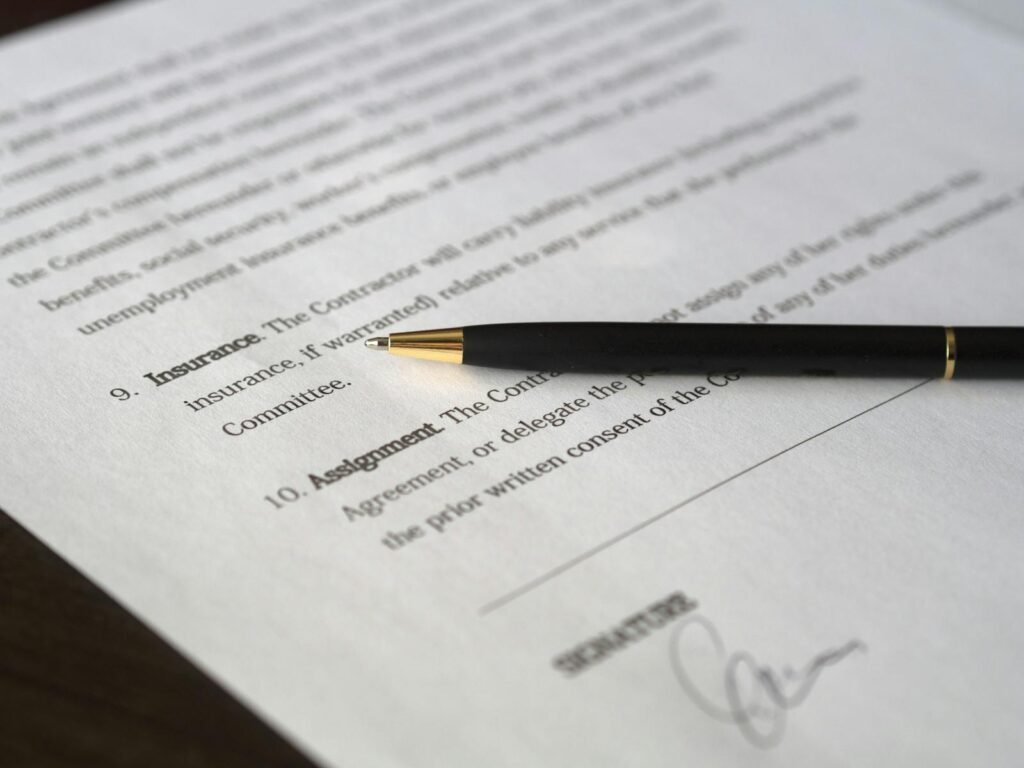
What Constitutes a Breach of Contract
A breach of contract occurs when one party does not perform a duty required by the agreement without a valid legal excuse. Under Michigan law, the injured party may seek compensation if they can prove:
1. A valid and enforceable contract existed;
2. The opposing party breached the contract; and
3. The breach caused measurable damages.
Depending on the situation, damages may include lost profits, repair or completion costs, consequential losses, or specific performance (forcing the breaching party to perform).
Michigan Contract Law Overview
Michigan contract law is largely governed by common law principles and certain statutes, including the Uniform Commercial Code (UCC) for the sale of goods. Courts will generally enforce contracts as written unless:
In interpreting contracts, Michigan courts apply the principle of “plain meaning” — enforcing the clear terms of the agreement without rewriting or expanding them. See Rory v. Continental Ins. Co., 473 Mich. 457 (2005) (contract terms are to be enforced as written unless contrary to law or public policy).
Resolving Contract Disputes
At JKH Law, we focus on resolving disputes efficiently and cost-effectively through:
Negotiation and pre-litigation demand letters to achieve early settlement.
Mediation and arbitration when appropriate to avoid prolonged litigation.
Civil litigation in Michigan state and federal courts when necessary to enforce contractual rights.
Detailed contract review and drafting to prevent future disputes.

Common Legal Remedies
Depending on the facts, Michigan law may allow for:
1. Compensatory damages – to restore the injured party to the position they would have been in had the contract been fulfilled.
2. Consequential damages – for foreseeable losses caused by the breach.
3. Specific performance – a court order requiring a party to carry out their contractual obligations (common in real estate).
4. Rescission or reformation – cancelling or revising an unfair or mistaken agreement.
5. Attorney’s fees and costs, if provided by the contract or statute.
Contract Cases at JKH Law, PLC
We bring a practical, business-minded approach to every case. Whether the goal is to enforce a contract, defend against a claim, or negotiate a resolution, JKH Law offers:
If you are involved in a contract dispute or need guidance before signing or enforcing an agreement, contact JKH Law today. Your initial consultation is confidential and without obligation.
JKH Law, PLC
312 Fulton Street East
Grand Rapids, MI 49503
(616) 226-3762 (office)
(616) 988-6504 (fax)
info@jkhlawfirm.com
JHK Law Blog