What Happened at Interlochen?
And
Do survivors have legal rights?
Authored by Attorneys Jon Homa and Marcus Baldori
For many survivors of childhood sexual abuse, finding the courage to come forward can take years — sometimes decades. By the time they’re ready to speak, the law may tell them they waited too long.
That difficult reality is now part of the story unfolding at Interlochen Center for the Arts.
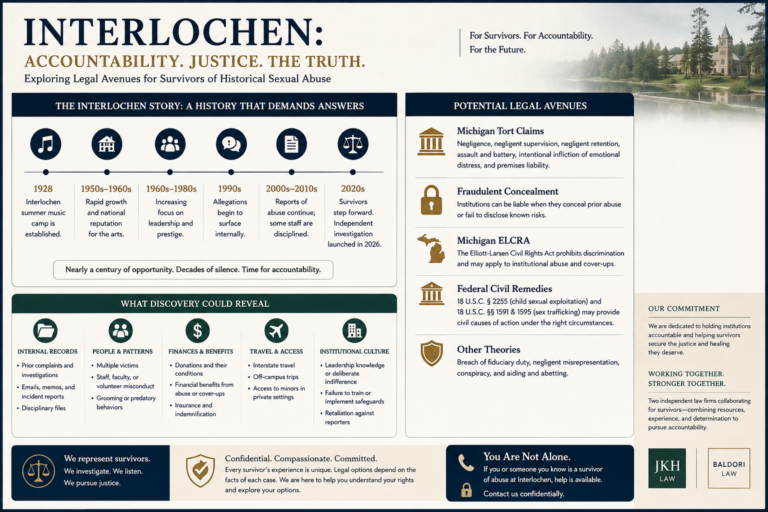
In July 2026, Interlochen released the results of an independent investigation into historical sexual abuse involving its students and campers. Investigators conducted roughly 180 interviews and collected approximately 70 firsthand reports of physical sexual conduct involving 47 adults affiliated with the school. The allegations span from the 1950s into the 2010s.
Those numbers are hard to grasp on their own. Some history helps put the scope into perspective.
The Timeline
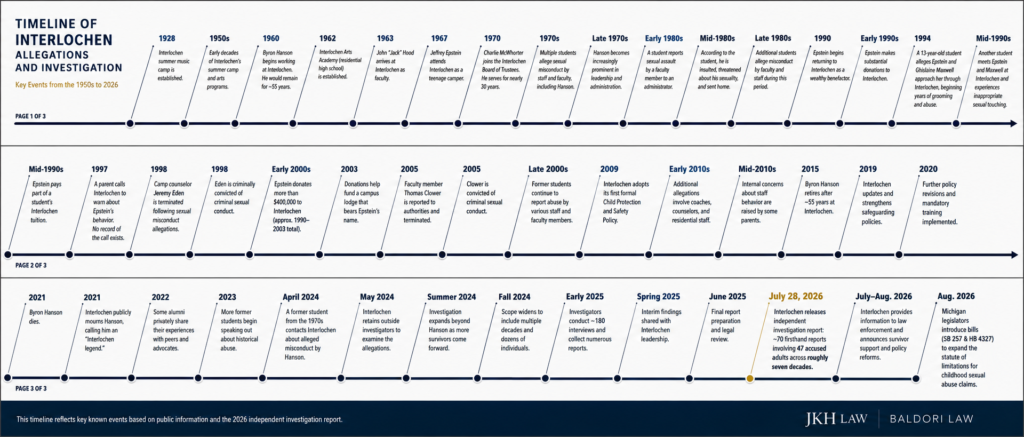
Here is the chronology, as laid out in the investigation and the public record:
- 1928 Interlochen opens its summer music camp.
- 1960 Byron Hanson begins working at Interlochen. He goes on to become a prominent faculty member and administrator, staying roughly 55 years. Investigators later receive seven independent firsthand reports alleging sexual misconduct by Hanson, principally from the 1960s and 1970s.
- 1962 Interlochen opens its residential Arts Academy.
- 1963 John “Jack” Hood arrives as faculty, later becoming an administrator. Investigators later receive four independent firsthand reports concerning him.
- 1967 Jeffrey Epstein attends Interlochen as a teenage camper.
- 1970 Charlie McWhorter becomes an Interlochen trustee, a role he holds for nearly three decades. Investigators later receive two firsthand reports about him, plus additional corroborating information.
- 1980s A former student alleges he reported a serious sexual assault by a faculty member to an administrator. He says that instead of protecting him, the administrator insulted him, threatened to tell his parents he was gay unless he left quietly, and had him driven to the airport.
- 1990–2003 Epstein, now a wealthy benefactor, donates more than $400,000 to Interlochen. The gifts help fund a campus lodge bearing his name, where he sometimes stays with Ghislaine Maxwell. Two other former students separately describe encounters with Epstein connected to Interlochen during this period: one says she met Epstein and Maxwell at the school, entered the lodge, and experienced inappropriate sexual touching — Epstein later helped pay part of her tuition; another alleges misconduct involving Epstein after traveling to New York, and her mother says she called Interlochen to warn the school about him. Interlochen says it has no surviving record of that call.
- 1994 A woman alleges in litigation that Epstein and Maxwell approached her through Interlochen when she was approximately 13, beginning what she describes as years of grooming and sexual abuse.
- 1998 Camp counselor Jeremy Eden is terminated following sexual-misconduct allegations and criminally convicted.
- 2005 Faculty member Thomas Clower is reported to authorities, terminated, and convicted of criminal sexual conduct.
- 2015 Hanson retires after roughly 55 years at Interlochen.
- 2021 Hanson dies. Interlochen publicly remembers him as an “Interlochen legend.”
- 2024 A former student from the 1970s contacts Interlochen about alleged sexual misconduct by Hanson, setting off the process that leads to the current investigation. Interlochen retains outside investigators later that year; the inquiry — which starts as a look at Hanson and allegations from the 1960s and 1970s — expands as more former students come forward.
This year
In July, 2026, Interlochen released the investigation’s findings:
- Approximately 70 firsthand reports of physical sexual conduct,
- involving 47 adults,
- across roughly seven decades.
Seventeen of the accused were already deceased. None remained employed by Interlochen. Beyond this list of individuals, the allegations were not limited to isolated comments or boundary violations. Former students described alleged sexual touching, oral sex, intercourse and other sexual conduct involving faculty members, administrators, counselors, residential staff and other adults associated with Interlochen.
The school has since apologized, given information on the accused individuals to law enforcement, and announced new measures to support survivors and strengthen current protections.
Why It Can Take Decades to Come Forward
Childhood sexual-abuse cases often don’t fit neatly within traditional legal deadlines. Children may not fully comprehend what has happened to them. Grooming can blur the line between mentorship and exploitation. A child may be ashamed, afraid of not being believed, or dependent on the very adult responsible for the abuse.
At an institution like Interlochen, some of those dynamics can become even more complicated. A student might reasonably see a powerful teacher or mentor as someone who controls scholarships, recommendations, artistic opportunities or even a future career.
For some survivors, understanding what happened — and being ready to talk about it — takes years. For others, it takes decades. Some may only begin to make sense of their own experience after learning that others have made similar allegations.
By then, another problem can arise. Even when the facts would otherwise support a civil lawsuit, the time to file one may already have expired.
What Legal Recourse Can a Survivor Have?
Criminal prosecution and civil liability are separate matters — a survivor does not necessarily need a criminal conviction before pursuing civil damages.
There is no single civil claim called a “sexual abuse lawsuit.” Sexual abuse can instead give rise to several different causes of action, depending on who committed the abuse, what an institution knew, and what happened afterward.
TORT CLAIMS?
The person who committed the abuse can potentially be held personally liable through traditional intentional-tort claims, including assault, battery and intentional infliction of emotional distress. Furthermore, an institution may face liability for its own shortcomings in failing to adequately protect students and other individuals. Claims for negligent hiring, retention and supervision may arise where an institution knew or should have known that an employee posed a danger but nevertheless placed or kept that person in a position to harm students. Other negligence theories can arise from an institution’s own failure to exercise reasonable care in protecting the children entrusted to it.
That distinction matters. A claim against an institution isn’t necessarily an attempt to make it automatically responsible simply because an employee committed an intentional act. The focus may instead be on what the institution itself knew, what it reasonably should have known, and what it did — or failed to do — in response.
CIVIL RIGHTS LAWS?
Michigan’s Elliott-Larsen Civil Rights Act (ELCRA), MCL 37.2101 et seq., prohibits sex discrimination in education, and sexual harassment may constitute prohibited sex discrimination. Depending on the circumstances, sexual abuse or harassment by someone associated with an educational institution can therefore implicate civil-rights protections in addition to traditional tort law.
Some conduct can implicate more specialized federal laws. 18 U.S.C. §2255, for example, provides a civil remedy to minors harmed through certain federal sexual-exploitation, trafficking and transportation definitions. Federal trafficking law under 18 U.S.C. §§1591 and 1595 can also provide civil remedies under appropriate circumstances. Those statutes could warrant particular attention where allegations involve recruitment, financial inducements or interstate transportation — as some of the Epstein-related allegations potentially do.
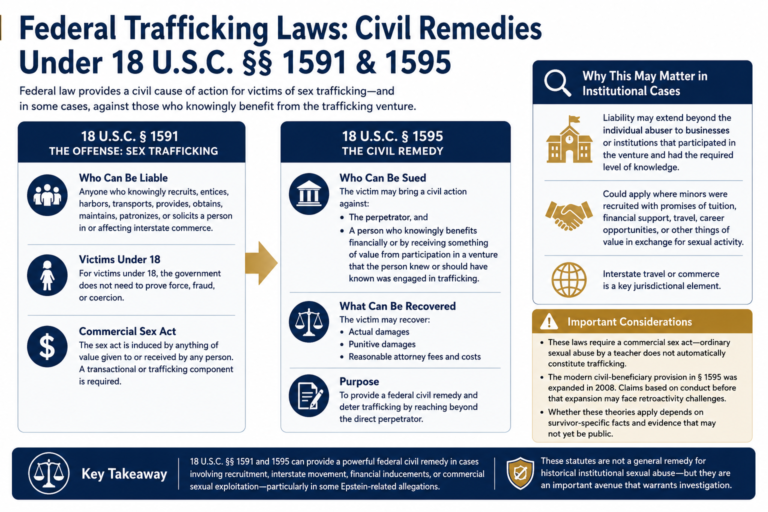
So there are several possible legal paths to civil accountability. For many of the oldest Interlochen allegations, however, the difficult question may not be whether the alleged conduct could support a cause of action. The problem may simply be that too much time has passed to bring it.
Michigan Recognized the Problem in 2018
Michigan substantially changed its treatment of childhood sexual-abuse claims in 2018, following the Larry Nassar scandal.
Among those changes was MCL 600.5851b. Importantly, the statute does not create a new cause of action for sexual abuse. Instead, it gives survivors additional time to pursue civil claims seeking damages arising from criminal sexual conduct committed against them while they were minors. Under current law, a survivor may generally bring such an action before the later of the person’s 28th birthday or three years after discovering — or reasonably being expected to discover — both the injury and its causal relationship to the sexual abuse.
Michigan law also generally provides a 10-year limitations period for damages caused by criminal sexual conduct under MCL 600.5805(6).
The discovery provision in MCL 600.5851b was an important change because it recognized a reality that ordinary limitation periods can miss: knowing that sexual conduct occurred is not necessarily the same as understanding that it was abuse, or appreciating the injuries it caused.
But the Legislature’s 2018 solution had an important limitation. In McLain v. Roman Catholic Diocese of Lansing, 514 Mich 1 (2024), the Michigan Supreme Court considered claims arising from alleged childhood sexual abuse in 1999. The plaintiff maintained that it wasn’t until therapy many years later that he understood the relationship between the abuse and his psychological injuries. The Supreme Court agreed that §5851b created a genuine discovery rule. But it held that the Legislature did not make that rule retroactive. A claim that had already expired before the 2018 law took effect was not suddenly brought back to life.
That distinction could be critical to Interlochen. Someone allegedly abused in the 1960s, 1970s or 1980s may today finally understand what happened. A survivor may learn through the 2026 investigation that other students reported remarkably similar experiences. The investigation may reveal information about what adults at Interlochen knew that the survivor could never have known as a child.
But none of those developments, standing alone, necessarily revives a civil claim that legally expired decades ago. Put simply, Michigan formally recognized the problem of delayed disclosure in 2018. However, the reality for many older survivors is that the recognition came too late.
Are There Still Paths Around the Time Barrier?
Possibly — but this is where the analysis becomes highly dependent on the circumstances of each survivor.
One important possibility is fraudulent concealment under MCL 600.5855. Michigan law can provide additional time where someone who may be liable fraudulently concealed the existence of the claim or the identity of a person responsible for it. The rule isn’t triggered simply because an institution remained silent. Michigan courts generally require affirmative conduct designed to prevent discovery. In Doe v. Roman Catholic Archbishop of the Archdiocese of Detroit, 264 Mich App 632 (2004), the Court of Appeals emphasized that fraudulent concealment ordinarily requires affirmative acts or misrepresentations capable of concealing the cause of action.
That makes some details in the Interlochen investigation potentially significant. Was abuse reported and then covered up? Was a student threatened into silence? Were parents affirmatively misled? Were records hidden or falsified? Did someone tell a survivor that nothing improper had occurred? Did an institution conceal information that would have revealed another potentially responsible party?
The investigation report contains allegations that make those questions more than hypothetical. One former student alleged that after reporting a serious sexual assault, an administrator threatened him rather than protecting him and sent him away from Interlochen.
Whether conduct like that ultimately satisfies Michigan’s fraudulent-concealment statute would depend on the evidence in an individual case. But it illustrates why an old claim shouldn’t necessarily be assumed impossible based solely on the date of the abuse.
The same case-by-case analysis applies to ELCRA and the specialized federal exploitation or trafficking statutes. Each has its own elements, limitation periods, effective dates and rules governing when a claim accrues. They are potential avenues of recovery, not universal exceptions to an expired statute of limitations.
For some survivors, one of those paths may remain open. For others, current law may provide no viable civil remedy at all.
A Proposed Path Forward
The same gap in Michigan law is now the subject of another debate in Lansing. Pending legislation would significantly expand the time available for childhood sexual-abuse claims.
Senate Bill 257, part of a broader package of proposed reforms, passed the Michigan Senate in May 2025 and remains pending in the House. The bill would significantly extend the filing period — generally allowing claims within 10 years, until age 42, or within seven years after discovery of the injury and its relationship to the abuse, whichever is later. But the most consequential part for older survivors is different: the proposed legislation would create a one-year revival, or “look-back,” period for certain previously barred claims. That is something the 2018 legislation did not do. However, claims brought under that proposed one-year revival period would be subject to a $1.5 million cap on damages recoverable from a single defendant.
The two paths under SB 257 are distinct. Extending a statute of limitations prospectively gives more time to a person whose claim remains legally alive. A revival period temporarily reopens the courthouse to someone whose claim has already expired.
For a survivor alleging abuse in 1975, that difference can determine whether there’s a lawsuit at all.
Michigan wouldn’t be confronting this issue in a vacuum. The Larry Nassar scandal exposed how sexual abuse can continue while victims remain silent for years. The allegations involving former University of Michigan physician Robert Anderson again demonstrated how the scope of institutional abuse may not become publicly understood until decades later.Now Interlochen presents another painful example.
There are legitimate reasons for statutes of limitation. Memories fade. Witnesses die. Documents disappear. At some point, defending a decades-old allegation can become extraordinarily difficult. Interlochen itself illustrates the problem: 17 of the 47 accused adults identified through the investigation are already deceased.
But childhood sexual abuse presents an equally difficult reality. Delay is often not unrelated to the injury — it can be part of it. A child may remain silent because of fear, shame, grooming, dependence on an adult, or simply an inability to understand what happened. Years later, that person may finally be capable of confronting the abuse. The result under traditional limitation rules can be particularly harsh: the same circumstances that help explain why a child couldn’t come forward can eventually become the reason the adult survivor is denied a day in court.
When the Truth Comes Too Late for the Law
Interlochen’s investigation has accomplished something important. People who carried these experiences privately for decades have been heard. Allegations once known only to individual students are now part of a much larger public record, and Interlochen has acknowledged the reported harm and apologized.
But an investigation cannot award damages. An apology cannot impose civil accountability. And acknowledging what happened does not necessarily reopen a courthouse door that closed decades earlier.
That is what makes the legislation pending in Lansing important. The debate isn’t simply about giving future survivors more time — Michigan already took an important step in that direction in 2018. The harder question is what to do about the people that reform left behind: survivors who may have been children when they were abused, lived with what happened for decades, and finally came forward only after the law had already decided their time was up.
For many survivors, finding the courage to come forward may have taken decades. Whether Michigan law should tell them they came forward too late is now a question for the Legislature.
Reaching out to our Firms
Attorney Jon Homa has spent more than a decade handling institutional sexual-abuse litigation, including work arising from the Larry Nassar abuse at Michigan State University. This experience can be particularly important in cases involving historical records, institutional knowledge, delayed disclosure, complex limitation issues, and multiple potentially responsible parties. We offer confidential case reviews. A consultation does not require you to file a lawsuit, participate in Interlochen’s investigation, or make an immediate decision. Request a confidential case review. https://jkhlawfirm.com/ and https://baldorilaw.com/.
For more information regarding institutional sexual assault claims, see our respective practice pages by clicking here: JKH Law – Baldori Law.