
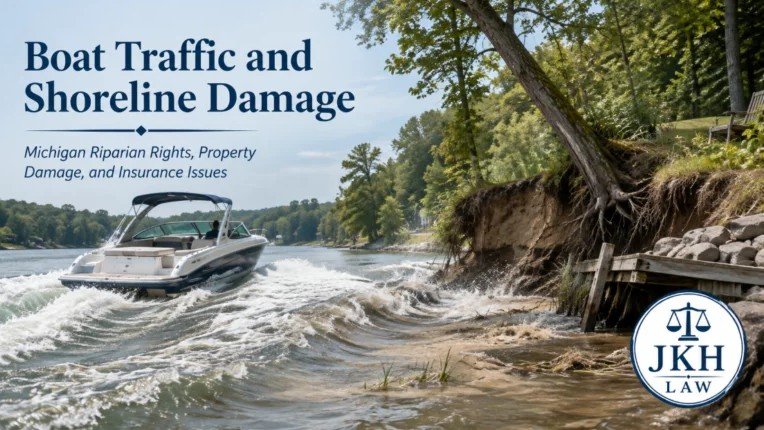
Who Pays When Boat Traffic Damages Michigan Shorelines?
Michigan has more than 11,000 inland lakes, thousands of miles of navigable rivers, and more freshwater coastline than any other state. Boating is woven into life here. But recreational boats have grown larger, heavier, and more powerful over the last two decades, and waterfront owners have started asking a question with real legal weight: what happens when repeated boat traffic damages the shoreline?
Property owners along the Thornapple River near Cascade have raised that question recently. They report unusually large waves striking the banks, erosion that appears to be accelerating, undermined retaining walls, damaged docks, and in some cases mature trees and whole sections of bank collapsing into the river.
Whether reports like those establish legal liability depends on the facts of each case. What is clear is that Michigan law gives waterfront owners meaningful rights in the water alongside their land, and those rights can support a claim when someone else’s unreasonable use of the water causes measurable damage.
Erosion is only part of the picture
It is tempting to think of shoreline damage as losing a few inches of bank each year. The consequences usually run deeper than that.
Repeated high-energy waves can undercut a bank until it fails, take retaining walls and seawalls down with it, and topple mature trees once their root systems are exposed. Docks, boat lifts, and other structures wear out faster. Sediment that had settled on the bottom gets stirred back into the water column, clouding it, smothering fish spawning beds, and carrying nutrients and pollutants along with it. Aquatic plants that depend on sunlight thin out, and with them goes the food and cover that turtles, insects, amphibians, and waterfowl rely on.
Narrow rivers feel this most. On a wide lake, a wave has room to lose energy before it reaches shore. On a river a few hundred feet across, it does not. Researchers have paid growing attention to these cumulative effects on inland lakes and rivers for exactly that reason.
Whether a particular boat actually caused any of it, though, is a scientific question before it is a legal one.
Where wake boats fit in
Large ballast-equipped wake-surf boats get most of the attention, and there is a reason. Operated in surf mode, they are designed to throw a much bigger, higher-energy wave than a conventional runabout.
But the legal analysis does not turn on the type of boat. The principles below apply to any vessel, whether that is a wake boat, a cabin cruiser, or anything else capable of putting a damaging wave on someone’s bank.
Riparian rights and the reasonable use standard
Michigan has long recognized that owning property along a lake or river carries with it a set of riparian rights. Those rights are valuable, and they are protected.
At the same time, Michigan’s waterways are held for public use, including navigation and recreation. The law therefore has to balance two legitimate interests. A property owner cannot shut down lawful boating simply because waves reach the shore. A boater’s right to use the water is not unlimited either.
Michigan courts sort out competing uses through the doctrine of reasonable use, asking whether one person’s use of the water unreasonably interferes with another’s lawful riparian rights. That standard is flexible by design, which is both its strength and the reason these cases are difficult to predict.
When does boat traffic become liability?
A big wave, on its own, is not a lawsuit. But where repeated boating activity causes measurable damage, several theories may become available: negligence, private nuisance, trespass, interference with riparian rights, and other property damage claims recognized under Michigan law.
Most of them come down to the same two questions. Was the boating unreasonable under the circumstances? And did it actually cause the damage being claimed? Both answers depend heavily on the specific facts.
Causation is usually the fight
Proving cause is typically the hardest part of these cases, and it is worth understanding why.
Michigan shorelines move on their own. Storms, seasonal water level swings, ice, current, runoff, lost vegetation, and ordinary wave action all take material off a bank, and a defendant will point to every one of them. The property owner generally has to show that repeated boating activity, not simply nature doing what nature does, was a substantial cause of the loss.
That usually takes evidence built over time: historical photographs, drone imagery, measurements showing progressive shoreline loss, video of repeated wave activity, sediment studies, testimony from neighbors, records identifying the vessels involved, and often an engineer or shoreline expert to tie it all together. Owners who begin documenting early are in a far better position than those who start after the wall has already failed.
Insurance is often the real issue
These disputes look like homeowner versus boat owner. In practice, insurance frequently drives the outcome.
Coverage might come from the boat owner’s watercraft liability policy, a homeowner’s policy, umbrella coverage, or a commercial policy if the vessel is used in a business. Which one responds, and whether any of them do, gets complicated quickly when damage develops gradually over several seasons, involves more than one boat, or results from an accumulation of ordinary use rather than a single identifiable incident. Gradual-damage exclusions, notice requirements, allocation between carriers, and the proper measure of property damage all become live issues.
Even where liability appears straightforward, the coverage fight can turn out to be the bigger half of the case.
Where this is heading
Boating in Michigan keeps changing, and the law will keep catching up to it.
Most boat owners want to enjoy the water responsibly. Most waterfront owners want to keep their land from washing away. Those goals are not incompatible. Thoughtful boating practices, education, no-wake rules where they make sense, and sound shoreline stewardship go a long way toward both.
Still, as these disputes become more common, courts, insurers, local governments, and lake associations will continue drawing the line between reasonable recreation and legal responsibility. Anyone who owns waterfront property, or a boat capable of throwing a serious wake, has a stake in where that line ends up.
This article is for general informational purposes only and is not legal advice. Every shoreline damage claim turns on its own facts, the available scientific evidence, and applicable Michigan law.