Does Michigan Have a Bad Faith Insurance Law? What the Statutes Actually Say
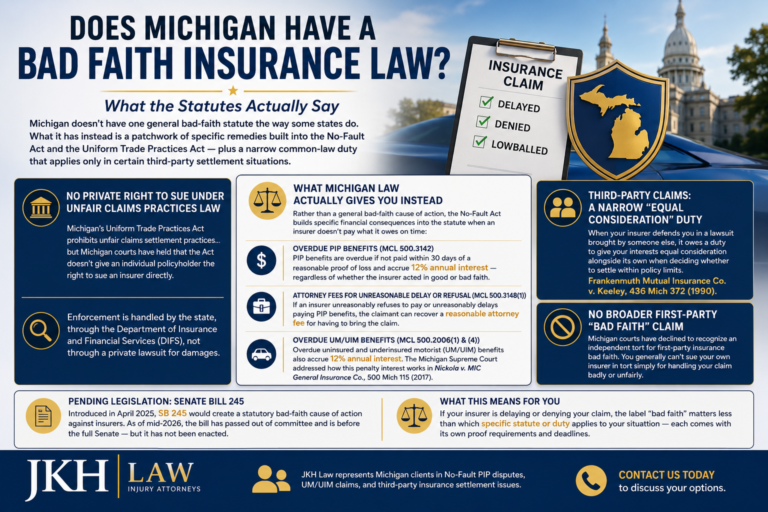
Many Michigan drivers who feel an insurance company slow-walked, lowballed, or wrongly denied their claim search for a “bad faith insurance law” to sue under. Michigan doesn’t have one general bad-faith statute the way some states do. What it has instead is a patchwork of specific remedies built into the No-Fault Act and the Uniform Trade Practices Act — plus a narrow common-law duty that applies only in certain third-party settlement situations. Understanding which tool actually applies to your situation matters more than the label “bad faith.”
There’s No Private Right to Sue Under Michigan’s Unfair Claims Practices Law
Michigan’s Uniform Trade Practices Act, MCL 500.2001 et seq., prohibits insurers from engaging in unfair claims settlement practices — things like misrepresenting policy provisions, failing to investigate promptly, or not attempting a fair settlement once liability is reasonably clear. But Michigan courts have held that the Act doesn’t give an individual policyholder the right to sue an insurer directly for violating it. Enforcement is handled by the state, through the Department of Insurance and Financial Services (DIFS), not through a private lawsuit for damages.
What Michigan Law Actually Gives You Instead
Rather than a general bad-faith cause of action, Michigan’s No-Fault Act builds specific financial consequences into the statute when an insurer doesn’t pay what it owes on time:
- Overdue PIP benefits: Under MCL 500.3142, No-Fault personal injury protection (PIP) benefits are overdue if not paid within 30 days of a reasonable proof of loss, and overdue amounts accrue 12% annual interest — regardless of whether the insurer acted in good or bad faith.
- Attorney fees for unreasonable delay or refusal: Under MCL 500.3148(1), if an insurer unreasonably refuses to pay or unreasonably delays paying PIP benefits, the claimant can recover a reasonable attorney fee for having to bring the claim.
- Overdue UM/UIM benefits: Under MCL 500.2006(1) and (4), overdue uninsured and underinsured motorist (UM/UIM) benefits also accrue 12% annual interest. The Michigan Supreme Court addressed how this penalty interest works in Nickola v. MIC General Insurance Co., 500 Mich 115 (2017).
Third-Party Claims: A Narrow “Equal Consideration” Duty
A different rule applies when your own insurer is defending you in a lawsuit brought by someone else — for example, after an accident where you’re the at-fault driver and the injured party sues you personally for damages beyond your policy limits. Michigan courts have recognized that an insurer defending a policyholder owes a duty to give the insured’s interests equal consideration alongside its own when deciding whether to settle within policy limits. The leading case is Frankenmuth Mutual Insurance Co. v. Keeley, 436 Mich 372 (1990). This is a narrow, specific duty tied to third-party settlement decisions — it isn’t a general bad-faith standard that applies to how an insurer handles your own first-party claim.
Is There a Broader First-Party “Bad Faith” Claim in Michigan?
No. Michigan appellate courts, in the Casey line of cases, have consistently declined to recognize an independent tort for first-party insurance bad faith — meaning you generally can’t sue your own insurer in tort simply for handling your claim badly or unfairly, separate from the specific statutory remedies above. That’s a meaningful difference from states that do recognize a first-party bad-faith tort, and it’s part of why the interest and attorney-fee provisions in the No-Fault Act carry so much practical weight in Michigan claims.
Pending Legislation: Senate Bill 245
That could change. Senate Bill 245, introduced in the Michigan Senate in April 2025, would create a statutory bad-faith cause of action against insurers. As of mid-2026, the bill has passed out of committee and is before the full Senate — but it has not been enacted, and current Michigan law still does not include a general bad-faith cause of action. Anyone researching this topic should treat SB 245 as pending legislation, not existing law, unless and until it’s actually signed.
What This Means If Your Insurer Is Delaying or Denying Your Claim
If a Michigan insurer is sitting on your PIP claim, disputing a UM/UIM claim, or refusing to negotiate a third-party settlement in good faith, the label “bad faith” matters less than which specific statute or duty actually applies to your situation — each comes with its own proof requirements and deadlines. An attorney can review your claim, identify whether interest or attorney fees are owed under the No-Fault Act, and evaluate whether an insurer’s third-party settlement conduct breached its duty of equal consideration.
JKH Law represents Michigan clients in No-Fault PIP disputes, UM/UIM claims, and third-party insurance settlement issues. If your claim has been delayed or denied, contact us to discuss your options.