
Chapter 6 · The dog the owner knew was dangerous
Common-Law Strict Liability
Long before the statute, Michigan held the keeper of a dangerous animal liable for the harm it did, without proof of negligence, if the keeper knew what the animal was. That claim survives alongside the statute and reaches cases the statute does not: injuries without a bite, keepers who are not owners, and victims who were not lawfully present. This chapter explains its three elements, what counts as knowledge, and the narrow defenses.

In plain terms
The second claim
Michigan gives a dog-bite victim two routes. The statute, covered in Chapter 2, does not require proof that the owner knew anything about the dog. The common-law claim does, and in exchange it reaches further. It applies when a dog knocks you down or chases you into a fall rather than biting you. It applies against a person who keeps and controls the dog without owning it. It does not depend on where you were standing. And an unintentional act on your part, which can defeat the statutory claim as “provocation,” is no defense to it.
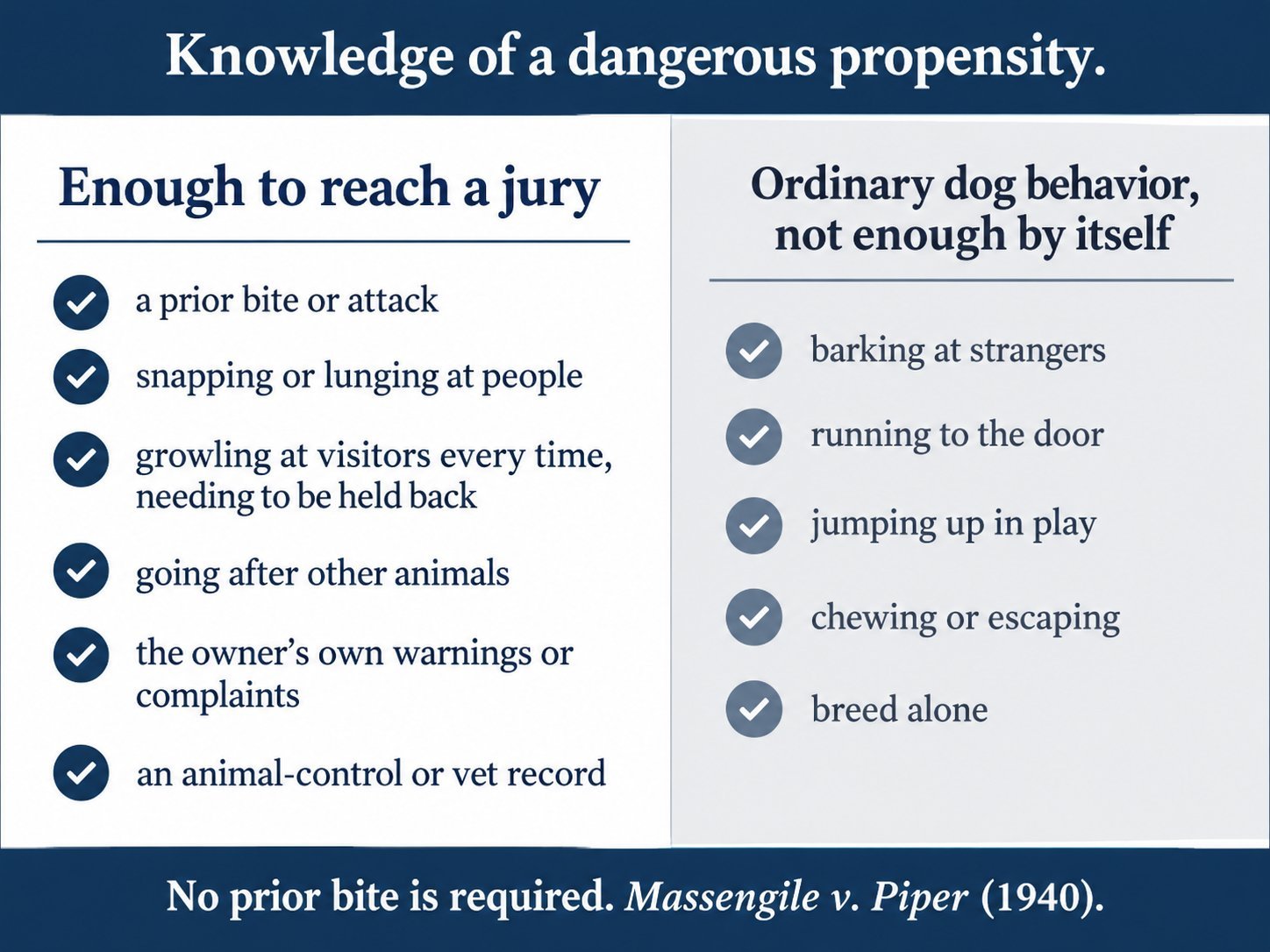
What you have to prove is that the person who kept the dog knew, or should have known, that it had a dangerous tendency unusual for a dog, and that the harm came from that tendency. You do not need a prior bite. Growling and lunging at people, needing to be held back from visitors, snapping, a history of going after other animals, or the owner’s own admissions that the dog is a problem can all be enough, and the question is usually for the jury. What is not enough is ordinary dog behavior: barking at strangers, running to the door, jumping up in play.
If you prove the claim, the owner is liable regardless of how carefully the dog was kept; a dog that got loose despite a good fence is no defense. The only defenses are that you deliberately provoked the dog or were grossly careless in approaching a dog you knew was dangerous.
Analysis
The rule and where it comes from
The modern statement is the Supreme Court’s in Trager v. Thor, 445 Mich. 95, 99–100 (1994), adopting Restatement (Second) of Torts § 509: “Strict liability attaches for harm done by a domestic animal where three elements are present: (1) one is the possessor of the animal, (2) one has scienter of the animal’s abnormal dangerous propensities, and (3) the harm results from the dangerous propensity that was known or should have been known.” The liability is imposed on the person who “introduced the potential danger into the community”; it “is not imposed because of a failure to restrain the animal.” Id. at 100–101.
The rule is old. “[W]hoever keeps an animal accustomed to attack and injure mankind, with knowledge that it is so accustomed, is prima facie liable in an action on the case at the suit of any person attacked and injured by the animal, without any averment of negligence or default in the securing and taking care of it.” Brooks v. Taylor, 65 Mich. 208, 210–211 (1887). “When it appears that a domestic animal is vicious, and has a propensity to do mischief, of which facts the owner or keeper has notice, either express or implied, the law imposes the duty upon such owner or keeper of keeping such animal secure; from which duty a liability arises in favor of any person who without his fault is injured by it.” Knowles v. Mulder, 74 Mich. 202, 205 (1889). The common-law action was expressly preserved when the Legislature enacted the Dog Law, MCL 287.288, and again when it enacted the bite statute, which “retained the common law remedy but in addition enacted the statute.” Nicholes v. Lorenz, 396 Mich. 53, 59 (1976).
Because the liability rests on keeping the animal with knowledge, how it got out is irrelevant. “We hold the owner or custodian of a domestic animal with knowledge of its vicious propensities is liable regardless of fault for personal injuries caused by the escape of the animal.” Papke v. Tribbey, 68 Mich. App. 130, 136 (1976) (reversing a verdict obtained on an instruction that excused an escape “by means beyond the control of the owner”). Some of the nineteenth-century opinions used the word “negligence” for this claim, but the negligence they meant “was said to consist, not in the manner of keeping and confining the animal, but in keeping him at all.” Fye v. Chapin, 121 Mich. 675, 679 (1899).
The three elements
Knowledge of an abnormally dangerous propensity
No prior bite is required. The idea that every dog gets one free bite “does not correctly define the law.” Slater v. Sorge, 166 Mich. 173, 176 (1911). “Knowledge of viciousness of a dog does not necessarily await a first bite.” Massengile v. Piper, 294 Mich. 653, 660 (1940) (Wiest, J., concurring). The Court of Appeals put the standard this way in the decision Trager and Hiner adopted: “A plaintiff need not prove that the owner or custodian knew that his or her domestic animal had already attacked human beings when unprovoked to make a prima facie case of strict liability. Rather, plaintiff need only present proof that the owner knew or had reason to know that the animal had a dangerous tendency that is unusual and not necessary for the purposes for which such an animal is usually kept. … It is enough for plaintiff to prove that the animal has exhibited a tendency to attack human beings or other animals such that the owner would be apprised of the animal’s dangerous character. Sufficient as well is evidence that the animal has exhibited any form of ill temper in the presence of human beings that would apprise a reasonable owner that the animal would attack if uncontrolled.” Rickrode v. Wistinghausen, 128 Mich. App. 240, 245–246 (1983); Hiner v. Mojica, 271 Mich. App. 604, 610 (2006).
Constructive knowledge counts. The test “is whether the owner or custodian knew or should have known of the vicious propensities of the animal.” Papke, 68 Mich. App. at 136 n.2. An owner “may be chargeable with notice through his own negligence to take note of the vicious habits of his domestic animal,” and “[t]he length of time such vicious habit is shown to have existed has an important bearing upon the question whether notice or knowledge of such habit may be inferred and imputed to the owner.” Knowles, 74 Mich. at 206. The knowledge of an agent who manages the premises and the animal is the principal’s knowledge. Meilke v. Schabble, 159 Mich. 163, 166 (1909).
Once knowledge is shown, the dog’s general good character is immaterial. “If he has manifested a disposition to bite mankind, the law casts the burden upon the owner or keeper to take measures to see to it that the animal is so restrained that he cannot do an injury to another,” and “it is immaterial what the general character of the animal is.” Kennett v. Engle, 105 Mich. 693, 695 (1895); Willet v. Goetz, 125 Mich. 581, 583 (1901). Defense evidence that the dog was gentle with everyone else does not answer evidence of the specific propensity.
The question is for the jury. Whether a dog has shown enough ill temper to put its keeper on notice “is generally a question for the finder of fact.” Hiner, 271 Mich. App. at 610 (citing Massengile). In Massengile the chow had never bitten anyone, but it growled and barked at the housekeeper whenever she arrived, had to be held back from visitors, and the owner had said she lost a maid “on account of the dog”; veterinarians added that the breed is apt to bite. The Supreme Court reinstated the plaintiff’s verdict: “it was a question for the jury to determine whether defendants knew or had reasonable grounds to believe that the dog in question had vicious propensities.” 294 Mich. at 660. Where the record shows a documented prior bite and an animal-control recommendation that the dog be euthanized, the element is established as a matter of law. Fitzpatrick v. Bridgestone Retail Operations, LLC, 444 F. Supp. 3d 786, 796–797 (E.D. Mich. 2020) (summary judgment for the plaintiff on strict liability).
The line between ordinary behavior and a dangerous propensity
The element is a dangerous tendency “unusual and not necessary for the purposes for which such an animal is usually kept.” Dogs bark, guard, run to the door and jump up in greeting, and the Court of Appeals has held that conduct of that kind, standing alone, does not show the required propensity: “the mere fact that a dog barks, growls, jumps, or approaches strangers in a somewhat threatening way is common canine behavior. Thus, such behavior will ordinarily be insufficient to show that a dog is abnormally dangerous or unusually vicious.” Hiner, 271 Mich. App. at 612. The unpublished decisions apply the same line: barking and running at a stranger (Bartholomew v. Hazy, 1999); bolting through an open door (Myers v. Myers, 2003; Stoll v. Stobby, 2008); jumping on a door (Kirkman v. Ellis, 2014); chewing furniture and escaping the house (James v. Gutherie, 2014); growling at a member of the household (Costanza v. Limon, 2021); a herding dog chasing horses (Witt v. Smith, 1999); one playful collision (Kibbe v. Richie, 2012). Breed alone is not notice of a propensity in the individual dog. Tieman v. Grinsteiner (2011) (unpublished).
The word “ordinarily” in Hiner matters, and so does what is on the other side of the line. A tendency to jump on people “might permit a dangerous propensity finding,” Kirkman, and a large dog jumping directly on a person is a harm the law anticipates. Myers. Ill temper directed at people, a pattern of aggression toward a class of visitors, a prior bite, snapping, or the owner’s own concern about the dog is the Massengile and Rickrode evidence that goes to the jury. In Rickrode itself the trial court had held that a cat’s scratching of three children in the prior weeks was normal feline reaction; the Court of Appeals reversed because that “was essentially a finding of fact” for the jury. 128 Mich. App. at 246. The claim is proved with specifics: who the dog went after, how often, what the owner said and did about it, and what the owner was told.
Harm resulting from the propensity
The injury must come from the tendency the possessor knew about. Notice that a dog chases horses in the field is not notice that it will lunge at a horse inside a barn, Witt, and a jury that finds an owner knew the dog was dangerous may still find that a particular bite was caused by the victim’s act rather than by the propensity. Brans v. Extrom, 266 Mich. App. 216, 222 n.7 (2005). The element is satisfied when the dog did what it was known to do: a dog known to bite people bit a person; a dog known to go after visitors went after a visitor.
Defenses
Once the three elements are shown, the possessor’s care is not a defense, and neither is the victim’s ordinary carelessness. “If it were proven, as a matter of defense, that the plaintiff willfully provoked the bull, or was grossly negligent in going near him, with knowledge of his vicious habit of hooking, it would, of course, preclude recovery; but I do not think that a want of negligence upon the part of the plaintiff is necessary to be averred or proven. The gist of the action … is the keeping of the dangerous animal with knowledge; and the injury by such an animal is prima facie actionable, without reference to the conduct of plaintiff.” Brooks, 65 Mich. at 211. The Court of Appeals has carried that rule forward: on the strict-liability theory, “negligence on the part of plaintiff … or for that matter any fault, is not at issue,” and “[o]nly the defenses of willful provocation or gross negligence” preclude recovery. Rickrode, 128 Mich. App. at 247–248; Papke, 68 Mich. App. at 135. Comparative fault applies to the negligence theory, not to this one. Rickrode, 128 Mich. App. at 248; Hill v. Hoig, 258 Mich. App. 538 (2003).
That makes the common-law claim stronger than the statute on one point. Under the statute an unintentional act can be “provocation” and defeats the claim entirely (Chapter 3). Under common-law strict liability only willful provocation does. A person who stepped on a known-dangerous dog by accident has a provocation problem under the statute and none under the common law.
When the common-law claim decides the case
The statute is the easier claim whenever it applies, and most bite cases are pleaded and won on it. The common-law strict-liability count is the claim that matters when the statute is unavailable or in doubt:
- No bite. A knock-down, a chase, a fall while fleeing, a dog that spooks a horse. The statute requires a bite; the common law requires only harm from the known propensity. Knowles; Willet; Jenkinson v. Coggins, 123 Mich. 7 (1900); see Chapter 8.
- The defendant is a keeper, not the owner. The statute reaches only owners; strict liability reaches a possessor with proprietary control. Trager, 445 Mich. at 101–103; Burnham v. Strother, 66 Mich. 519 (1887).
- The victim was not lawfully present. Lawful presence is an element of the statute, not of this claim. Kelsey v. Lint, 322 Mich. App. 364, 377–378 (2017).
- An unintentional act is being called provocation. Only willful provocation defeats this claim. Brooks; Rickrode.
- The attack was serious and the owner knew. A documented history supports summary disposition on liability and makes the dog’s history admissible, which the statute alone does not. Fitzpatrick; Nicholes, 396 Mich. at 59 n.2.
One cost comes with joining the counts. In a purely statutory action the dog’s history is inadmissible on liability. Nicholes, 396 Mich. at 60–61. When a common-law count is joined, that history comes in on knowledge, for better and worse. Where the history is good for the plaintiff, join the counts; where the dog’s record is clean and the statute plainly applies, the statutory count alone keeps the trial short and the evidence narrow.
For lawyers
Practice points
- Plead the three Trager elements in the words of the opinion, and plead that the defendant “knew or should have known.” Constructive knowledge is enough. Papke n.2; Knowles.
- Subpoena animal control for every complaint, bite report and quarantine order on the address, and the veterinarian for behavioral notes and any medication for aggression or anxiety; these records decided Fitzpatrick and were missing in Blaylock.
- Depose neighbors, mail and delivery carriers, and prior visitors about what the dog did and what the owner said about it. The owner’s own statements (“he doesn’t like strangers,” “keep the kids away”) are the Massengile evidence.
- Get every out-of-court account into admissible form before the summary-disposition response. Hearsay about prior incidents, without an affidavit from the declarant or a hearsay exception, lost Hightower, Kirkman and Costanza.
- Frame the propensity specifically and match it to the injury: “lunges at and bites people approaching the yard,” not “aggressive.” Mismatch between the known behavior and the harm defeated Witt.
- Where the dog’s history is strong, move for partial summary disposition on this count; it does not depend on provocation or lawful presence. Fitzpatrick.
- Instruct the jury separately on the two common-law theories: no fault on strict liability except willful provocation or gross negligence; comparative negligence on the negligence count. Rickrode, 128 Mich. App. at 247–248.
- Against a keeper who is not the owner, plead strict liability and negligence together; proprietary control plus knowledge supports the first, the undertaking of care supports the second. Trager.
Authorities
Published decisions
| Case | Court / year | Point |
|---|---|---|
| Trager v. Thor, 445 Mich. 95 | Mich. 1994 | Three elements (Restatement § 509); liability not based on failure to restrain; possessor means owner or keeper with proprietary control. |
| Hiner v. Mojica, 271 Mich. App. 604 | Ct. App. 2006 | Barking, growling, jumping or approaching strangers is ordinarily insufficient; scienter standard from Rickrode; generally a jury question. |
| Rickrode v. Wistinghausen, 128 Mich. App. 240 | Ct. App. 1983 | No prior unprovoked attack required; “any form of ill temper” suffices; only willful provocation or gross negligence is a defense; comparative fault applies to negligence only. |
| Papke v. Tribbey, 68 Mich. App. 130 | Ct. App. 1976 | Liability regardless of fault for an escape; knew or should have known; negligence as the fallback theory. |
| Massengile v. Piper, 294 Mich. 653 | Mich. 1940 | Growling, lunging, owner’s concern and breed temperament reach the jury without a prior bite. |
| Slater v. Sorge, 166 Mich. 173 | Mich. 1911 | No “one bite” rule; household head as keeper. |
| Kennett v. Engle, 105 Mich. 693 | Mich. 1895 | Prior manifestation plus knowledge; general good temper then immaterial. |
| Willet v. Goetz, 125 Mich. 581 | Mich. 1901 | Same; non-bite highway injury recoverable. |
| Knowles v. Mulder, 74 Mich. 202 | Mich. 1889 | Duty to secure a known-vicious animal; constructive notice from a habit’s duration. |
| Brooks v. Taylor, 65 Mich. 208 | Mich. 1887 | Keeping with knowledge is the gist; willful provocation or gross negligence the only plaintiff-conduct defenses. |
| Meilke v. Schabble, 159 Mich. 163 | Mich. 1909 | Managing agent’s knowledge imputed to the principal; “ought to have known.” |
| Grummel v. Decker, 294 Mich. 71 | Mich. 1940 | Scienter must be pleaded and proved at common law; no insurer liability without it. |
| Nicholes v. Lorenz, 396 Mich. 53 | Mich. 1976 | Common law preserved; dog’s history admissible on scienter but not on the statutory count. |
| Fitzpatrick v. Bridgestone Retail Operations, 444 F. Supp. 3d 786 | E.D. Mich. 2020 | Prior bite and euthanasia recommendation: summary judgment for plaintiff on strict liability. |
Unpublished Court of Appeals and federal decisions
Unpublished opinions are not binding precedent under MCR 7.215(C)(1).
| Case | Year | Point |
|---|---|---|
| Bartholomew v. Hazy, 1999 WL 33453937 | 1999 | Barking and running at strangers is not an abnormal propensity. |
| Myers v. Myers, 2003 WL 22399483 | 2003 | Bolting through an open door is ordinary; a large dog jumping on a person might be anticipated to injure. |
| Stoll v. Stobby, 2008 WL 2390031 | 2008 | Playful jumping and excitement to get outside is not a dangerous propensity. |
| Kirkman v. Ellis, 2014 WL 7217557 | 2014 | Jumping on a door is ordinary; a tendency to jump on people might permit a propensity finding; hearsay insufficient. |
| James v. Gutherie, 2014 WL 4214949 | 2014 | Chewing and escaping are natural; breed reputation alone is not propensity evidence. |
| Costanza v. Limon, 2021 WL 941569 | 2021 | Growling at a household member is common behavior; no scienter. |
| Witt v. Smith, 1999 WL 33441239 | 1999 | Breed-typical chasing is a normal characteristic; notice of one behavior is not notice of another. |
| Kibbe v. Richie, 2012 WL 5854486 | 2012 | One playful collision is not an abnormal propensity (over a dissent). |
| Tieman v. Grinsteiner, 2011 WL 5108506 | 2011 | Breed alone does not establish a propensity unique to the dog. |
| Adams v. Wooldridge, 2013 WL 1748586 | 2013 | Owner’s warning to the victim does not prove a caretaker’s knowledge. |
| Hightower v. Nuyen, 2018 WL 6004469 | 2018 | Unsworn hearsay about a prior jump is worthless at summary disposition. |
| Wiitanen v. Dworatschek, 2006 WL 2521425 | E.D. Mich. 2006 | A single bite during the incident is not proof of prior knowledge. |
Common questions
The dog had never bitten anyone before. Does that end this claim?
No. Michigan has never required a prior bite. What matters is whether the owner knew the dog had a dangerous tendency: growling and lunging at people, snapping, going after other animals, or the owner’s own warnings about the dog.
Why would I bring this claim when the statute doesn’t require proof of knowledge?
Because it reaches cases the statute doesn’t: an injury without a bite, a dog kept by someone who isn’t the owner, a place where you weren’t lawfully present, or a situation where the owner is calling your accidental act “provocation.” Most cases plead both.
The dog got out through a gate the owner thought was latched.
That is no defense. Once the owner knew the dog was dangerous, the owner is liable for what it does when it gets loose, regardless of how careful the owner was.
What evidence shows the owner knew?
Animal-control complaints and bite reports, veterinary records, the owner’s statements to neighbors and visitors, “beware of dog” warnings, prior incidents with people or animals, and the dog’s behavior toward people who came to the house.
Hurt by a dog the owner knew was dangerous?
JKH Law builds the record on what the owner knew: animal-control files, vet records and witnesses. Consultations are free, in Grand Rapids and statewide.
This page is part of the Michigan Dog Bite Law Compendium published by JKH Law, PLC. It is legal information about Michigan law, not legal advice about any particular situation, and reading it does not create an attorney-client relationship. Citations were last checked in October 2026. Unpublished opinions are identified as such and are not binding under MCR 7.215(C)(1).

Personal injury litigation for Grand Rapids and West Michigan.
312 Fulton Street EastGrand Rapids, MI 49503 (616) 226-3762
Fax (616) 988-6504
Free consultation