
Chapter 14 · Beyond the bite statute
Related Animal Law: Other Animals, the Dog Law and Dangerous-Animal Proceedings
The dog-bite statute is one part of a larger body of Michigan animal law that a dog-attack case touches. The same common-law rules govern injuries by cats, horses, goats, bulls and other domestic animals; a different rule governs wild animals. The Dog Law of 1919 regulates licensing, leashing and destruction. The dangerous-animal statute provides a court proceeding to order a biting dog destroyed, with its own definition of provocation. And a dog is property, which matters when a dog is the victim or is killed. This chapter collects those rules and explains where each one bears on an injury claim.
In plain terms
The rest of the field
Michigan’s no-fault bite statute applies to dogs and only to dogs. If a horse kicks you, a cat scratches you, a goat butts you or a bull gores you, you have the common-law claims described in Chapters 6 and 7: strict liability if the owner knew the animal had the dangerous tendency that hurt you, and negligence if the owner failed to use reasonable care in controlling the animal in a situation where harm was foreseeable. If a wild animal hurts you, no one is liable for it unless someone had captured, confined or otherwise controlled it, although a landowner who knows a dangerous wild animal is living on the property can be liable to visitors for the condition of the land, as a 2026 decision about a nesting goose holds.
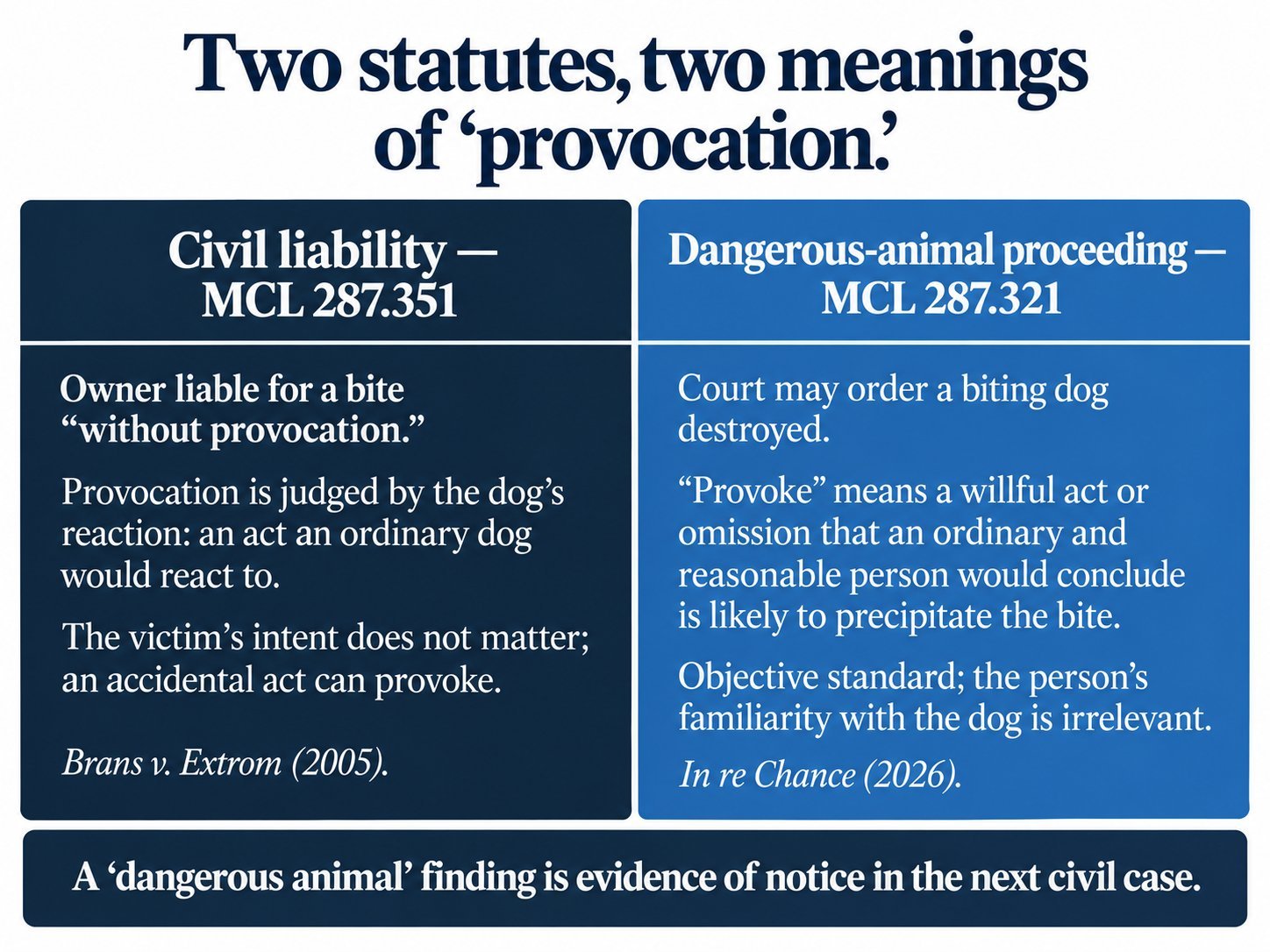
Separate from any lawsuit, a biting dog may face a court proceeding under Michigan’s dangerous-animal statute. On a sworn complaint, the owner is summoned to show cause why the dog should not be destroyed; destruction is mandatory if the dog is found dangerous and caused serious injury or death, and discretionary otherwise. That statute has its own definitions. “Provoke” there requires a willful act judged by what an ordinary person would expect to set off an ordinary dog, which is a narrower defense than the one in the civil statute, and “serious injury” means permanent disfigurement or impairment, so punctures and a few stitches do not qualify. A finding in that proceeding that a dog is dangerous is powerful evidence of notice in a later civil case against anyone who knew of it.
Finally, a dog is property. Its owner may recover its value and the veterinary bills if another dog or a person injures or kills it, but may not recover for grief. A person may kill a dog only in the narrow circumstances the Dog Law allows, such as a dog caught in the act of attacking a person or livestock; killing a trespassing dog for anything less is a wrong for which the dog’s owner may sue. And an owner’s failure to license a dog does not make the dog contraband or forfeit the owner’s rights in it.
Analysis
Injuries by animals other than dogs
Domestic animals. The common-law rules of strict liability and negligence stated in Trager v. Thor, 445 Mich. 95, 99–106 (1994), are rules of domestic-animal liability, not dog liability, and the cases that built them involved other animals. The classic statement of strict liability for keeping an animal with knowledge of its vicious propensity was a bull case, Brooks v. Taylor, 65 Mich. 208, 210–211 (1887); the rule that an owner with scienter is liable regardless of fault, so that an escape beyond the owner’s control is no defense, came from a goat that followed children across a road and attacked a man who died months later, Papke v. Tribbey, 68 Mich. App. 130, 134–136 (1976); and the rule that no prior attack is required, that “any form of ill temper” the owner knows of will do, and that an ordinance violation is evidence of negligence, came from a cat that scratched a child, Rickrode v. Wistinghausen, 128 Mich. App. 240, 245–247 (1983). The negligence track is equally old: the owner of a two-and-a-half-year-old bull driven through a street was answerable for its goring on a theory of negligent management although the bull “had never gored or attacked any one before.” Barnum v. Terpenning, 75 Mich. 557, 559–560 (1889). A dog that startles a horse which then injures the plaintiff is analyzed the same way; the plaintiff must show the dog’s known propensity to do what it did in that setting. Witt v. Smith (1999) (unpublished) (herding dog’s habit of chasing horses outdoors was a normal characteristic, not notice that it would lunge at a horse in a barn); compare Jenkinson v. Coggins, 123 Mich. 7 (1900), and Willet v. Goetz, 125 Mich. 581 (1901) (recovery for highway injuries through a frightened horse).
Livestock at large and trespassing. Two statutory and common-law rules impose liability without fault for livestock, and should not be confused with the dog rules. The animals-running-at-large act, MCL 433.11 et seq., makes the owner of an animal running at large liable for property damage it causes without proof of negligence. Auto Owners Insurance Co. v. Austin, 147 Mich. App. 28, 29–30 (1985) (cow in the road). And the owner of trespassing cattle is strictly liable for the damage they do to a neighbor’s land. Johnson v. Robinson, 11 Mich. App. 707, 708–710 (1968). Both are property-damage doctrines; neither displaces the scienter and negligence rules for personal injury.
Wild animals. Liability for an animal’s conduct presupposes possession of it. “By asserting dominion over a wild animal and keeping it, an individual may be held liable for personal injuries caused by the animal’s conduct,” but where no one tamed, confined or controlled the animal, no one answers for it. Glave v. Michigan Terminix Co., 159 Mich. App. 537, 540–541 (1987) (pigeons encouraged to leave a building). That rule, called ferae naturae, bars ordinary-negligence claims about wild animals absent dominion or control. It does not bar a premises claim: a goose that had nested on hospital grounds for days and attacked several people, one attack reported to the hospital a week earlier, was a dangerous condition on the land of which the possessor knew, and the contractor it attacked stated a premises-liability claim as an invitee. Leiendecker v. Ascension Genesys Hospital, ___ Mich. App. ___, 2026 WL 97441, at *3–*4 (Jan. 13, 2026) (applying Tripp v. Baker, 346 Mich. App. 257 (2023); a goose, “like a dog, can pose an ‘artificial risk’ to invitees”). See Chapter 9. A person who merely feeds free-roaming animals without possessing, confining or controlling them, or occupying the premises where they stay, is not their owner or keeper. Thomas v. Briggs (E.D. Mich. 2019) (unpublished) (city-code definition paralleling the Dog Law’s).
Wolf-dog crosses. The Wolf-Dog Cross Act, MCL 287.1001 et seq., regulates the keeping of canids bred from wolves and dogs, with licensing, confinement and signage requirements; its constitutionality was upheld against a pre-enforcement challenge. Michigan Wolfdog Ass’n v. St. Clair County, 122 F. Supp. 2d 794 (E.D. Mich. 2000). An attack by such an animal raises the question whether it is a “dog” under MCL 287.351 and, in any event, supplies the owner’s regulatory violations as evidence of negligence.
The Dog Law of 1919
The Dog Law of 1919, MCL 287.261 et seq., is the state’s regulatory statute for dogs. It requires licensing and a collar and tag; makes it unlawful for an owner to allow a dog “to stray unless held properly in leash,” MCL 287.262 (the leash law of Chapter 7); authorizes counties, cities and townships to adopt animal-control ordinances, MCL 287.290; permits any person to kill a dog seen “in the act of pursuing, worrying, or wounding any livestock or poultry or attacking persons,” without liability, while otherwise making it unlawful to kill or injure a licensed dog, MCL 287.279; provides a show-cause procedure for the destruction of a dog that has attacked or bitten, MCL 287.286a; makes violations misdemeanors, MCL 287.286; and provides that nothing in it limits “the common law liability of the owner of a dog for damages committed by it.” MCL 287.288. Its definition of “owner” includes anyone who has a right of property in a dog, keeps or harbors it, has it in his care, or permits it to remain on premises he occupies, MCL 287.261, but that definition is confined to the Dog Law and does not govern MCL 287.351. Trager v. Thor, 199 Mich. App. 223 (1993); see Chapter 5. Federal courts applying it have treated a cohabitant who lets a partner’s dog live on the premises as an “owner” for Dog Law purposes. Crandall v. Newaygo County (6th Cir. 2024) (unpublished); Reed v. Presque Isle County, 702 F. Supp. 3d 553 (E.D. Mich. 2023).
The Dog Law’s constitutional footing is the police power, and the Supreme Court upheld its licensing, dog-killing and sheep-compensation provisions a century ago. Finley v. Barker, 219 Mich. 442, 448–451 (1922) (authority to kill unlicensed dogs valid, but it must be exercised “with some judgment” and a licensed dog’s owner is entitled to notice and a hearing before the dog is destroyed); Bugai v. Rickert, 258 Mich. 416, 417–418 (1932) (landowner may kill an unaccompanied dog in his field; “[t]here is property in dogs … but of an imperfect or qualified nature”); Fremont Canning Co. v. Waters, 209 Mich. 178, 182–185 (1920) (license-fee fund to compensate sheep owners). Finley also supplies the definition of “running at large” (“strolling without restraint or confinement; rambling at will”) that the ordinance cases apply, and that does not reach a dog loose on its owner’s own property. Kibbe v. Richie (2012) (unpublished); Tieman v. Grinsteiner (2011) (unpublished). Enforcement of the Dog Law and local ordinances is a governmental function, and failures to impound or to act on complaints are addressed in Chapter 10. Christopher v. Baynton, 141 Mich. App. 309 (1985); Phillips v. City of Detroit (2025) (unpublished).
Licensing and the owner’s rights. Failure to license a dog does not make it contraband or forfeit the owner’s property in it. After the 2014 amendment to MCL 287.277, officers may not summarily kill unlicensed dogs; “[j]ust as the police cannot destroy every unlicensed car or gun on the spot, they cannot kill every unlicensed dog on the spot,” and the owner retains a property interest protected by the Fourth Amendment. Smith v. City of Detroit, 751 F. App’x 691, 696 (6th Cir. 2018). An unlicensed dog is, however, evidence of the owner’s noncompliance with the statute, and the Dog Law’s civil-damages provision for livestock speaks of licensed dogs.
Dangerous-animal proceedings, MCL 287.321–.323
“‘Dangerous animal’ means a dog or other animal that bites or attacks a person, or a dog that bites or attacks and causes serious injury or death to another dog while the other dog is on the property or under the control of its owner. However, a dangerous animal does not include any of the following: (i) An animal that bites or attacks a person who is knowingly trespassing on the property of the animal’s owner. (ii) An animal that bites or attacks a person who provokes or torments the animal. (iii) An animal that is responding in a manner that an ordinary and reasonable person would conclude was designed to protect a person if that person is engaged in a lawful activity or is the subject of an assault. (iv) Livestock.”
The dangerous-animals act, enacted in 1988, is a regulatory and criminal statute, not a damages statute. On “a sworn complaint that an animal is a dangerous animal and the animal has caused serious injury or death to a person or has caused serious injury or death to a dog,” the district court or magistrate summons the owner to show cause why the animal should not be destroyed. MCL 287.322(1). After the hearing, the court “shall order the destruction of the animal, at the expense of the owner, if the animal is found to be a dangerous animal that caused serious injury or death to a person or a dog,” and “may order the destruction” if the animal is dangerous but did not cause serious injury or death and “is likely in the future to cause” it; otherwise the court imposes conditions such as confinement, fencing, muzzling and insurance. MCL 287.322(3), (4). Where the finding is that the dog was dangerous and the bite caused serious injury or death, the owner faces criminal exposure as well. MCL 287.323. Any person, a prosecutor or an animal-control officer may file the complaint.
“Serious injury.” The term means permanent, serious disfigurement, serious impairment of health or of a bodily function, or death. MCL 287.321(e). Scrapes, puncture wounds and three stitches to a forearm were not “serious injury,” so destruction was not mandatory, and a single bite does not by itself prove that the dog “is likely in the future to cause” serious injury; the court must have some other evidence of future danger before ordering discretionary destruction. Reid v. Kramer (2019) (unpublished). That definition is the statute’s own and has no bearing on damages in a civil case, where every injury is compensable (Chapter 12).
“Provoke.” The act defines “provoke” as “a willful act or omission that an ordinary and reasonable person would conclude is likely to precipitate the bite or attack by an ordinary dog or animal.” MCL 287.321(d). In In re Chance, 2026 WL 2355046 (Mich. Ct. App. Aug. 13, 2026), the first published construction of that definition, the Court of Appeals held that “ordinary and reasonable person” is an objective standard, so that a district court erred in considering a house guest’s own familiarity and comfort with the dog when deciding whether putting her face within inches of the dog’s while scolding it was provocation. This is a different definition from the civil statute’s. Under MCL 287.351 provocation requires no willful act, is judged by the dog’s reaction, and may be an accidental act. Brans v. Extrom, 266 Mich. App. 216 (2005); Chapter 3. Chance construes § 321(d) only and does not alter Brans; a dog may be found “dangerous” under the act although the victim’s civil claim would fail for provocation, and the converse is also true.
The proceeding’s value in a civil case. A prior § 287.322 finding that the dog is a “dangerous animal,” or a prior investigator’s determination to that effect, is admissible evidence that the owner, and anyone told of it, knew of the dog’s dangerous propensity. It was the core of the plaintiff’s allegations against animal control in Phillips, and the absence of any such finding for the particular dog (as opposed to a different dog of the same tenant) defeated the landlord claim in Morgan v. Nickowski (2017) (unpublished). The owner’s testimony in the show-cause hearing is admissible against him. The proceeding is also a reason to act quickly after a bite: the complaint is the victim’s to file, the hearing produces a sworn record, and the conditions the court imposes under § 287.322(4) protect the next victim. The owner’s recourse is limited; a co-owner not named in a local ordinance proceeding had no federal remedy when the court ordered the dog removed from the township. Sekulovski v. Charter Township of Commerce (E.D. Mich. 2022) (unpublished). A person who harbors the dog is answerable under the act even without a property interest in it. Crandall v. Newaygo County (W.D. Mich. 2023), aff’d (6th Cir. 2024) (unpublished).
The dog as property: when the dog is the victim
“There is property in dogs … but of an imperfect or qualified nature.” Bugai, 258 Mich. at 417–418 (citing Ten Hopen v. Walker, 96 Mich. 236 (1893)). An owner whose dog is injured or killed by another dog or by a person recovers the dog’s value and the veterinary expense as property damage. Morgan (about $8,000 in veterinary bills after two pit bulls pulled a dog over a fence); Putman v. Zeluff, 372 Mich. 553 (1964) (value of a pedigreed coonhound shot by a neighbor’s son). Exemplary damages in Michigan compensate for aggravated injury to feelings and are not punitive. McChesney v. Wilson, 132 Mich. 252 (1903). The owner’s claim against another dog’s owner is a common-law claim: strict liability on proof of the attacking dog’s known propensity, or negligence; the dangerous-animal act also reaches a dog that seriously injures or kills another dog on its own property or under its owner’s control. MCL 287.321(a).
Killing a dog. The Dog Law permits any person to kill a dog seen “in the act of pursuing, worrying, or wounding any livestock or poultry or attacking persons,” MCL 287.279, and a landowner may deal with an unaccompanied dog in his field under the same section. Short of that, killing a trespassing or nuisance dog is a wrong for which the owner may recover; whether the killing was justified is ordinarily a jury question. McChesney, 132 Mich. at 254 (controlling concurrence). An insurer’s intentional-act exclusion requires intent to destroy the dog, not merely to shoot toward it. Putman, 372 Mich. at 556; Chapter 13.
Rabies and infection. The common law treated a rabid dog’s conduct as outside the owner’s fault unless the owner knew of the exposure, Elliott v. Herz, 29 Mich. 202 (1874) (Cooley, J.), and the modern statute, which imposes liability for a bite regardless of the dog’s condition, has no such exception. On damages, evidence that dog bites may cause rabies is inadmissible absent a claim of actual exposure or fear. French v. Wilkinson, 93 Mich. 322, 324 (1892). A bite that becomes infected is compensable in the ordinary way, and the infection was the serious injury in Tripp and Evers v. Medallion Management, Inc. (2024) (unpublished).
For lawyers
Practice points
- For a non-dog domestic animal, plead common-law strict liability and negligence on the Trager elements; there is no statutory no-fault claim. The scienter cases from bulls, goats and cats (Brooks, Papke, Rickrode) are the authority.
- For a wild animal on someone’s land, plead premises liability under Tripp and Leiendecker, not ordinary negligence, and prove the possessor’s prior knowledge of the specific animal’s attacks.
- File, or have the client file, the sworn complaint under MCL 287.322(1) promptly after a serious bite. The show-cause hearing yields a sworn record, a judicial finding of dangerousness, and conditions on the owner; all of it is evidence in the civil case and in any later case against a landlord or animal control.
- Keep the two provocation definitions apart. A defense argument that imports Chance‘s objective “willful act” test into the civil statute should be met with Brans; a plaintiff’s argument that the dog’s “dangerous animal” status establishes civil liability should not be made, because the civil statute needs no such finding.
- Do not let the act’s “serious injury” definition into a civil damages argument; it is a threshold for mandatory destruction, nothing more. Reid.
- Subpoena the animal-control file for the dog, including any prior dangerous-animal complaint, investigation or determination and any license record; an unlicensed dog is a Dog Law violation and evidence of the owner’s disregard of the regulatory scheme.
- For a dog-on-dog attack, value the claim as property damage (veterinary bills, replacement value) and plead the owner’s knowledge of the attacking dog’s propensity; the dangerous-animal act is available where the victim dog was on its own property or under its owner’s control.
- Where the attacking animal is a wolf-dog cross, obtain the Wolf-Dog Cross Act permit records; the owner’s violations are evidence of negligence, and the “dog” question under MCL 287.351 is answered by the animal’s actual breeding.
Authorities
Published decisions
| Case | Court / year | Point |
|---|---|---|
| In re Chance, 2026 WL 2355046 (reporter cite pending) | Ct. App. 2026 | “Provoke” under MCL 287.321(d) is a wholly objective standard; first published construction. |
| Leiendecker v. Ascension Genesys Hospital, 2026 WL 97441 (reporter cite pending) | Ct. App. 2026 | Wild animal the possessor knows to be dangerous is a condition on the land; negligence claims barred by ferae naturae absent control. |
| Glave v. Michigan Terminix Co., 159 Mich. App. 537 | Ct. App. 1987 | No liability for a wild animal’s conduct absent dominion, control or possession. |
| Papke v. Tribbey, 68 Mich. App. 130 | Ct. App. 1976 | Goat: owner with scienter liable regardless of fault; escape no defense. |
| Rickrode v. Wistinghausen, 128 Mich. App. 240 | Ct. App. 1983 | Cat: no prior attack required; ordinance violation is evidence of negligence. |
| Brooks v. Taylor, 65 Mich. 208 | Mich. 1887 | Bull: keeping with knowledge is the gist of common-law strict liability. |
| Barnum v. Terpenning, 75 Mich. 557 | Mich. 1889 | Bull: negligent management actionable without a prior attack. |
| Auto Owners Insurance Co. v. Austin, 147 Mich. App. 28 | Ct. App. 1985 | Animals-running-at-large act imposes strict liability for property damage by livestock. |
| Johnson v. Robinson, 11 Mich. App. 707 | Ct. App. 1968 | Strict liability for trespassing cattle. |
| Finley v. Barker, 219 Mich. 442 | Mich. 1922 | Dog Law licensing and destruction provisions upheld; notice and hearing before a licensed dog is killed; “running at large” defined. |
| Bugai v. Rickert, 258 Mich. 416 | Mich. 1932 | Qualified property in dogs; landowner may kill an unaccompanied dog in his field. |
| Fremont Canning Co. v. Waters, 209 Mich. 178 | Mich. 1920 | Dog Law’s livestock-compensation fund is a valid police-power measure. |
| McChesney v. Wilson, 132 Mich. 252 | Mich. 1903 | Dog is property; justification for killing a nuisance dog is for the jury; exemplary damages compensatory. |
| Putman v. Zeluff, 372 Mich. 553 | Mich. 1964 | Value of a dog shot; intentional-act exclusion requires intent to destroy. |
| Elliott v. Herz, 29 Mich. 202 | Mich. 1874 | Rabid dog outside the owner’s fault under the 1871 statute (historical). |
| French v. Wilkinson, 93 Mich. 322 | Mich. 1892 | Rabies evidence inadmissible absent exposure or fear. |
| Smith v. City of Detroit, 751 F. App’x 691 | 6th Cir. 2018 | Unlicensed dog is not contraband; owner retains a property interest; 2014 amendment to MCL 287.277. |
| Michigan Wolfdog Ass’n v. St. Clair County, 122 F. Supp. 2d 794 | E.D. Mich. 2000 | Wolf-Dog Cross Act upheld against vagueness and Fourth Amendment challenges. |
| Reed v. Presque Isle County, 702 F. Supp. 3d 553 | E.D. Mich. 2023 | Dog Law “owner” definition reaches several persons; MCL 287.286a show-cause procedure; seizure of dogs that mauled a horse. |
Unpublished decisions
Unpublished opinions are not binding precedent under MCR 7.215(C)(1); federal district court decisions are persuasive only on Michigan law.
| Case | Year | Point |
|---|---|---|
| Reid v. Kramer, 2019 WL 2866091 | 2019 | “Serious injury” under § 287.321(e); a single bite does not prove future danger for discretionary destruction. |
| Witt v. Smith, 1999 WL 33441239 | 1999 | Dog startled a horse; breed-typical chasing is a normal characteristic; no notice of barn behavior. |
| Morgan v. Nickowski, 2017 WL 5759789 | 2017 | Dog-on-dog attack litigated as property damage; prior adjudication of a different dog not notice. |
| Kibbe v. Richie, 2012 WL 5854486 | 2012 | “Running at large” ordinance does not reach a dog loose on its owner’s property. |
| Tieman v. Grinsteiner, 2011 WL 5108506 | 2011 | “Stray” under MCL 287.262 means off the owner’s premises. |
| Crandall v. Newaygo County, 2024 WL 1924827 (6th Cir.); 2023 WL 4013221 (W.D. Mich.) | 2023–24 | Dangerous-animal destruction procedure; harborer responsible under the act; cohabitant an “owner” under the Dog Law. |
| Sekulovski v. Charter Township of Commerce, 2022 WL 3084472 (E.D. Mich.) | 2022 | Local dangerous-dog ordinance proceeding after a child bite; co-owner’s federal claims failed. |
| Thomas v. Briggs, 2019 WL 8646013 (E.D. Mich.) | 2019 | Feeding free-roaming dogs without possession or control is not ownership. |
| Phillips v. City of Detroit, 2025 WL 3671815 | 2025 | Prior dangerous-dog determination and repeated bites as notice to animal control. |
Common questions
I was hurt by a horse (or a cat, or a goat). Does the dog-bite law apply?
No. The no-fault statute applies only to dogs. For any other domestic animal you have the common-law claims: strict liability if the owner knew the animal had the dangerous tendency that hurt you, and negligence if the owner failed to use reasonable care in controlling it.
Can I have the dog that bit me put down?
You can file a sworn complaint under Michigan’s dangerous-animal statute. The owner is summoned to a hearing; the court must order destruction if the dog caused serious injury or death and may order it otherwise, or it can impose conditions such as confinement and muzzling. The hearing also produces a record that helps your civil claim.
The owner says I “provoked” the dog. Which rule applies?
Two different ones. In your civil claim, provocation is judged by whether your act would make an ordinary dog react, whether or not you meant anything by it. In the destruction proceeding, provocation requires a willful act judged objectively. The outcome of one does not control the other.
Another dog attacked and killed my dog. What can I recover?
The dog’s value and the veterinary bills, as property damage, from the attacking dog’s owner if the owner knew the dog was dangerous or was negligent in controlling it. The attacking dog can also be the subject of a dangerous-animal complaint. Michigan does not award damages for grief over a pet.
A neighbor shot my dog.
Unless the dog was caught attacking a person or livestock, the shooting was unlawful, and you may recover the dog’s value. Whether the neighbor was justified is usually a jury question.
Injured by an animal in Michigan?
Dog or otherwise, the claim depends on what the owner knew and what the owner did. JKH Law builds that case and uses every proceeding the law provides. Consultations are free, in Grand Rapids and statewide.
This page is part of the Michigan Dog Bite Law Compendium published by JKH Law, PLC. It is legal information about Michigan law, not legal advice about any particular situation, and reading it does not create an attorney-client relationship. Citations were last checked in October 2026. Unpublished opinions are identified as such and are not binding under MCR 7.215(C)(1).

Personal injury litigation for Grand Rapids and West Michigan.
312 Fulton Street EastGrand Rapids, MI 49503 (616) 226-3762
Fax (616) 988-6504
Free consultation