
Chapter 8 · Knock-downs, falls and flight
Injuries Without a Bite
A dog that knocks a person down, drags a leash around an ankle, bolts through a door into a visitor, or sends a cyclist into the path of a truck causes an injury the dog-bite statute does not reach. Those cases are won or lost under the common law, and most of the reported ones were lost. This chapter explains why, and what the winning ones had.
In plain terms
When the dog never bit anyone
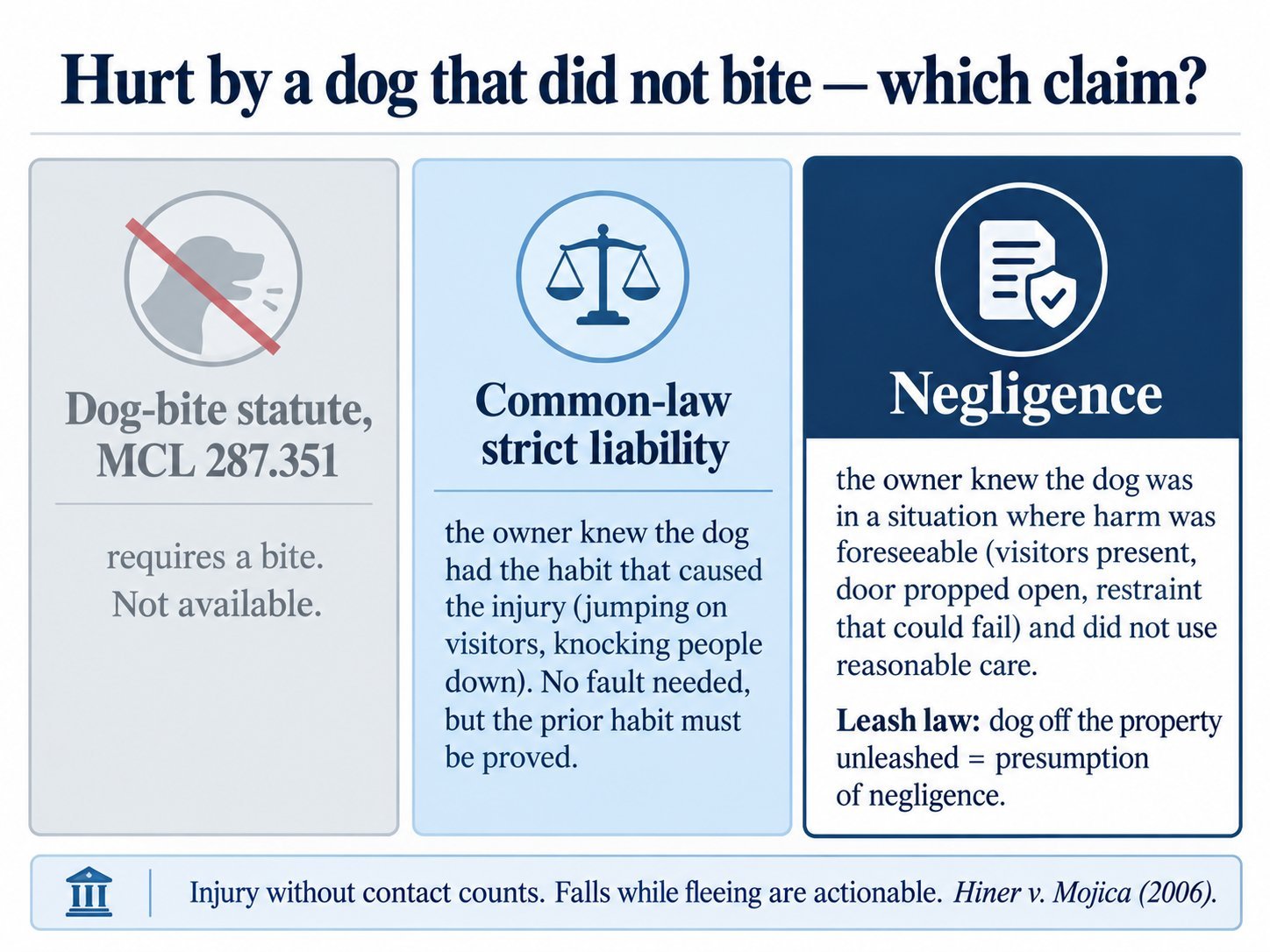
Michigan’s dog-bite statute begins “If a dog bites a person.” It does not say “attacks,” “injures” or “knocks down.” A person who is hurt by a dog in some other way, by being jumped on, bowled over, tangled in a leash, or by falling while running from a dog, has no claim under the statute, and the two protections the statute gives a bite victim (no need to prove the owner knew anything, and no reduction for the victim’s own carelessness) are not available.
What remains are the two common-law claims. The first, strict liability, requires proof that the owner knew the dog had the particular habit that caused the injury. A dog known to jump on visitors and knock them over is the textbook example, and an owner who keeps such a dog answers for the broken hip. The second, negligence, asks whether the person in control of the dog used reasonable care in the situation, and it is the claim that fits most non-bite injuries: a dog let out a door toward a visitor, a leash that failed, a dog that escaped the yard.
The courts treat a great deal of what dogs do as ordinary: barking, running up to strangers, jumping in play, bolting through an open door. An injury caused by ordinary dog behavior, with nothing more, usually does not produce a judgment. What turns an ordinary-behavior case into a winning one is evidence of something more: the dog had done it before, the owner had been warned, the owner knew the visitor was there and let the dog out anyway, or the dog had left the owner’s property in violation of the leash law. That evidence is almost always in the hands of the neighbors, the prior visitors, the mail carrier and the animal-control file, and it has to be gathered before it disappears.
Analysis
The statute requires a bite
MCL 287.351(1) imposes liability “[i]f a dog bites a person.” The trigger is the bite. The Legislature “retained the common law remedy but in addition enacted the statute,” Nicholes v. Lorenz, 396 Mich. 53, 59 (1976); see MCL 287.288, and the common law is where every other dog injury goes. The point has been applied without controversy in the unpublished non-bite cases: the plaintiffs in Kinney v. Crane (2014) dismissed their statutory claim “because the dog never bit anyone”; the plaintiff in Witt v. Smith (1999) conceded the case “did not fall under” the statute; the Smith v. Conroy panel (2017) noted that the statutory claim failed because there was no bite or physical contact; and Bartholomew v. Hazy (1999), Stoll v. Stobby (2008), Myers v. Myers (2003), Kibbe v. Richie (2012) and Kirkman v. Ellis (2014) were all litigated on common-law theories alone. Whether a particular injury was a bite is a jury question when it is disputed; a verdict of no cause was sustained where the defense theory was that the plaintiff’s nose was injured by “accidental bumping” against the dog’s face rather than a bite, Danison v. Velazquez (1996) (unpublished), and where the evidence left open whether a child’s wounds were bites or scratches. Cull v. Nielsen (2000) (unpublished).
It was not always so. Michigan’s first dog statute, 1850 PA 161, made the owner or keeper liable if a dog “shall assault, or bite or otherwise injure, any person while traveling,” and the Supreme Court held that a plaintiff whose horse was bitten on the heels and kicked him in the face could recover: the statute “does not indicate that the person must be bitten by the dog to entitle him to recover.” Jenkinson v. Coggins, 123 Mich. 7, 9 (1900). That act was repealed in 1929, and the 1939 statute that replaced it chose the narrower word. Jenkinson remains authority for who is a “keeper,” Trager v. Thor, 445 Mich. 95, 102–103 (1994), but not for non-bite recovery under the present statute. See Chapter 1.
Common-law strict liability for a known habit
Common-law strict liability has three elements: possession of the animal, scienter of its “abnormal dangerous propensities,” and harm resulting “from the dangerous propensity that was known or should have been known.” Trager, 445 Mich. at 99. The propensity need not be viciousness and the harm need not be a bite. The Restatement that Michigan follows gives the non-bite case as its illustration: “[i]f the possessor knows that his dog has the playful habit of jumping up on visitors, he will be liable without negligence when the dog jumps on a visitor, knocks him down and breaks his hip.” 3 Restatement Torts, 2d, § 509, comment i, p. 19 (quoted in Kibbe v. Richie (2012) (Meter, J., concurring in part and dissenting in part)). The Court of Appeals has said the same thing in passing: “a dog’s tendency to jump on people might permit a dangerous propensity finding.” Kirkman v. Ellis (2014) (unpublished). And the earliest Michigan strict-liability cases were not bite cases at all; Rickrode v. Wistinghausen, 128 Mich. App. 240 (1983), was a cat that scratched a child, and the court held that scienter of the scratching habit was enough.
The limit is that the habit must be one the owner knew about and must be the habit that caused the injury. The reported knock-down cases failed on that element because the record showed only ordinary behavior: dogs that “jumped on” guests “because they wanted to play,” Stoll; a Great Dane with a known habit of running out an open door, which “is nothing unusual or abnormally dangerous,” Myers; a 20-pound sheltie that jumped on a kitchen door, “generally a harmless activity common to canines,” Kirkman; a herding dog that chased horses, “a normal characteristic of this particular dog, and this type of dog in general,” Witt; a dog that barked while running up to strangers, Bartholomew; and three large dogs that had once collided with their owner at play, which the Kibbe majority held was not evidence of an abnormal propensity, over Judge Meter’s dissent that a tendency “to run into people and knock them down, causing injury, could indeed be considered an ‘abnormal dangerous propensity.'” The strict-liability count in a non-bite case is therefore worth pleading when, and only when, there is admissible evidence of a prior knock-down, a prior jump that hurt someone, or the owner’s own acknowledgment of the habit. See Chapter 6.
Negligence: the claim that fits
Negligence does not depend on an abnormal propensity. The duty to control a dog arises when the possessor knows of a dangerous propensity or “is aware that the animal is in such a situation that a danger of foreseeable harm might arise,” and the standard of care is the control “which would be exercised by a reasonable person based upon the total situation at the time, including the past behavior of the animal and the injuries that could have been reasonably foreseen.” Trager, 445 Mich. at 106; Hiner v. Mojica, 271 Mich. App. 604, 612–613 (2006). The only published Michigan decision on a non-bite dog injury is a negligence case, and the plaintiff won it: in Hiner a cable technician who ruptured a tendon running from a charging dog had no strict-liability claim, because the dog’s record was ordinary, but reached a jury on negligence, because the owner had been told the dog “doesn’t like us,” knew the men were working in her yard, and left the back door propped open. Id. at 607, 613–614. It was no answer that the precise mechanism of injury, a fall on muddy ground, was unforeseeable; “[i]t is only necessary that the evidence establishes that some injury to the plaintiff was foreseeable.” Id. at 614 n.3. And the premises-liability defenses were unavailable to the owner, because the duty to control a dog “is separate and distinct from the duty owed by” a landowner. Id. at 615–616.
Contact is not required. A fall while fleeing a dog that never touched the plaintiff is a “domestic animal injury” under Trager. In Mitchell v. Cunningham (2006) (unpublished), a canvasser fell on the sidewalk running from two dogs that escaped through a side door and were at her heels; the Court of Appeals reversed a directed verdict for the plaintiff and ordered a new trial, but on the ground that the jury should have heard the dogs’ history and how they got out, not on any suggestion that a no-contact injury is outside the claim. Hiner itself was a no-contact case.
Leash entanglement and the leash law. In Radcliffe v. Herdman (2023) (unpublished), the owners’ son unhooked a high-energy dog from its stake; it sprinted at the neighbor, the trailing leash wrapped around her ankle, and she fell. Summary disposition was reversed because the dog’s known character and the owner’s admission that it had knocked him down “twice in our driveway” would let a jury find that the standard of care “required [him] to exercise greater caution when removing Zelda’s leash from the stake and freeing her to roam,” and because the trial court plainly erred in refusing an amendment to add the leash-law count, MCL 287.262, which raises a rebuttable presumption of negligence whenever a dog strays off its owner’s property unleashed. The leash law is the non-bite plaintiff’s most useful statute. It supplied the presumption in Hack v. Foster, 89 Mich. App. 254 (1979) (woman knocked down when a Doberman broke its leash and attacked her dog), in Cassibo v. Bodwin, 149 Mich. App. 474 (1986) (cyclist fell and was struck by a truck after a loose dog ran at him), in Young v. Esker (1998) (unpublished) (leash hook broke) and in Roesner v. Tyler (2010) (unpublished) (dog let out unleashed bounded to the road). None of those plaintiffs was bitten. See Chapter 7.
What the losing cases lacked. The negligence counts in the defense decisions failed for the absence of a “situation” the owner should have recognized. A dog tethered to a 25-foot cable that stopped well short of the porch, known only to bark at strangers, created no foreseeable danger to a delivery driver who fell backing away from it, and the tether “fulfilled that duty” in any event. Smith v. Conroy (2017) (unpublished) (vacating a plaintiff’s judgment). Owners with no reason to expect a dog to charge, Bartholomew; a dog whose door-bolting had never hurt anyone in many visits, Myers; a small dog jumping on a door inside its own home, Kirkman; playful dogs running into a house, Stoll; a dog that had chased horses outdoors but never caused trouble in the barn, Witt; and a dog that jumped up on a jogger without growling or biting, Kinney (majority, over Judge Jansen’s dissent that propensity “is not central to a negligence claim”), all came out for the owner. Each of these is unpublished. Each turned on a record that contained nothing beyond ordinary dog behavior, and several turned on hearsay: the prior-incident evidence in Hightower v. Nuyen (2018) and Kirkman was a secondhand account with no affidavit and no showing of how it could be made admissible, and it was disregarded.
The possessor need not be the owner. The negligence claim runs against whoever had the dog: the temporary caretaker in Trager, the house-sitter whose negligence was imputed to the owners in Young, the mobile-home-park operator that let a tenant’s loose and repeatedly escaping pit bull remain until it attacked a resident walking in a common area, Skiver v. Durga (2022) (unpublished) (jury verdict affirmed; negligence for failure to enforce pet rules and premises liability for a loose dangerous dog as a condition on the land). But it does not run against a landowner for a stray dog that no one owns: a restaurant patron who fell backing away from a stray in the parking lot had no claim against the property owner, who “has no duty to control the incidence of stray dogs roaming onto his property.” Tosa v. Yono (2008) (unpublished). See Chapter 9.
Fault and the two things the statute would have given
Because the non-bite plaintiff is in negligence, the plaintiff’s own conduct counts. Comparative fault under MCL 600.2959 reduces the award in proportion to the plaintiff’s negligence, and provocation is not a bar but a factor. Hill v. Hoig, 258 Mich. App. 538, 541–542 (2003). On a common-law strict-liability count, by contrast, only willful provocation or gross negligence by the plaintiff is a defense. Rickrode, 128 Mich. App. at 247–248. In Skiver, the jury allocated 60 percent of the fault to the park operator and 40 percent to the dog’s owner and none to the plaintiff. The verdict form in a non-bite case must separate the counts and the fault questions. See Chapter 11.
The injuries in these cases are typically orthopedic and serious: a fractured hip followed by death in Hightower; a fractured leg in Myers and Kirkman; a cervical fusion in Stoll; a vertebral compression fracture in Skiver; a ruptured tendon in Hiner; a severely injured elbow in Mitchell. The damages are the same as in any negligence case. See Chapter 12.
For lawyers
Practice points
- Do not plead MCL 287.351 unless there was a bite. A statutory count in a knock-down case invites a motion and costs credibility; the Kinney and Smith plaintiffs had to dismiss theirs.
- Plead negligence on the Trager situation prong, in its words, and build the record on what the possessor knew at the moment: who was present, where the dog was, what restraint was in use, what the owner had been told. Hiner is the model.
- Plead MCL 287.262 whenever the dog was off the owner’s property. The presumption converts a “just a dog being a dog” case into one the owner must explain. Radcliffe; Hack; Cassibo.
- Plead common-law strict liability only with admissible evidence of a prior knock-down or jump that caused harm, or the owner’s own admission of the habit. Cite Restatement § 509 comment i and Kirkman‘s dictum.
- Get the prior-incident evidence in admissible form. The hearsay that sank Hightower and Kirkman would have survived as an affidavit from the person who saw it; the owner’s own statement is a party admission, MRE 801(d)(2), which carried Radcliffe.
- Canvass the neighbors, the carriers and animal control at once; the “situation” and “past behavior” evidence is what the defense decisions lacked.
- Inspect and preserve the restraint and the escape route: the tether length defeated Smith v. Conroy; the propped door made Hiner; the side door was relevant evidence in Mitchell.
- Where the defendant is a landlord or community operator rather than the owner, plead the failure-to-enforce-rules negligence theory and the condition-on-the-land premises theory as in Skiver; where the dog is a stray no one owns, there is no claim against the landowner. Tosa.
Authorities
Published decisions
| Case | Court / year | Point |
|---|---|---|
| Hiner v. Mojica, 271 Mich. App. 604 | Ct. App. 2006 | Non-contact flight injury; negligence claim reaches the jury on the owner’s awareness of the situation; mechanism of injury need not be foreseeable; premises-liability defenses inapplicable to the owner’s claim. |
| Trager v. Thor, 445 Mich. 95 | Mich. 1994 | Elements of common-law strict liability (harm must result from the known propensity); negligence standard; claim against temporary possessors. |
| Cassibo v. Bodwin, 149 Mich. App. 474 | Ct. App. 1986 | Cyclist’s fall after a loose dog ran at him; leash-law presumption; causation still required. |
| Hack v. Foster, 89 Mich. App. 254 | Ct. App. 1979 | Knock-down during a dog-on-dog attack; leash-law presumption must be weighed by the jury. |
| Rickrode v. Wistinghausen, 128 Mich. App. 240 | Ct. App. 1983 | Scratching cat; common-law strict liability for a known non-bite propensity; defenses limited to willful provocation or gross negligence. |
| Hill v. Hoig, 258 Mich. App. 538 | Ct. App. 2003 | Comparative negligence applies to the negligence count. |
| Jenkinson v. Coggins, 123 Mich. 7 | Mich. 1900 | 1850 statute (“assault, or bite or otherwise injure”) covered non-bite injury; superseded on that point by the 1939 statute’s “bites.” |
Unpublished Court of Appeals decisions
Unpublished opinions are not binding precedent under MCR 7.215(C)(1).
| Case | Year | Point |
|---|---|---|
| Radcliffe v. Herdman, 2023 WL 327860 | 2023 | Leash wrapped around neighbor’s ankle; owner’s admission of prior knock-downs created a fact question; leash-law amendment required. |
| Skiver v. Durga, 2022 WL 7724061 | 2022 | Loose pit bull attacked resident in common area; verdict against park operator affirmed on negligence and premises theories. |
| Mitchell v. Cunningham, 2006 WL 659465 | 2006 | Fall while fleeing escaped dogs that never touched the plaintiff is actionable; ordinance violation is evidence only; dogs’ history admissible. |
| Roesner v. Tyler, 2010 WL 5093295 | 2010 | Dog let out unleashed; leash-law presumption; rebuttal for the jury. |
| Young v. Esker, 1998 WL 1991225 | 1998 | Broken leash hook; presumption of negligence; house-sitter’s negligence imputed to owners. |
| Kibbe v. Richie, 2012 WL 5854486 | 2012 | Knock-down by large dogs; one prior playful collision not an abnormal propensity (majority); Restatement § 509 cmt. i (dissent). |
| Kirkman v. Ellis, 2014 WL 7217557 | 2014 | Dog jumped on a door that struck a guest; door-jumping is ordinary behavior; hearsay of prior incidents disregarded; dictum that jumping on people may be a dangerous propensity. |
| Kinney v. Crane, 2014 WL 2917803 | 2014 | Dog jumped on jogger; majority required knowledge of aggression; dissent applied Hiner. |
| Stoll v. Stobby, 2008 WL 2390031 | 2008 | Dog ran between guest’s legs on a porch; playful jumping not an abnormal propensity; no duty of constant control. |
| Myers v. Myers, 2003 WL 22399483 | 2003 | Great Dane bolted through a door and pulled guest down steps by her purse strap; running out a door is ordinary behavior; mechanism unforeseeable. |
| Hightower v. Nuyen, 2018 WL 6004469 | 2018 | Dog jumped on visitor, fatal hip fracture; premises relabeling does not avoid the knowledge requirement; hearsay of a prior jump disregarded. |
| Smith v. Conroy, 2017 WL 461263 | 2017 | Delivery driver fell backing from a tethered dog that could not reach her; no duty; tether satisfied any duty. |
| Bartholomew v. Hazy, 1999 WL 33453937 | 1999 | Injury while jumping onto a truck bed to avoid a charging dog; barking at strangers is normal; chain of events unforeseeable. |
| Witt v. Smith, 1999 WL 33441239 | 1999 | Dog startled a horse that injured a child; herding behavior is a normal characteristic; no duty. |
| Tosa v. Yono, 2008 WL 723979 | 2008 | Fall while backing from a stray dog in a parking lot; landowner has no duty to control strays. |
| Danison v. Velazquez, 1996 WL 33348816 | 1996 | Jury may find a facial injury was a bump, not a bite; no statutory recovery. |
| Cull v. Nielsen, 2000 WL 33534002 | 2000 | Whether wounds were bites or scratches was for the jury. |
Common questions
A dog knocked me down and I broke my wrist, but it never bit me. Do I have a case?
Not under the dog-bite statute, which requires a bite. You may have a negligence claim if the owner should have seen the risk (the dog was loose, or let out toward you, or had done it before), and a leash-law claim if the dog was off its owner’s property. If the owner knew the dog jumps on people, strict liability may apply as well.
I fell running away from a dog that never touched me.
That can be an actionable injury. The published Michigan case on the point involved a technician who was hurt running from a charging dog that never reached him, and the owner was held to answer because she knew the men were in her yard and left the door open.
The owner says the dog was just being friendly.
That is the usual defense, and courts accept it when the record shows nothing more than ordinary dog behavior. The answer is evidence: prior incidents, warnings the owner received, the restraint that failed, the dog being off the property. That evidence has to be gathered early.
Does it matter that I may have been partly at fault?
In a negligence claim, yes; your share of fault reduces your recovery. It does not eliminate it.
The dog that knocked me over was a stray.
With no owner or keeper, there is usually no one to hold responsible. A landowner is not liable for strays that wander onto the property, even where strays are common.
Knocked down, dragged or injured fleeing a dog?
These cases are won on evidence that the owner should have seen it coming. JKH Law gathers it before it is gone. Consultations are free, in Grand Rapids and statewide.
This page is part of the Michigan Dog Bite Law Compendium published by JKH Law, PLC. It is legal information about Michigan law, not legal advice about any particular situation, and reading it does not create an attorney-client relationship. Citations were last checked in October 2026. Unpublished opinions are identified as such and are not binding under MCR 7.215(C)(1).

Personal injury litigation for Grand Rapids and West Michigan.
312 Fulton Street EastGrand Rapids, MI 49503 (616) 226-3762
Fax (616) 988-6504
Free consultation