
Chapter 1 · 1850 to today
How Michigan Dog-Bite Law Developed
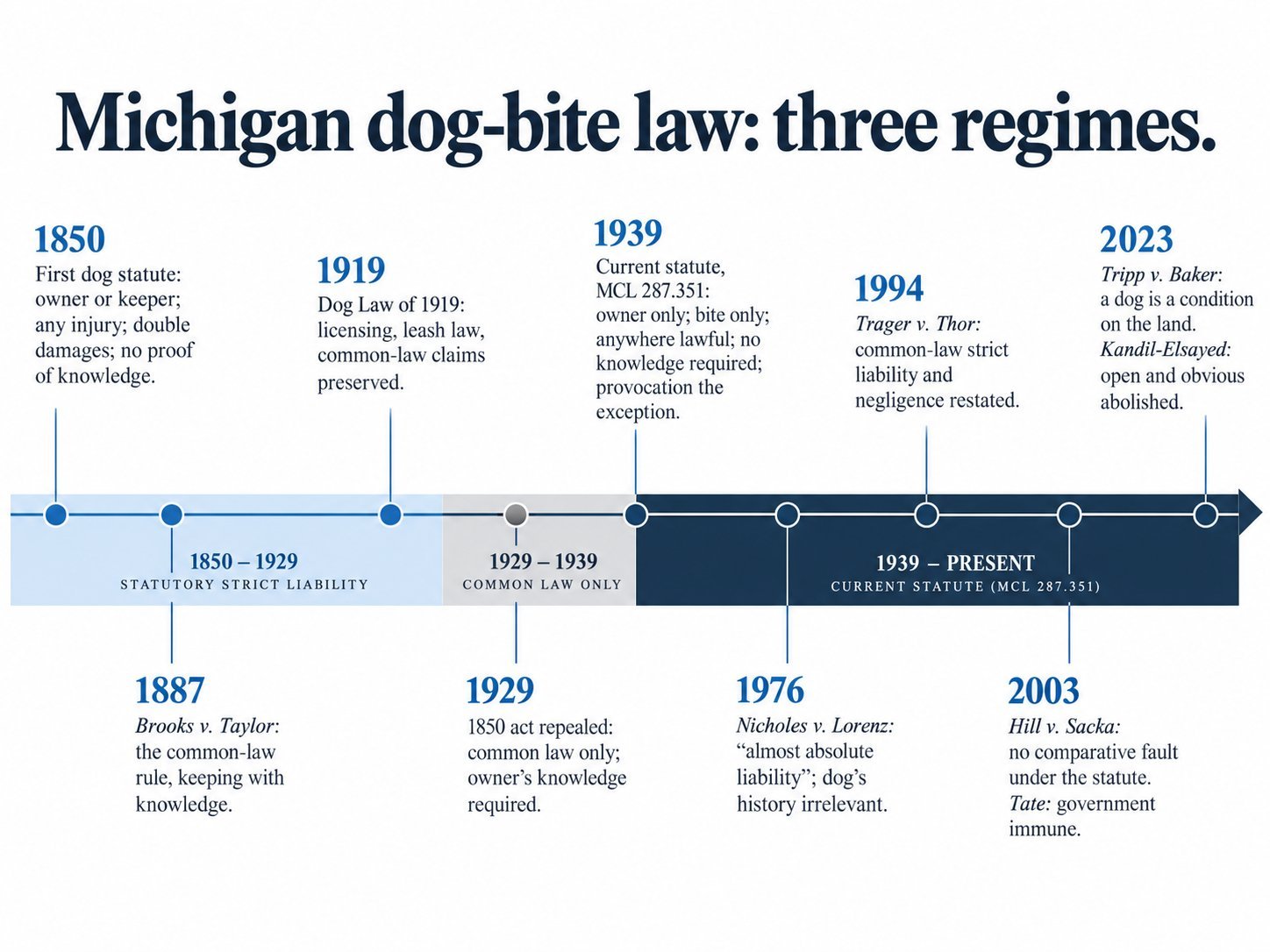
Michigan has had three regimes of dog-bite liability: a strict statute from 1850 that reached the dog’s keeper and any injury; a decade of pure common law after that statute was repealed in 1929; and the 1939 statute that governs today, which reaches only the owner and only a bite. The common-law claims never went away, and the modern decisions build on cases that are a century old. This chapter traces the line, so that a reader knows which rule each old case was applying and why it still matters.

In plain terms
Why the history matters to a case today
Under the English common law that Michigan inherited, a dog’s owner was liable for a bite only if the owner knew the dog was dangerous. Every dog was presumed harmless until it showed otherwise, and the victim had to prove both the dog’s vicious disposition and the owner’s knowledge of it, a requirement the courts called “scienter.” That rule still exists in Michigan as common-law strict liability, and it is the reason a second claim, negligence, developed alongside it.
Michigan’s Legislature first changed the rule in 1850, with a statute that made the owner or keeper of a dog liable, without proof of knowledge and in double damages, for a dog that would “assault, or bite or otherwise injure” a person traveling the highway or outside the owner’s enclosure. The Supreme Court applied that act for nearly eighty years, producing the decisions on who is a “keeper,” on non-bite injuries, and on the victim’s own conduct that modern courts still quote. The Legislature repealed it in 1929, and for ten years dog-bite victims had only the common law and its knowledge requirement.
In 1939 the Legislature enacted the statute in force today. It again dispensed with proof of knowledge, but it narrowed the claim: it reaches the “owner” rather than the “owner or keeper,” it requires a “bite” rather than any injury, it covers a victim anywhere in public or lawfully on private property rather than only on the highway, it allows compensatory rather than double damages, and it names provocation as the exception. Nearly every question a modern dog-bite case raises comes from one of those choices, and nearly every old case is useful only once the reader knows which statute, if any, it was applying.
Analysis
The common-law foundation
The Michigan common law of animal liability was stated in its classic form in a case about a bull. “[W]hoever keeps an animal accustomed to attack and injure mankind, with knowledge that it is so accustomed, is prima facie liable in an action on the case at the suit of any person attacked and injured by the animal, without any averment of negligence or default in the securing and taking care of it.” Brooks v. Taylor, 65 Mich. 208, 210–211 (1887). The gist of the action is the keeping with knowledge; the plaintiff need not plead or prove the defendant’s negligence, and the plaintiff’s own want of care is not an element, though willful provocation or gross negligence in approaching a known-vicious animal is a defense. Id. For dogs specifically, “in case of domestic animals, whose dispositions are universally regarded as peaceable, no action can be maintained at common law without proof of the scienter.” Knowles v. Mulder, 74 Mich. 202, 206 (1889). The plaintiff had to show “that the dog had on previous occasions manifested a vicious disposition, indicating a disposition to bite mankind, and that the defendant had knowledge or notice of the fact,” after which “it is immaterial what the general character of the animal is.” Kennett v. Engle, 105 Mich. 693, 695 (1895).
Three refinements from the same era remain live. Knowledge may be constructive: an owner “may be chargeable with notice through his own negligence to take note of the vicious habits of his domestic animal,” and the length of time a habit persisted bears on whether notice is inferred. Knowles, 74 Mich. at 206. The “one bite” rule was rejected early; counsel’s argument that “every dog is entitled to one bite” “does not correctly define the law,” and knowledge of a disposition likely to produce the injury suffices. Slater v. Sorge, 166 Mich. 173, 176 (1911). And a managing agent’s knowledge is the principal’s. Meilke v. Schabble, 159 Mich. 163, 166 (1909). These are the rules of common-law strict liability set out in Chapter 6, and the Supreme Court restated them in Restatement terms in Trager v. Thor, 445 Mich. 95, 99–100 (1994).
The 1850 act: owner or keeper, any injury, double damages
“If any dog … shall assault, or bite or otherwise injure, any person while traveling [the highway or out of the enclosure of the owner or keeper] …”
The act made the owner or keeper liable for double the damages, found by the “court,” which the Supreme Court held to include the jury, and it was constitutional: “[i]t is competent for the legislature to provide for doubling damages in this class of cases.” Fye v. Chapin, 121 Mich. 675, 678–679 (1899). Its purpose was described in terms the courts still use: “It confers a right of action without requiring proof of knowledge in the defendant of the dog’s habit,” it “does not supersede common law actions,” and it was “intended to give a liberal remedy to the injured party in a few special cases and to authorize a recovery in its nature penal.” Monroe v. Rose, 38 Mich. 347, 348 (1878); Wojewoda v. Rybarczyk, 246 Mich. 641, 642–643 (1929). “The effect of this statute is to extend the common law so as to include all keepers of dogs, and to dispense with proof of the previous knowledge of their vicious character.” Fye, 121 Mich. at 680. Because the recovery was penal, the owner’s knowledge of the dog’s viciousness was admissible on damages. Swift v. Applebone, 23 Mich. 252, 258–259 (1871).
Keeper. Because the act reached the “keeper,” the Supreme Court worked out who that was. “A man may own a dog, and yet not be his keeper”; the keeper is the person at whose home the dog “really lived” and who “undertook to control his actions,” and an owner whose dog had been enticed away and kept at another’s house was not liable. Burnham v. Strother, 66 Mich. 519, 520–521 (1887). A woman who owned and controlled the farm where her adult son’s dog lived was its keeper. Jenkinson, 123 Mich. at 8. A husband who occupied the household on weekends could be charged as keeper of his wife’s dog. Slater, 166 Mich. at 176. An owner who had placed the dog with another for six weeks was not the keeper, and his post-incident statement that he “assumed all the responsibility” did not make him one. Wetzel v. Bolster, 169 Mich. 43, 44–47 (1912). These are the cases Trager drew on in 1994 to define possession and keeper status at common law. 445 Mich. at 100–104.
Any injury. The act’s words “assault, or bite or otherwise injure” reached a man whose horse was bitten on the heels and kicked him in the face: “[i]t does not indicate that the person must be bitten by the dog to entitle him to recover.” Jenkinson, 123 Mich. at 9. The 1939 act chose the word “bites,” and non-bite injuries went back to the common law (Chapter 8).
The victim’s conduct. Under a statute that dispensed with knowledge, the only conduct-based defense was the victim’s own knowing exposure: “the owner cannot be released from liability by any act of the person injured unless it can be affirmed that he caused the injury himself with a full knowledge of its possible consequences,” and a parent’s negligence was not imputed to a bitten child. Fye, 121 Mich. at 679–680. “The basis of liability is not negligence in the manner of keeping and confining the animal but in keeping him at all,” and “[t]he law of canine self-defense does not relieve the owner of liability for damages because the injured person inadvertently stepped on the dog.” Wojewoda, 246 Mich. at 643–644. The 1939 act’s express exception for provocation is what later allowed the Court of Appeals to treat an unintentional act as provocation under the modern statute (Chapter 3).
The Dog Law of 1919, the 1929 repeal and the decade without a statute
In 1919 the Legislature enacted the Dog Law of 1919, 1919 PA 339, MCL 287.261 et seq., a licensing and animal-control statute that defines “owner” broadly for its own purposes, makes it unlawful to allow a dog to stray unless held properly in leash, authorizes local animal-control ordinances, and provides that “[n]othing in this act contained shall be construed as limiting the common law liability of the owner of a dog for damages committed by it.” MCL 287.288. The leash provision, MCL 287.262, became the source of the rebuttable presumption of negligence discussed in Chapter 7, and the Dog Law’s broad definition of “owner” has been held confined to that act. Trager v. Thor, 199 Mich. App. 223 (1993), aff’d in part, 445 Mich. 95.
In 1929 the Legislature repealed the 1850 act outright, 1929 PA 309, with immediate effect, and the Supreme Court held that a pending statutory claim fell with it; a verdict doubled under the repealed act was reversed. Bejger v. Zawadzki, 252 Mich. 14, 18–19 (1930). For the next decade dog-bite claims were governed by the common law alone. “In all cases arising under the common law, it is necessary for the plaintiff to aver and prove scienter,” the owner is “not liable as insurers,” and contributory negligence and provocation were complete defenses. Grummel v. Decker, 294 Mich. 71, 76–78 (1940) (visitor who stooped to pet a dog after a warning took nothing). The same term the Court held that growling at every arrival, the need to restrain the dog from visitors, and the owner’s own statement that the dog had cost her a maid were enough to send scienter to the jury although the dog had never bitten anyone, Massengile v. Piper, 294 Mich. 653, 660 (1940), Justice Wiest adding that “[k]nowledge of viciousness of a dog does not necessarily await a first bite.” Id. (Wiest, J., concurring). Those two decisions remain the Supreme Court’s fullest statements of the common-law claim.
The 1939 act and its construction
1939 PA 73, now MCL 287.351, restored no-fault liability for dog bites and has governed since. Its text and elements are set out in Chapter 2. The Legislature “retained the common law remedy but in addition enacted the statute,” Nicholes v. Lorenz, 396 Mich. 53, 59 (1976), and the five differences from the 1850 act are the architecture of the modern law: “owner” rather than “owner or keeper” (Chapter 5); “bites” rather than “assault, or bite or otherwise injure” (Chapter 8); any public place or lawful private place rather than the highway and land outside the enclosure (Chapter 4); compensatory rather than double damages (Chapter 12); and “without provocation” as an express exception (Chapter 3). The act was amended once, by 1988 PA 142, which added subsection (2) defining lawful presence on private property in terms of legal duty, invitee and licensee status, and the exclusion of a person who enters for a criminal purpose.
The Supreme Court has construed the 1939 act once. In Nicholes it held that the statute “creates an almost absolute liability,” that the only facts necessary are the bite and the absence of provocation, that “[n]othing else had to be proved and nothing else was relevant—not his prior gentleness or roughness nor the sensitivities of his breed,” and that the statute “does not provide for punitive damages.” 396 Mich. at 59–63. Everything else in the modern statutory law is the work of the Court of Appeals: the objective test for provocation, Bradacs v. Jiacobone, 244 Mich. App. 263 (2001); Brans v. Extrom, 266 Mich. App. 216 (2005); Koivisto v. Davis, 277 Mich. App. 492 (2008); the meaning of “owner,” Szkodzinski v. Griffin, 171 Mich. App. 711 (1988); Trager, 199 Mich. App. 223; lawful presence, Kelsey v. Lint, 322 Mich. App. 364 (2017); the exclusion of comparative fault and third-party fault, Hill v. Sacka, 256 Mich. App. 443 (2003); parental immunity, Thelen v. Thelen, 174 Mich. App. 380 (1989); and governmental immunity, Tate v. City of Grand Rapids, 256 Mich. App. 656 (2003).
The common law since 1939
The common-law claims developed on their own track. Papke v. Tribbey, 68 Mich. App. 130 (1976), fixed the rule that an owner with knowledge of a vicious propensity is liable regardless of fault, so that an escape beyond the owner’s control is no defense, and that only willful provocation or gross negligence by the plaintiff defeats the claim. Rickrode v. Wistinghausen, 128 Mich. App. 240 (1983), confirmed that a prior attack is not required, that an ordinance violation is evidence of negligence, and that comparative negligence applies to the negligence count but not to strict liability, after Placek v. City of Sterling Heights, 405 Mich. 638 (1979), replaced contributory negligence with comparative fault. Trager v. Thor, 445 Mich. 95 (1994), restated common-law strict liability in Restatement terms, held that a temporary caretaker is neither owner nor keeper as a matter of law, and recognized the negligence claim for “ineffective control of an animal in a situation where it would reasonably be expected that injury could occur,” judged by “the total situation at the time.” Hiner v. Mojica, 271 Mich. App. 604 (2006), applied that negligence claim to a non-bite flight injury and held that premises-liability defenses do not apply to it.
The landlord and premises line ran from Klimek v. Drzewiecki, 135 Mich. App. 115 (1984), which first treated a loose dangerous dog as a condition on the land, through Szkodzinski, Feister v. Bosack, 198 Mich. App. 19 (1993), and Braun v. York Properties, Inc., 230 Mich. App. 138 (1998), to Tripp v. Baker, 346 Mich. App. 257 (2023), which adopted Klimek‘s rule in a binding decision and stated the two-element premises case, and Leiendecker v. Ascension Genesys Hospital (2026), which applied it to any animal a possessor knows to be dangerous (Chapter 9). Three months after Tripp, the Supreme Court abolished the open-and-obvious doctrine in Kandil-Elsayed v. F & E Oil, Inc., 512 Mich. 95 (2023), removing a defense that had been raised in dog cases for two decades (Chapter 11).
Two related statutes round out the field. The dangerous-animals act, MCL 287.321 et seq., enacted in 1988, provides for a sworn complaint, a hearing and a destruction order against a dog that has attacked a person, with its own definition of provocation; and the Dog Law’s leash provision continues to supply the standard of care in negligence (Chapter 14).
For lawyers
Reading the old cases
- Date the decision and identify the regime. A decision between 1850 and May 24, 1929, may be applying the 1850 act, the common law, or both; one between 1929 and 1939 is common law only; one after 1939 may be applying MCL 287.351, the common law, or both. The opinion usually says which count was tried.
- “Keeper” holdings under the 1850 act (Burnham, Jenkinson, Wetzel, Slater) are authority for common-law possessor and keeper status, which Trager adopted, and for the Dog Law’s definition of “owner.” They are not authority that a keeper is liable under MCL 287.351, which reaches the owner only.
- “Otherwise injure” holdings (Jenkinson, Monroe) are authority for non-bite recovery only at common law today.
- The 1850 act’s defense of knowing, voluntary self-exposure (Fye, Wojewoda) is not the modern statute’s provocation exception, which the Court of Appeals reads objectively and to include unintentional acts (Brans). Cite Wojewoda for the proposition that inadvertent contact was never treated as provocation under a no-fault statute, and expect the response that the 1939 text is different.
- Double-damages and knowledge-on-damages holdings (Swift, Fye) are history; Nicholes holds the 1939 act compensatory only.
- Common-law scienter holdings (Brooks, Knowles, Kennett, Slater, Grummel, Massengile) are current law on common-law strict liability, restated by Trager and applied by Hiner, Rickrode and Papke.
- Contributory-negligence holdings on the common-law counts (Grummel, Kennett) are superseded by comparative fault (Placek; Hill v. Hoig, 258 Mich. App. 538 (2003)).
- Pre-November 1990 published Court of Appeals decisions (Papke, Rickrode, Klimek, Cassibo, Szkodzinski, Thelen) are not binding on later panels under MCR 7.215(J)(1) but are precedent entitled to deference and are followed in the trial courts; Tripp adopted Klimek on that footing.
Authorities
Michigan Supreme Court, by era
| Case | Year | Regime and point |
|---|---|---|
| Swift v. Applebone, 23 Mich. 252 | 1871 | 1850 act: owner’s knowledge admissible on penal damages; statutory and common-law counts are distinct causes of action. |
| Monroe v. Rose, 38 Mich. 347 | 1878 | 1850 act: no proof of knowledge required; statute does not supersede common law; recovery penal. |
| Jenks v. Brown, 38 Mich. 651 | 1878 | 1850 act: “owned or kept” pleaded in the alternative. |
| Robb v. Shepard, 50 Mich. 189 | 1883 | Estoppel to deny ownership where a knowing misstatement was relied on. |
| Brooks v. Taylor, 65 Mich. 208 | 1887 | Common law (bull): keeping with knowledge is the gist; willful provocation or gross negligence a defense. |
| Burnham v. Strother, 66 Mich. 519 | 1887 | 1850 act: keeper is where the dog “really lived”; owner not keeper. |
| Knowles v. Mulder, 74 Mich. 202 | 1889 | Common law: scienter required; constructive knowledge from a persistent habit; non-bite highway injury. |
| French v. Wilkinson, 93 Mich. 322 | 1892 | Common law: damages limited to injuries pleaded; hydrophobia evidence improper. |
| Kennett v. Engle, 105 Mich. 693 | 1895 | Common law: two-part scienter showing; general good disposition immaterial once shown. |
| Fye v. Chapin, 121 Mich. 675 | 1899 | 1850 act constitutional; double damages; parents’ negligence not imputed; only knowing self-exposure a defense; remittitur. |
| Jenkinson v. Coggins, 123 Mich. 7 | 1900 | 1850 act: premises control makes the keeper; “otherwise injure” covers non-bite injury. |
| Willet v. Goetz, 125 Mich. 581 | 1901 | Common law: prior specific acts plus knowledge establish scienter; non-bite highway injury. |
| Meilke v. Schabble, 159 Mich. 163 | 1909 | Common law: managing agent’s knowledge imputed to the owner. |
| Slater v. Sorge, 166 Mich. 173 | 1911 | Common law: “one bite” rule rejected; household head as keeper. |
| Wetzel v. Bolster, 169 Mich. 43 | 1912 | 1850 act: bailee for six weeks is keeper; owner’s assumption of responsibility no estoppel. |
| Wojewoda v. Rybarczyk, 246 Mich. 641 | 1929 | 1850 act: liability for keeping the dog at all; inadvertent contact not a defense. |
| Bejger v. Zawadzki, 252 Mich. 14 | 1930 | 1929 repeal: pending statutory claims fell; common law only. |
| Grummel v. Decker, 294 Mich. 71 | 1940 | Common law (1929–1939): scienter required; owner not an insurer; contributory negligence and provocation defenses (superseded on fault). |
| Massengile v. Piper, 294 Mich. 653 | 1940 | Common law: no prior bite required; manifested disposition, owner’s statements and breed temperament send scienter to the jury. |
| Nicholes v. Lorenz, 396 Mich. 53 | 1976 | 1939 act: “almost absolute liability”; two elements; history and breed irrelevant; no punitive damages. |
| Placek v. City of Sterling Heights, 405 Mich. 638 | 1979 | Comparative negligence replaces contributory negligence. |
| Trager v. Thor, 445 Mich. 95 | 1994 | Common law restated: three-element strict liability; keeper requires proprietary control; temporary caretaker not liable in strict liability; negligence claim recognized. |
| Kandil-Elsayed v. F & E Oil, Inc., 512 Mich. 95 | 2023 | Open-and-obvious doctrine abolished. |
Common questions
Is Michigan a “one bite” state?
No, and it never was. The Supreme Court rejected the idea in 1911 under the common law, and since 1939 the dog-bite statute has made the owner liable for a bite without any proof that the dog had bitten or threatened anyone before.
Does the dog-bite statute replace the older law?
No. The statute adds a claim; the common-law claims, which require proof that the owner knew the dog was dangerous or failed to use reasonable care, still exist and are pleaded alongside it. The Dog Law of 1919 says so expressly.
Why do lawyers cite cases from the 1800s in dog-bite briefs?
Because the rules on who “keeps” a dog, what counts as knowledge of a dog’s dangerousness, and whether a victim’s own conduct is a defense were worked out by the Michigan Supreme Court between 1871 and 1940 and have not been displaced. The 1994 Trager decision restated them. The care is in knowing which statute, if any, each old case applied.
Has the statute changed since 1939?
Once, in 1988, to define when a person is “lawfully on” private property. The liability rule itself is unchanged.
Bitten by a dog in Michigan?
The law has favored the victim since 1939, and JKH Law knows how every piece of it fits together. Consultations are free, in Grand Rapids and statewide.
This page is part of the Michigan Dog Bite Law Compendium published by JKH Law, PLC. It is legal information about Michigan law, not legal advice about any particular situation, and reading it does not create an attorney-client relationship. Citations were last checked in October 2026. Unpublished opinions are identified as such and are not binding under MCR 7.215(C)(1).

Personal injury litigation for Grand Rapids and West Michigan.
312 Fulton Street EastGrand Rapids, MI 49503 (616) 226-3762
Fax (616) 988-6504
Free consultation