
Chapter 10 · When the government owns the dog
Police Dogs, Animal Control and Governmental Immunity
A dog owned by a city, a county or a sheriff’s department is outside the dog-bite statute in practice, because the Governmental Tort Liability Act immunizes the agency from all tort liability and the statute does not say otherwise. The victim of a police K-9, a shelter dog or an animal-control failure is left with narrow routes: gross negligence by the individual handler or officer, the proprietary-function exception for an agency run for profit, and federal civil-rights claims. This chapter sets out what those routes require and what has defeated them.
In plain terms
Why a police-dog bite is different
If a police dog bites you, the dog-bite statute does not help you against the police department. Michigan’s immunity act shields cities, counties and the state from “tort liability” when they are carrying out a governmental function, and the courts have held that a dog-bite claim is tort liability and that running a police department or an animal shelter is a governmental function. The statute that makes private owners liable without fault says nothing about the government, and the courts will not read it as a waiver of immunity.
That leaves the individual officer or employee. A government employee is personally liable only for gross negligence, which the statute defines as conduct so reckless that it shows a substantial lack of concern for whether someone is hurt, and only if that conduct was the cause of the injury. A bite by a leashed, muzzled, trained dog that “spun” or “slipped” is not gross negligence; the courts have said so repeatedly. A dog that was deliberately sent to bite a suspect is a different matter entirely: that is a use of force, judged as an intentional act, and the officer is immune unless the deployment was malicious.
There are two openings. First, an animal-control agency that has turned its operation into a revenue source, or ceded its enforcement to a donor with a no-kill agenda, may be engaged in a “proprietary function,” which the immunity act does not protect; a 2025 decision let a wrongful-death claim against Detroit Animal Care and Control go forward to discovery on exactly that theory. Second, where an agency’s employees knew a particular dog was dangerous and still returned it to the street, the gross-negligence route against those employees is live, and that same decision let it proceed. These cases are hard and must be pleaded correctly from the first filing.
Analysis
The agency is immune
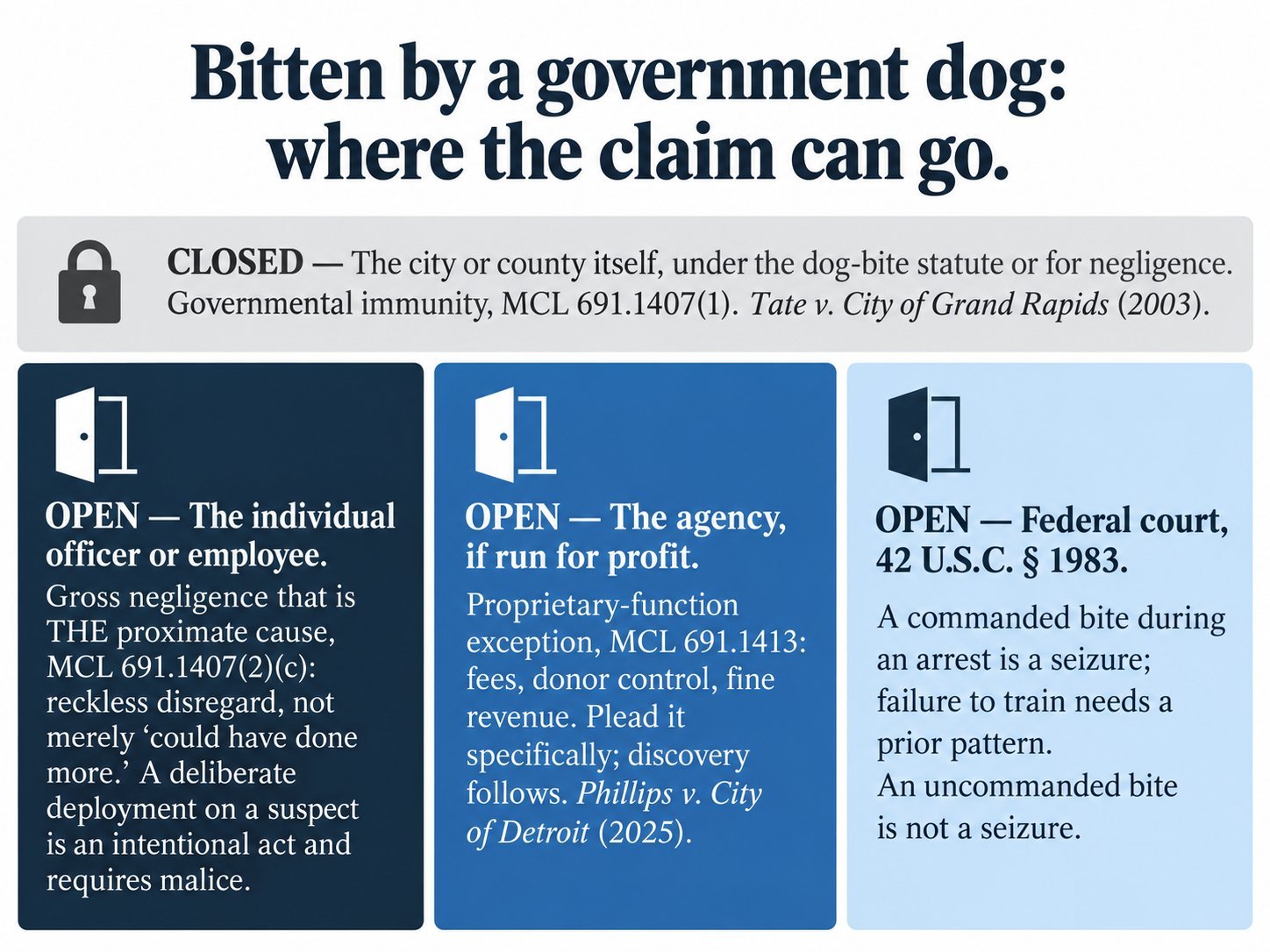
The statute does not abrogate the GTLA. The Governmental Tort Liability Act provides that “a governmental agency is immune from tort liability if the governmental agency is engaged in the exercise or discharge of a governmental function,” except as the act itself provides. MCL 691.1407(1). In Tate v. City of Grand Rapids, 256 Mich. App. 656 (2003), a police tracking dog ran at a bystander who had knelt with his arms over his head and bit his shoulder despite the handler’s repeated commands to heel. The plaintiff argued that strict liability under MCL 287.351 is not “tort liability.” The Court of Appeals disagreed: “M.C.L. § 287.351 does not itself establish liability for dog bites; rather, it merely replaces the negligence standard applicable to the existing common law tort (liability imposed regarding an animal known to be vicious) with a strict liability standard (liability imposed regardless of such knowledge),” and “[t]he GTLA unambiguously grants immunity from all tort liability, i.e., all civil wrongs for which legal responsibility is recognized, regardless of how the legal responsibility is determined, except as otherwise provided in the GTLA.” Id. at 660–661. The officers were engaged in a governmental function because “the focus must be on the general activity, not the specific conduct involved at the time of the tort,” and investigating a felonious assault is a governmental activity even though the dog disobeyed its handler. Id. at 661. Chief Judge Whitbeck added that immunity is abrogated only by express enactment or necessary inference, and the dog-bite statute neither mentions government nor defines “owner” to include it. Id. at 663–664 (Whitbeck, C.J., concurring).
The Supreme Court has since defined “tort liability” in the GTLA as encompassing “all legal responsibility arising from noncontractual civil wrongs for which a remedy may be obtained in the form of compensatory damages,” and in doing so said of Tate that “[w]e do not necessarily disagree with Tate’s general understanding of the phrase ‘tort liability,'” only that its definition was “incomplete.” In re Bradley Estate, 494 Mich. 367, 381, 397–398 (2013). A statutory dog-bite claim is a noncontractual civil wrong remedied by compensatory damages, so Tate‘s conclusion stands on the Supreme Court’s own definition. Every later decision applies it. Mondak v. Taylor Police Department (2017) (unpublished); Alexander v. City of Detroit (2022) (unpublished) (the statute “neither defines ‘owner of the dog’ nor mentions the state or its political subdivisions”); Richardson v. Oakland County Animal Shelter (2020) (unpublished) (“There is no statutory exception to governmental immunity pertaining to dangerous animals in the possession of a governmental agency. However reasonable or beneficial such an exception might be, it does not exist in Michigan”); Lynum v. Detroit Police Department (2023) (unpublished); Mata v. Van Buren County (2021) (unpublished); Graff v. City of Lincoln Park (E.D. Mich. 2026). Common-law negligence and vicarious-liability claims against the agency fall with the statutory claim. Mondak; Tate.
Animal control is a governmental function. “[P]rotection of the public from vicious, dangerous or diseased animals is a nonproprietary governmental function,” and a pound master’s decisions whether a dog is vicious and how to dispose of it are discretionary; a willful failure to impound a dog after complaints is not an intentional tort or a nuisance. Christopher v. Baynton, 141 Mich. App. 309, 311–314 (1985) (mail carrier mauled by a dog the city had been warned about). A municipal shelter’s foster-placement program for impounded dogs is impliedly authorized by the animal-control ordinance and is therefore a governmental function. Alexander. Police responding to an attack in progress owe no private duty to the victim absent a special relationship, and a toddler cannot have relied on them. Goree v. City of Grand Rapids (1999) (unpublished) (public-duty doctrine).
On-duty officers and firefighters. A police officer bitten by another agency’s K-9 during an arrest has no claim at all: MCL 600.2966 immunizes governmental agencies and employees from all tort liability for injuries to police officers and firefighters that arise from the normal, inherent and foreseeable risks of the profession, without regard to gross negligence, and the dog-bite statute is not an exception to it any more than to the GTLA. Mata.
The individual handler or employee
Gross negligence that is the proximate cause. A governmental employee acting within the scope of authority in the course of employment is immune unless “the officer’s, employee’s, member’s, or volunteer’s conduct amount[s] to gross negligence that is the proximate cause of the injury or damage.” MCL 691.1407(2)(c). Gross negligence is “conduct so reckless as to demonstrate a substantial lack of concern for whether an injury results.” MCL 691.1407(8)(a). The decisions apply the standard strictly. Two K-9 officers who ran leashed dogs through a fireworks crowd in pursuit of suspects, on their shortest leashes with choker collars and K-9 identification, were not grossly negligent when one dog bit a bystander’s leg in passing; “short of barring all police dogs from public events,” the court could not see what the plaintiff would have had them do. Mondak. A handler who took his K-9 to the veterinarian muzzled and leashed and held it on the floor in a headlock, the technician’s own preferred method, was not grossly negligent when the dog slipped the muzzle and bit her arm; a different muzzle or a shorter leash “at best, would only amount to ordinary negligence.” Lynum. A handler who left his K-9 on its bed in a keycard-secured office was not grossly negligent when a fellow officer brought his three-year-old through the back door and the dog bit her. Graff. Shelter employees who took two minutes to reach an inmate worker being attacked in a kennel, and had not provided protective gear, were not grossly negligent. Richardson.
A statutory count against the officer is self-defeating. The dog-bite statute imposes “liability without fault,” so a claim under it “amount[s] to an assertion that the officers should be held liable for their mere ownership of the dog, without regard to their conduct,” and alleges no gross negligence at all; the officers were immune from it as a matter of law. Mondak. The claim against the individual is pleaded as gross negligence with specific facts, or it is nothing.
Off duty is still in the course of employment. A K-9 handler responsible for the dog around the clock was acting in the course of employment when the dog bit a visitor at his vacation cottage two and a half hours from the county, because the county “expressly and unequivocally placed that responsibility on [him] as a condition of his employment” and the dog “is not equivalent to a patrol vehicle that can simply be left unattended.” Foster v. Szlaga (2016) (unpublished) (over a dissent that would have required discovery on whether the handler was in fact required to keep the dog with him). A handler taking the dog to its annual checkup was likewise in the course of employment. Lynum. The Foster dissent is the plaintiff’s discovery plan: the department’s K-9 policy, the handler’s actual obligations, and whether the department required or merely permitted the dog’s presence.
The handler is not the statutory “owner.” The statute reaches “the owner of the dog,” and the courts have declined to treat a handler who possesses, keeps and cares for a department’s dog as its owner. “We find nothing in the plain language of the statute that would support an interpretation that simply possessing, keeping, and taking care of a dog constitutes ownership for purposes of MCL 287.351(1).” Foster. Where the department testified that it owned the dog, the plaintiff’s bare assertion that the handler was the “constructive owner” did not create a fact question, Foster; Graff (city’s earlier litigation statement that it was “not the owner,” offered without record support, given no weight). The point is academic in practice: an owner-handler would still be immune from the statutory claim unless grossly negligent, Mondak, so the gross-negligence count is the claim in either event. See Chapter 5.
Deliberate deployment is an intentional tort. When an officer intentionally releases a dog on a resisting suspect, the claim is assault and battery, governed by the good-faith immunity of Odom v. Wayne County, 482 Mich. 459 (2008). “A police officer’s decisions regarding how to respond to a citizen, how to safely defuse a situation, and how to effectuate the lawful arrest of a citizen who resists are also clearly discretionary,” and “[a]n action may lie only if the officer has utilized wanton or malicious conduct or demonstrated a reckless indifference to the common dictates of humanity.” Norris v. Lincoln Park Police Officers, 292 Mich. App. 574, 579 (2011). The deployment on a motorist who had driven at 80 miles an hour on a rim and kicked an officer was discretionary police judgment, and “[e]lements of intentional torts may not be transformed into gross negligence claims.” Id. at 581–582. Norris governs an admitted intentional deployment; it does not reach the accidental or uncommanded bite, which is analyzed under the gross-negligence standard above. Estate of Stanley-Jones v. Weekley (2018) (unpublished) (distinguishing Norris).
The openings: proprietary function and known-dangerous dogs
Proprietary function. The GTLA does not immunize “actions to recover for bodily injury or property damage arising out of the performance of a proprietary function,” defined as “any activity which is conducted primarily for the purpose of producing a pecuniary profit for the governmental agency, excluding, however, any activity normally supported by taxes or fees.” MCL 691.1413. In Phillips v. City of Detroit (2025) (unpublished), a man walking home from work was killed by three roaming dogs that Detroit Animal Care and Control had known since 2021 to be dangerous (at least three prior bites, including a five-year-old; an investigator’s dangerous-dog determination) and had nonetheless returned to their owners. The complaint alleged that DACC, dependent on funding from a nonprofit and its national no-kill affiliates, had ceded enforcement in exchange for pecuniary benefit and collected fines from reckless owners rather than enforcing the ordinances. The Court of Appeals affirmed the denial of the city’s pre-discovery motion: the allegations were sufficient to plead the proprietary-function exception, “the mere fact that animal care and control, writ large, may be a governmental function does not mean that the proprietary-function exception cannot apply to how that function is—or is not—being performed in this case,” and the city’s loss-operation affidavit, offered only in reply and covering the wrong years, could not be tested before discovery. In Alexander, where a fostered shelter dog bit a visitor to the foster home, the court affirmed an order for limited discovery into adoption fees and the nonprofit arrangement before immunity was decided, and held that the plaintiff’s failure to plead the exception was curable by amendment as of course because no answer had been filed.
Gross negligence of animal-control employees who knew. Phillips also held that allegations that named employees knew of repeated prior bites and a prior dangerous-dog determination and still declined to enforce the ordinances sufficiently pleaded gross negligence, and that the court could not say as a matter of law that the dog owners rather than the employees were “the proximate cause”: the dogs themselves cannot be the proximate cause, and an owner’s negligence does not automatically render the governmental actor too remote. The decision is a prematurity ruling and decides nothing on the merits, but it is the roadmap for the fatal-attack and repeat-offender cases, and it is the answer to Christopher‘s “discretionary” rule, which predates the 1986 amendments that replaced the discretionary/ministerial test with the gross-negligence standard.
Federal claims. A commanded bite in the course of an arrest is a seizure under the Fourth Amendment and is judged for reasonableness; an uncommanded bite is not a seizure at all, because a seizure requires force “intentionally applied.” Dunigan v. Noble, 390 F.3d 486, 493 (6th Cir. 2004) (bystander pushed toward a tracking dog that bit her three times; no seizure by the handler). A municipal failure-to-train claim requires a prior pattern of constitutional violations, and a handler’s management of a dog inside a secured police building is not governed by clearly established excessive-force law. Graff. The federal route is for the deliberate-deployment case with a bad arrest or a documented pattern, not for the accidental bite.
For lawyers
Practice points
- Plead in avoidance of immunity in the first complaint. Against the agency: invoke MCL 691.1413 by section with concrete profit-motive facts (fees, donor funding, fine revenue, contractual control by a nonprofit). Against the individuals: plead gross negligence with the specific prior knowledge and the specific omission, and plead that it was “the proximate cause” in the statute’s words. Phillips; Alexander; Mondak.
- Do not plead MCL 287.351 against an individual officer; it alleges no conduct and will be dismissed. Mondak. Plead it against the agency only where a proprietary-function case is being made.
- Build the record on policy violations: the department’s K-9 manual, training and certification records, the handler’s logs, prior bite reports and any discipline. The gross-negligence cases were lost on records that showed the handler followed standard practice; “could have done more” is not enough. Mondak; Lynum; Graff.
- For an off-duty bite, take discovery on whether the department required the dog to remain with the handler at all times; the Foster dissent sets out the questions. A handler with no such obligation who keeps a department dog at a private home is outside the course of employment.
- Against animal control, subpoena the complaint history, prior bite investigations, dangerous-dog determinations and the return-to-owner decisions for the specific dogs, and the agency’s funding agreements. Phillips; Christopher.
- If the motion arrives before discovery, file the MCR 2.116(H) affidavit naming the witnesses and the testimony expected; an affidavit restating the complaint is not enough. Richardson.
- For a public-building theory against a shelter, give the 120-day notice under MCL 691.1406 or abandon the theory. Richardson.
- Where the victim is an on-duty officer or firefighter, MCL 600.2966 ends the case against governmental defendants; look to a privately owned dog or a third party. Mata.
- Preserve the deliberate-deployment case for federal court on the Fourth Amendment where the arrest itself was unlawful or the force unreasonable; in state court, Norris requires malice.
Authorities
Published decisions
| Case | Court / year | Point |
|---|---|---|
| Tate v. City of Grand Rapids, 256 Mich. App. 656 | Ct. App. 2003 | Statutory dog-bite claim is “tort liability”; GTLA bars it against an agency; police investigation is a governmental function though the dog disobeyed. |
| In re Bradley Estate, 494 Mich. 367 | Mich. 2013 | “Tort liability” encompasses all legal responsibility arising from noncontractual civil wrongs remedied by compensatory damages; Tate‘s understanding not disagreed with. |
| Christopher v. Baynton, 141 Mich. App. 309 | Ct. App. 1985 | Animal control is a nonproprietary governmental function; failure to impound after complaints is not an intentional tort or nuisance. |
| Norris v. Lincoln Park Police Officers, 292 Mich. App. 574 | Ct. App. 2011 | Deliberate K-9 deployment is a discretionary intentional act; immune absent malice; cannot be repackaged as gross negligence. |
| Dunigan v. Noble, 390 F.3d 486 | 6th Cir. 2004 | Uncommanded police-dog bite is not a Fourth Amendment seizure; state-law claim not decided. |
Unpublished and federal district court decisions
Unpublished opinions are not binding precedent under MCR 7.215(C)(1); federal district court decisions are persuasive only on Michigan law.
| Case | Year | Point |
|---|---|---|
| Phillips v. City of Detroit, 2025 WL 3671815 | 2025 | Fatal attack by dogs animal control knew were dangerous; proprietary-function and gross-negligence exceptions sufficiently pleaded; pre-discovery dismissal premature. |
| Alexander v. City of Detroit, 2022 WL 496067 | 2022 | Shelter foster program is a governmental function; statute subject to immunity; discovery on proprietary function allowed; amendment as of course. |
| Mondak v. Taylor Police Department, 2017 WL 1103618 | 2017 | Agency immune; statutory count against officers alleges no gross negligence; leashed dogs through a crowd not grossly negligent. |
| Foster v. Szlaga, 2016 WL 805583 | 2016 | Off-duty handler in course of employment; no gross negligence; possession and care are not ownership (Servitto, P.J., dissenting). |
| Lynum v. Detroit Police Department, 2023 WL 8292585 | 2023 | Vet visit in course of employment; muzzle slip not gross negligence; statute subject to immunity. |
| Mata v. Van Buren County, 2021 WL 4494483 | 2021 | MCL 600.2966 bars all claims by an on-duty officer bitten by another agency’s K-9. |
| Richardson v. Oakland County Animal Shelter, 2020 WL 5496077 | 2020 | No dangerous-animal exception to the GTLA; two-minute response not gross negligence; MCR 2.116(H) affidavit; 120-day public-building notice. |
| Graff v. City of Lincoln Park, 2026 WL 2137815 (E.D. Mich.) | 2026 | City immune; handler not grossly negligent for a bite in a secured office; plaintiff bears the burden on ownership; no Monell pattern. |
| Estate of Stanley-Jones v. Weekley, 2018 WL 472152 | 2018 | Norris confined to an admitted intentional deployment. |
| Goree v. City of Grand Rapids, 1999 WL 33445211 | 1999 | Police responding to a fatal attack owed no private duty; public-duty doctrine. |
Common questions
A police dog bit me. Can I sue the police department?
Not under the dog-bite statute or for negligence; the department is immune. The officer handling the dog can be sued only for gross negligence that caused the bite, and if the dog was deliberately sent at you during an arrest, only for a malicious use of force. A federal civil-rights claim may be available for a commanded bite during an unlawful or unreasonable arrest.
Animal control knew about the dog and did nothing. Are they responsible?
Ordinarily the agency is immune, because animal control is a governmental function. Two things change that: evidence that the operation was run for profit or controlled by a funder, and evidence that specific employees knew this dog had bitten before and returned it anyway. A 2025 decision allowed a wrongful-death case against Detroit’s animal-control agency to proceed on both theories.
I was bitten by a shelter dog I was fostering or visiting.
The shelter is immune unless its adoption or foster program is run for revenue. The question is answered by the shelter’s fees and funding arrangements, which the court will allow you to investigate before the case is dismissed.
I’m a police officer and was bitten by another department’s K-9 on a call.
Michigan law bars all tort claims by on-duty officers and firefighters against governmental agencies and employees for the inherent risks of the job, and a K-9 bite during an arrest is one of them. The claim, if any, lies elsewhere.
The K-9 officer was off duty and the dog was at his house.
Courts have treated a handler’s round-the-clock responsibility for the dog as part of his job, which means he is immune unless grossly negligent. Whether the department actually required him to keep the dog with him is the fact to investigate.
Attacked by a police, shelter or animal-control dog?
These cases are won or lost in the first complaint. JKH Law pleads the exceptions the law allows and investigates the agency’s records before the immunity motion is heard. Consultations are free, in Grand Rapids and statewide.
This page is part of the Michigan Dog Bite Law Compendium published by JKH Law, PLC. It is legal information about Michigan law, not legal advice about any particular situation, and reading it does not create an attorney-client relationship. Citations were last checked in October 2026. Unpublished opinions are identified as such and are not binding under MCR 7.215(C)(1).

Personal injury litigation for Grand Rapids and West Michigan.
312 Fulton Street EastGrand Rapids, MI 49503 (616) 226-3762
Fax (616) 988-6504
Free consultation