
Chapter 2 · Statutory liability
The Dog-Bite Statute, MCL 287.351
Michigan’s dog-bite statute makes a dog’s owner liable for an unprovoked bite without proof of negligence, prior bites, or knowledge that the dog was dangerous. This chapter sets out the elements, what the plaintiff does not have to prove, the single defense, and how damages and fault work under the statute.

In plain terms
What the statute does
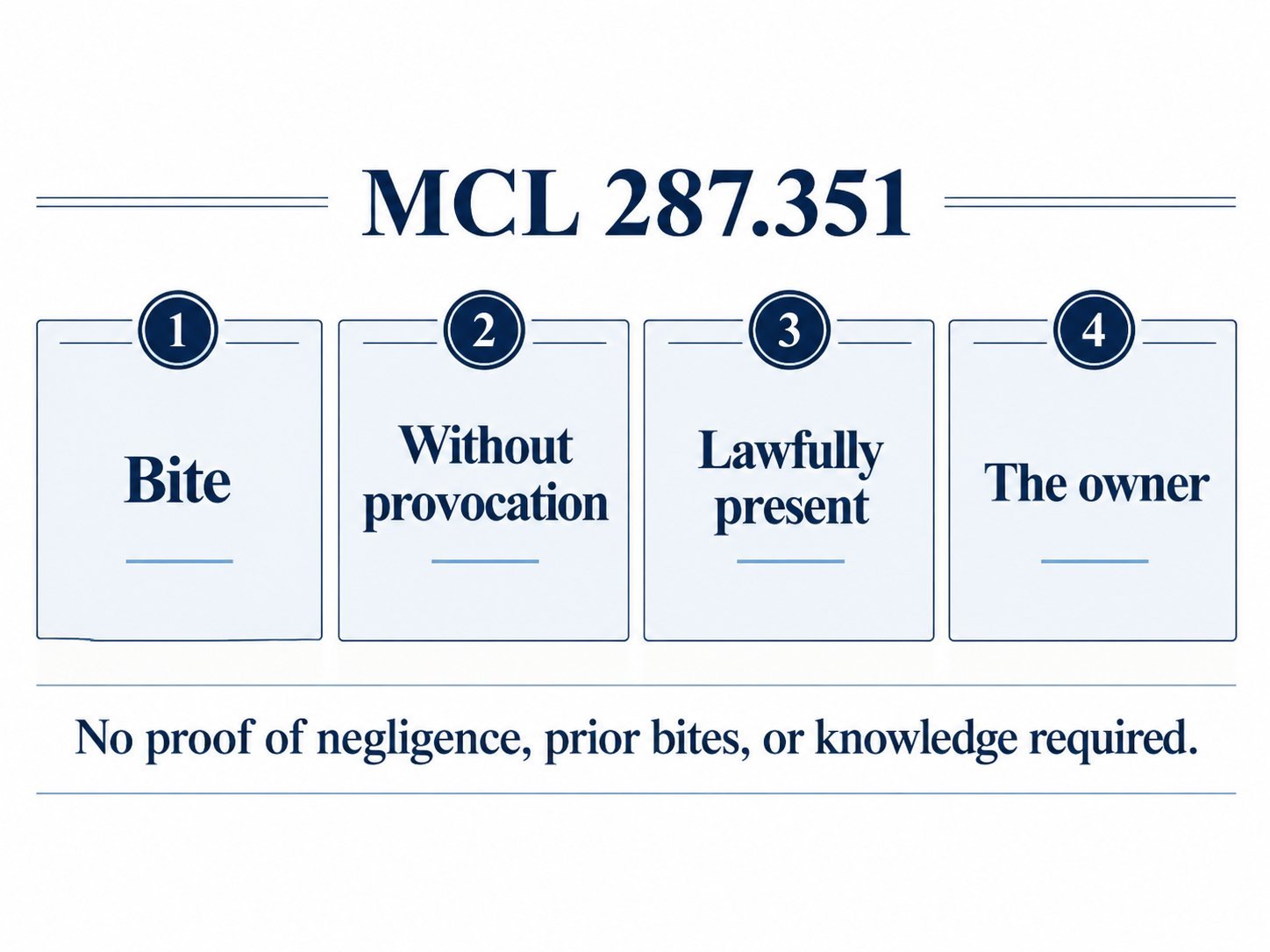
If a dog bites you in Michigan, you usually do not have to prove that the owner did anything wrong. The statute asks four questions. Did the dog bite you? Did you provoke it? Were you somewhere you had a right to be? Is the person you are suing the dog’s owner? If the answers are yes, no, yes and yes, the owner is liable for the harm the bite caused. The Michigan Supreme Court has called this “an almost absolute liability.”
What you do not have to prove is just as important. You do not have to show that the dog had bitten anyone before, that the owner knew it was aggressive, that the owner was careless about a leash or a gate, or that you were careful yourself. The owner cannot reduce what it owes by arguing that you, or a parent watching you, should have been more careful. The owner’s one defense is that you provoked the dog, and provocation does not require that you meant to.
The statute has limits. It covers bites only; a dog that knocks you down or chases you into traffic is handled by the common-law claims in Chapter 8. It reaches only the dog’s owner; a landlord, a dog-sitter or an employer is reached, if at all, through the claims in Chapter 5 and Chapter 9. And it does not apply to a city, county or police department at all, because governmental immunity bars it (Chapter 10).
The text
(1) “If a dog bites a person, without provocation while the person is on public property, or lawfully on private property, including the property of the owner of the dog, the owner of the dog shall be liable for any damages suffered by the person bitten, regardless of the former viciousness of the dog or the owner’s knowledge of such viciousness.”
(2) “A person is lawfully on the private property of the owner of the dog within the meaning of this act if the person is on the owner’s property in the performance of any duty imposed upon him or her by the laws of this state or by the laws or postal regulations of the United States, or if the person is on the owner’s property as an invitee or licensee of the person lawfully in possession of the property unless said person has gained lawful entry upon the premises for the purpose of an unlawful or criminal act.”
Two companion provisions matter. MCL 287.288, part of the Dog Law of 1919, preserves the common-law right of action, so the statute adds a claim rather than replacing one. And the Dog Law’s definition of “owner,” MCL 287.261, which includes anyone who harbors or keeps a dog, is confined to that act and does not apply to § 287.351 (see the owner element below).
Analysis
The nature of the liability
The Supreme Court’s only construction of the 1939 act is Nicholes v. Lorenz, 396 Mich. 53 (1976). A seven-year-old, pushed from behind, stepped on the tail of a chained dog and was bitten on the nose. The owner was sued under the statute alone, and the plaintiff spent much of the trial on neighbors’ accounts of the dog’s past behavior. The Court held that evidence irrelevant, because the statute “creates an almost absolute liability. However, the legislature excepted the consequences which might reasonably result from provoking an animal.” 396 Mich. at 59–60. On the facts, “the only facts necessary to sustain plaintiff’s case are (1) that the dog bit the girl (agreed) and (2) the biting was ‘without provocation.'” Id. at 60. “Nothing else had to be proved and nothing else was relevant—not his prior gentleness or roughness nor the sensitivities of his breed.” Id.
The Court of Appeals has described the same rule from two directions. In Tate v. City of Grand Rapids, 256 Mich. App. 656, 660–661 (2003), it explained that the statute “does not itself establish liability for dog bites; rather, it merely replaces the negligence standard applicable to the existing common law tort (liability imposed regarding an animal known to be vicious) with a strict liability standard (liability imposed regardless of such knowledge).” In Hill v. Sacka, 256 Mich. App. 443 (2003), it went further and called the liability “absolute,” distinguishing Michigan’s “strict liability” for defective products, which still turns on conduct, from the liability of one who keeps a dangerous animal: “In a dog-bite case brought pursuant to M.C.L. § 287.351, there is no ‘conduct’ that gives rise to liability. The dog owner need not do anything for there to be liability; the owner simply owns a dog that bites another person.” Id. at 455.
The statute and the common law coexist. The 1939 Legislature “retained the common law remedy but in addition enacted the statute,” Nicholes, 396 Mich. at 59, and a plaintiff may plead a statutory count and common-law counts in the alternative. Id. at 59 & n.2; Hiner v. Mojica, 271 Mich. App. 604 (2006). The two kinds of count carry different rules on fault and on evidence, which is why they must be pleaded and instructed separately (below).
The four elements
Read against its text, the statute requires a bite, the absence of provocation, the victim’s lawful presence, and a defendant who is the owner. Each element has its own chapter; this section states the rule and the leading authority.
A bite
The statute is triggered by a bite and nothing else. In Hiner v. Mojica, a cable technician who ruptured his Achilles tendon fleeing a dog that never touched him had his statutory count dismissed on the pleadings and did not appeal that ruling; his case proceeded in negligence. 271 Mich. App. at 608 n.2. No published decision construes the word “bite,” but the unpublished opinions treat it as an element the plaintiff must prove and the jury may reject. In Danison v. Velazquez (Mich. Ct. App. 1996) (unpublished), the panel observed that the statute “clearly provides that a ‘bite’ is required” and upheld a defense verdict on the theory that the dog made contact without biting. Whether a bite occurred, and which dog did it, is routinely resolved on circumstantial evidence: a victim’s contemporaneous statement, treating records, wound characteristics and the dog’s proximity have been enough to reach a jury even against eyewitness denials, Balcom v. Anderson (2021) (unpublished); Goodyke v. Wolfe (2004) (unpublished), while a physician’s “dog bite” diagnosis based only on the patient’s history does not establish the element conclusively, Knapp v. Card (2004) (unpublished). Whether a scratch from a dog’s teeth is a “bite” has not been decided; in Knapp both sides conceded that a scratch was not actionable, so the point was never ruled on.
Without provocation
Provocation is the statute’s one exception, and the cases call it the only defense. “It is our opinion that under the present statute ‘provocation’ is the only defense in this type of case. Contributory negligence is not a defense, except as the negligence might bear on provocation.” Nicholes v. Lorenz, 49 Mich. App. 86, 88 (1973), aff’d, 396 Mich. 53 (1976); accord Thelen v. Thelen, 174 Mich. App. 380, 386 (1989); Bradacs v. Jiacobone, 244 Mich. App. 263, 265 n.3 (2001); Koivisto v. Davis, 277 Mich. App. 492, 496 (2008). Provocation turns on the act and the dog’s reasonably expected response, not on what the victim intended: “The intent of the victim is immaterial.” Brans v. Extrom, 266 Mich. App. 216, 219 (2005). A dog already attacking cannot be provoked by the victim’s response to the attack. Koivisto, 277 Mich. App. at 499. The full treatment, including proportionality, children, and the different definition that governs dangerous-animal proceedings, is in Chapter 3.
One point the published decisions leave open is who bears the burden. Nicholes lists “without provocation” among “the only facts necessary to sustain plaintiff’s case,” 396 Mich. at 60, while the Court of Appeals consistently calls provocation a “defense.” None of the decisions in this compendium squarely allocates the burden of proof, and the standard civil jury instruction on the statute does not define the term. Bradacs, 244 Mich. App. at 266 n.5. In practice defendants plead provocation as an affirmative defense; a defendant who pleads it without evidence risks sanctions. Wilkinson v. Merrill (2002) (unpublished) (directed verdict on liability; fees under MCL 600.2591).
Lawful presence
The victim must have been on public property or “lawfully on private property, including the property of the owner of the dog.” Subsection (2) defines lawful presence on the owner’s property as performing a legal duty (a mail carrier, a meter reader), or being an invitee or licensee of the person in possession, unless the person entered to commit a crime. The Court of Appeals reads “licensee” to include implied licensees, so a person who walks up the ordinary route to a front door is covered. Cox v. Hayes, 34 Mich. App. 527 (1971); Alvin v. Simpson, 195 Mich. App. 418 (1992); Kelsey v. Lint, 322 Mich. App. 364 (2017). A trespasser is not. The unpublished decisions assess presence at the exact spot of the bite: a guest who enters a garage he was told to stay out of, or reaches over a fence into the yard where the dog is confined, is a trespasser as to that place. See Chapter 4.
The owner
The statute imposes liability on “the owner of the dog” and does not define the term. The Dog Law of 1919 defines “owner” broadly, to include a person who harbors or keeps a dog, but that definition is expressly limited to “this act” and does not carry over to § 287.351, which was enacted separately in 1939. Trager v. Thor, 199 Mich. App. 223 (1993), aff’d in part and rev’d in part on other grounds, 445 Mich. 95 (1994); Szkodzinski v. Griffin, 171 Mich. App. 711 (1988) (landlord not an “owner”). The unpublished decisions apply the point uniformly to dog-sitters, house-sitters and employers who have care and control but not ownership. Adams v. Wooldridge (2013) (unpublished); Fitzpatrick v. Bridgestone Retail Operations, LLC (2019) (unpublished). Those defendants are reached, if at all, through common-law strict liability (which runs against a possessor with knowledge of the dog’s dangerous propensity) or negligence. See Chapter 5.
What the plaintiff does not have to prove
Viciousness or the owner’s knowledge of it. The statute says so in terms, and Nicholes holds that evidence on either point is irrelevant to liability and, in a purely statutory action, inadmissible: “nothing in the dog’s or the owner’s history has any bearing upon the facts of the present injury.” 396 Mich. at 61. Michigan has no “one-bite rule,” and did not have one before the statute either; at common law the owner’s knowledge of a dog’s temper could be shown without a prior bite. Slater v. Sorge, 166 Mich. 173 (1911); Massengile v. Piper, 294 Mich. 653, 660 (1940) (Wiest, J., concurring) (“Knowledge of viciousness of a dog does not necessarily await a first bite.”).
Negligence. “Whether defendants exercised reasonable care is irrelevant in establishing liability under the dog-bite statute because liability is absolute absent provocation.” Hill v. Sacka, 256 Mich. App. at 459. Jury instructions that inject reasonable care, “greater vigilance around children,” or damages “that resulted from the conduct of defendants” are error (harmless in Hill because the verdict showed the jury found liability regardless). Id.
Restraint. Nothing in the statute turns on whether the dog was leashed, chained or fenced. The dog in Nicholes was chained; the dog in Hill was chained; liability followed. Restraint matters in negligence and under the leash law, MCL 287.262 (Chapter 7), not here.
The plaintiff’s own care. Contributory negligence was never a defense to the statutory claim, Nicholes, 49 Mich. App. at 88; Veal v. Spencer, 53 Mich. App. 560, 566 (1974), and comparative fault is not either (next section).
Fault, allocation and damages under the statute
Hill v. Sacka is the controlling decision. A two-year-old was mauled by a chained German shepherd during a social visit; the jury found for the child but also found the father 75 percent negligent, and the owners asked that the award be reduced. The Court of Appeals held that neither the comparative-fault statute, MCL 600.2957, nor the allocation statute, MCL 600.6304, applies to a claim under § 287.351: “the dog-bite statute does not allow for consideration of any comparative negligence on the part of the dog-bite victim, excluding possibly where the negligence may relate to the defense of provocation,” and “the fault or negligence of a third person, i.e., not the dog owner or the direct victim of the dog bite, is likewise not relevant.” 256 Mich. App. at 451–452. Liability “extends to ‘any’ damages incurred by the plaintiff, which by definition includes all damages suffered.” Id. at 451. The court reasoned that the allocation statutes require “an action predicated on concepts of fault,” which a dog-bite action is not, and that the “strict liability” language the Legislature added to § 6304(8) in 1995 came from products liability and was not meant to reach the absolute liability historically imposed on those who keep dangerous animals. Id. at 454–457.
The result is a sharp line between the two kinds of count. On the statutory count the owner pays all of the victim’s damages or none. On a common-law negligence count, comparative negligence applies in the ordinary way. Hill v. Hoig, 258 Mich. App. 538 (2003); Rickrode v. Wistinghausen, 128 Mich. App. 240 (1983). Where both are pleaded, the jury must be instructed separately. Veal, 53 Mich. App. at 566. See Chapter 11.
Damages under the statute are compensatory. The act allows “such damages as may be suffered by the person bitten” and “does not provide for punitive damages,” so the dog’s or owner’s history is irrelevant to damages as well as liability. Nicholes, 396 Mich. at 61–63 (distinguishing Swift v. Applebone, 23 Mich. 252 (1871), decided under the 1850 double-damages act). A jury that awards medical expenses is not required to award noneconomic damages, and a trial court may exclude the dog’s breed under MRE 403 while admitting its size and the details of the attack. Taylor v. Mobley, 279 Mich. App. 309, 314–316 (2008) (zero noneconomic award upheld; exclusion of “pit bull” within the court’s discretion, over a dissent). See Chapter 12.
Who the statute reaches, and who it does not
Family members. A child bitten by a parent’s or stepparent’s dog may sue under the statute; parental immunity bars the child’s common-law negligence counts but not the statutory claim. Thelen v. Thelen, 174 Mich. App. 380, 385–387 (1989). Spikes v. Banks, 231 Mich. App. 341, 352–353 (1998), restates the holding.
Governmental agencies. The statute does not abrogate governmental immunity. A statutory dog-bite claim is “tort liability” within MCL 691.1407(1), so a city, county or police department is immune for its police and animal-control dogs unless a GTLA exception applies. Tate, 256 Mich. App. at 660–661; see In re Bradley Estate, 494 Mich. 367, 380–385 (2013) (adopting a definition of “tort liability” that confirms the result). Individual officers and handlers are analyzed under the gross-negligence and intentional-tort rules of Chapter 10.
Landlords, employers and other non-owners. Outside the statute entirely. Szkodzinski, 171 Mich. App. 711. An owner’s statutory liability does not preclude a separate negligence claim against a non-owner for the same bite; in Ball v. Fourment (2017) (unpublished), the Court of Appeals allowed a negligence claim against the employer of two dog owners who brought the dog to work, holding that Hill v. Sacka “did not address an employer’s vicarious liability under a negligence theory.” One unpublished panel has read Hill the other way, holding that because the owner is liable for all of the victim’s damages a non-owner premises possessor cannot be liable for any of them, Michalek v. Estate of Malik (2022) (unpublished); that reading is not binding, is broader than anything Hill decided, and sits uneasily with the published landlord cases in Chapter 9.
Where the statute came from
Michigan’s first dog statute, 1850 PA 161, made the “owner or keeper” of a dog liable in double damages when the dog would “assault or bite or otherwise injure” a person on the highway or outside the owner’s enclosure, without proof of scienter. The Legislature repealed it in 1929, and for a decade dog-bite claims were governed by the common law alone, with its requirement that the owner knew the dog was dangerous. Bejger v. Zawadzki, 252 Mich. 14, 18–19 (1930); Grummel v. Decker, 294 Mich. 71 (1940). The 1939 act restored no-fault liability but narrowed it in three ways that still matter: it reaches the “owner” rather than the “owner or keeper,” covers a “bite” rather than any injury, and allows compensatory rather than double damages. Decisions under the 1850 act must be read with those differences in mind. Chapter 1 traces the three eras.
For lawyers
Practice points
- Plead the statutory count and the common-law counts separately, and request separate instructions on fault; the statutory count admits no comparative fault, the negligence count does. Veal; Hill v. Sacka; Hill v. Hoig.
- In a purely statutory action, move in limine to exclude the dog’s history and breed on liability. Nicholes; Taylor v. Mobley. If common-law counts are joined, that evidence comes in on scienter, which is a reason to think carefully before joining them.
- Where the bite, presence and ownership are undisputed and the provocation defense has no evidentiary support, move for summary disposition on liability under MCR 2.116(I)(2). Koivisto, 277 Mich. App. at 499; Radick v. Rouse (2021) (unpublished).
- Resist any “notice of at-fault nondefendant” naming a parent or supervising adult; third-party fault is irrelevant on the statutory count. Hill v. Sacka, 256 Mich. App. at 451–452.
- Do not draft a conditional verdict form for noneconomic damages (“If you find…”); it was the plaintiff’s own form that let the zero award stand in Taylor.
- Identify the owner early. Where the dog belonged to someone other than the person in control at the time, the statutory count runs against the owner and a negligence count against the person in control. Trager; Ball.
- Against a governmental defendant, plead in avoidance of immunity from the outset (proprietary function; gross negligence of the individual handler); the statutory count alone will be dismissed. Tate.
Authorities
Published decisions
| Case | Court / year | Point |
|---|---|---|
| Nicholes v. Lorenz, 396 Mich. 53 | Mich. 1976 | “Almost absolute liability”; elements; prior behavior and breed irrelevant to liability and damages; compensatory damages only. |
| Nicholes v. Lorenz, 49 Mich. App. 86 | Ct. App. 1973 | Provocation the only defense; contributory negligence not a defense except as it bears on provocation. |
| Hill v. Sacka, 256 Mich. App. 443 | Ct. App. 2003 | No comparative fault, no allocation to nonparties, “any damages”; reasonable-care instructions improper. |
| Hill v. Hoig, 258 Mich. App. 538 | Ct. App. 2003 | Comparative negligence applies to the common-law negligence count. |
| Tate v. City of Grand Rapids, 256 Mich. App. 656 | Ct. App. 2003 | Statutory claim is “tort liability”; governmental immunity applies; statute replaces the negligence standard with strict liability. |
| Bradacs v. Jiacobone, 244 Mich. App. 263 | Ct. App. 2001 | Provocation requires an act directed at the dog or a proportional response; insufficient evidence taken from the jury. |
| Brans v. Extrom, 266 Mich. App. 216 | Ct. App. 2005 | Victim’s intent immaterial; unintentional acts can provoke; generally a jury question. |
| Koivisto v. Davis, 277 Mich. App. 492 | Ct. App. 2008 | An attacking dog cannot be provoked; no duty to retreat; summary disposition for plaintiff on liability. |
| Thelen v. Thelen, 174 Mich. App. 380 | Ct. App. 1989 | Parental immunity does not bar the child’s statutory claim. |
| Veal v. Spencer, 53 Mich. App. 560 | Ct. App. 1974 | Statutory and common-law counts carry different fault rules and need separate instructions. |
| Taylor v. Mobley, 279 Mich. App. 309 | Ct. App. 2008 | Zero noneconomic award upheld; breed excluded under MRE 403. |
| Trager v. Thor, 199 Mich. App. 223, aff’d in part, rev’d in part, 445 Mich. 95 | Ct. App. 1993 / Mich. 1994 | Dog Law definition of “owner” does not apply to § 287.351; temporary caretaker not an owner or keeper but may be negligent. |
| Szkodzinski v. Griffin, 171 Mich. App. 711 | Ct. App. 1988 | Landlord is not an “owner” under the statute. |
| Hiner v. Mojica, 271 Mich. App. 604 | Ct. App. 2006 | No bite, no statutory claim; negligence available for flight injuries. |
| Kelsey v. Lint, 322 Mich. App. 364 | Ct. App. 2017 | Implied license to approach a residence; trespassers outside the statute. |
| Bejger v. Zawadzki, 252 Mich. 14 | Mich. 1930 | Effect of the 1929 repeal; scienter again required at common law. |
Unpublished Court of Appeals and federal decisions
Unpublished opinions are not binding precedent under MCR 7.215(C)(1). They are listed because they are the only authority on several recurring questions.
| Case | Year | Point |
|---|---|---|
| Danison v. Velazquez, 1996 WL 33348816 | 1996 | A “bite” is required; no-bite theory properly submitted to the jury. |
| Cull v. Nielsen, 2000 WL 33534002 | 2000 | Whether a bite occurred is a jury question; owner’s out-of-court admission can be neutralized at trial. |
| Goodyke v. Wolfe, 2004 WL 316425 | 2004 | Identification of the biting dog is a jury question on circumstantial evidence. |
| Knapp v. Card, 2004 WL 1621711 | 2004 | Defenses attacking the prima facie case need not be pleaded as affirmative defenses; physician’s history-based diagnosis not conclusive of a bite. |
| Balcom v. Anderson, 2021 WL 4395294 | 2021 | Conflicting evidence on whether the dog bit the decedent precludes summary disposition. |
| Wilkinson v. Merrill, 2002 WL 31930791 | 2002 | Directed verdict on liability; fees under MCL 600.2591 for a provocation defense pleaded without evidence. |
| Radick v. Rouse, 2021 WL 219221 | 2021 | Provocation is victim-focused; summary disposition for plaintiff on liability. |
| Adams v. Wooldridge, 2013 WL 1748586 | 2013 | Dog-sitters are not “owners”; Dog Law definition inapplicable. |
| Fitzpatrick v. Bridgestone Retail Operations, 2019 WL 4866127; 444 F. Supp. 3d 786 (E.D. Mich. 2020) | 2019–20 | Business that kept a dog on its premises not the statutory “owner.” |
| Ball v. Fourment, 2017 WL 694683 | 2017 | Statute did not displace common-law negligence; employer may be vicariously liable alongside owner’s statutory liability. |
| Michalek v. Estate of Malik, 2022 WL 128109 | 2022 | Read Hill v. Sacka to bar a premises claim against a non-owner possessor; an outlier not followed in any published decision. |
Open questions
- Who bears the burden of proof on provocation.
- Whether provocation by a third person, rather than the victim, is a defense (left open in Radick).
- Whether a scratch or a tooth graze without a puncture is a “bite.”
- Whether an owner’s statutory liability limits common-law claims against non-owners for the same bite (Ball and Michalek point in opposite directions; neither is binding).
Common questions
The dog had never bitten anyone. Does that matter?
Not under the statute. The owner is liable “regardless of the former viciousness of the dog or the owner’s knowledge of such viciousness,” and evidence of the dog’s good history is not admissible on liability.
I was bitten at a friend’s house. Can I really make a claim?
Yes. The statute expressly covers bites on “the property of the owner of the dog” when you are there as a guest. In most cases the claim is paid by the owner’s homeowners or renters insurer, not by your friend.
The owner says I provoked the dog. What does that mean?
Provocation is the owner’s only defense. It can include an unintentional act, but the act has to be one that would cause a normal dog to react the way this one did, and a dog that is already attacking cannot be “provoked” by your efforts to defend yourself. See Chapter 3.
I was bitten by a police dog. Does the statute apply?
Not against the city or department; governmental immunity bars the statutory claim. Claims against the individual handler are possible in limited circumstances. See Chapter 10.
Bitten by a dog in Michigan?
JKH Law handles dog-bite claims in Grand Rapids, across West Michigan and statewide. Consultations are free.

Personal injury litigation for Grand Rapids and West Michigan.
312 Fulton Street EastGrand Rapids, MI 49503 (616) 226-3762
Fax (616) 988-6504
Free consultation