
Chapter 5 · The right defendant
Who Is Liable: Owners, Keepers and Caretakers
The dog-bite statute reaches the dog’s owner. The common law reaches further: a keeper who exercises an owner’s control over the dog, anyone who undertakes to care for it and does so carelessly, and the employer of those people. This chapter explains who fits each category, how ownership is proved, and which claim runs against which defendant.
In plain terms
Who can be held responsible
The person who owns the dog is liable under the statute for an unprovoked bite, without any proof of fault. That is the main claim in nearly every case, and it is paid, in most cases, by the owner’s homeowners or renters insurer. Ownership is a question of fact: whose dog it is, who acquired it, who licenses it, takes it to the vet and makes decisions about it. A husband and wife, or parents and an adult child in the same household, can all be owners.
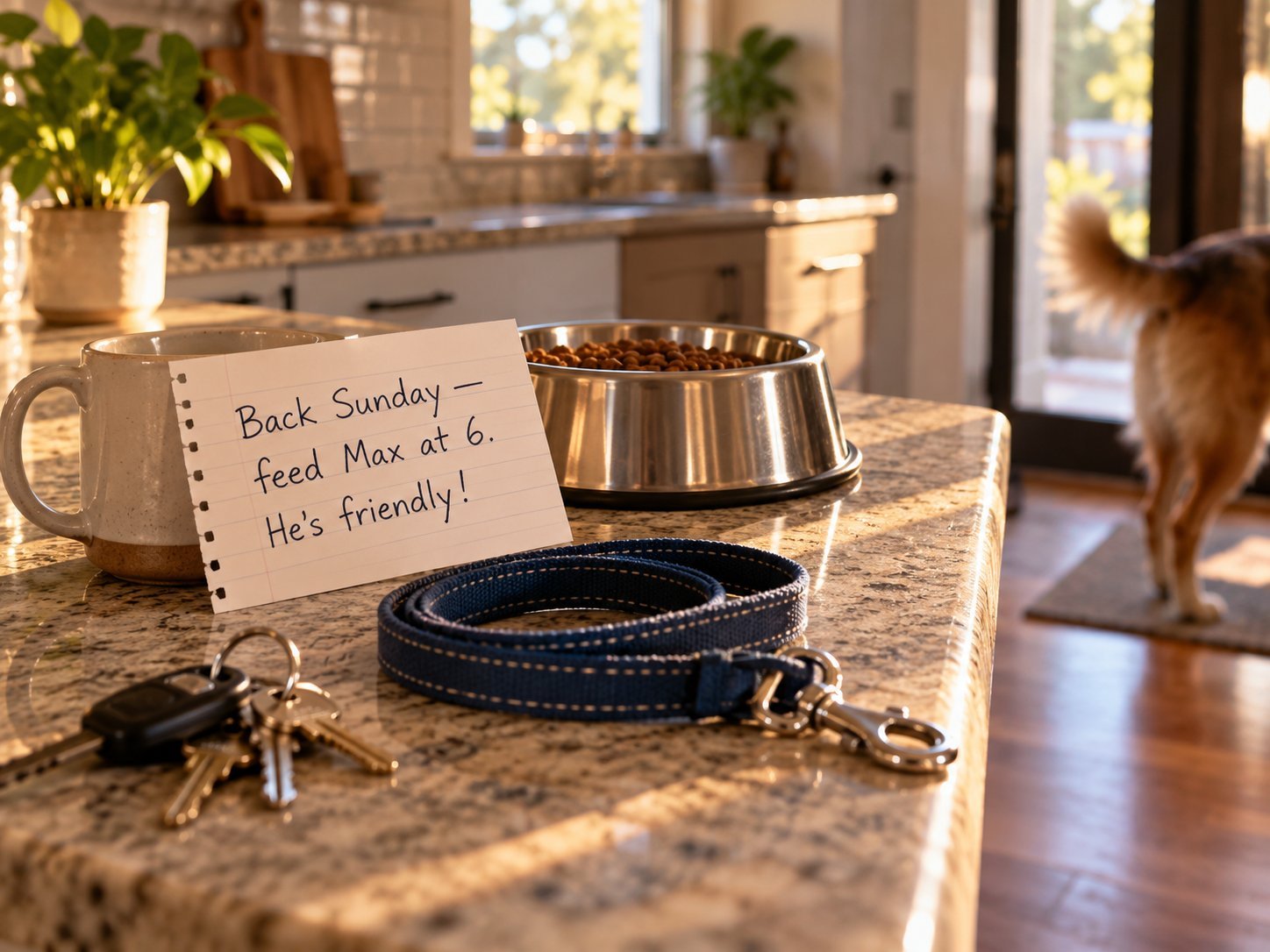
Other people can be responsible too, under different rules. A dog-sitter, a house-sitter, a boarding kennel, a roommate or a relative who had the dog in their care when it bit someone is not the “owner” under the statute, but Michigan law holds anyone who takes on the care of a dog to a duty of ordinary care. If the sitter let a dog with a known history off the leash, or left a door open, the sitter can be liable for negligence, and the owner can be liable for the sitter’s negligence as well. A business whose employees brought a dog to work can be liable for the employees’ carelessness. A former owner who gave the dog away is not liable for what it does later.
Two groups are handled in their own chapters. Landlords are never “owners” of a tenant’s dog and are reached only through premises and negligence law (Chapter 9). Cities, counties and police departments are immune from the statutory claim for their police and animal-control dogs (Chapter 10).
Analysis
“Owner” under the statute
MCL 287.351 imposes liability on “the owner of the dog” and does not define the term. Michigan has another dog statute that does. The Dog Law of 1919 defines “owner” to include “every person who keeps or harbors the dog or has it in his care, and every person who permits the dog to remain on or about any premises occupied by him.” MCL 287.261. That definition does not apply to the bite statute. The Dog Law says its definitions are “[f]or the purpose of this act,” the bite statute was enacted twenty years later as a separate act, and the Legislature’s choice to reach the “owner” alone in 1939, after repealing an 1850 statute that had reached the “owner or keeper,” is a deliberate narrowing: “a change in phraseology implies that a change in meaning was also intended.” Trager v. Thor, 199 Mich. App. 223, 230–231 (1993), aff’d in part and rev’d in part on other grounds, 445 Mich. 95 (1994). “By its own terms, the statute applies to the dog’s owner. … Because defendant was not the dog’s owner, he cannot be held liable under Michigan’s dog-bite statute.” Szkodzinski v. Griffin, 171 Mich. App. 711, 713–714 (1988).
The rule has been applied without exception to everyone short of an owner. A grandfather babysitting in his son’s home, who shut the family dog in a bedroom, was not an owner. Trager, 199 Mich. App. at 231. Neighbors “helping to look after the dog while its owners were away” were not owners: “The statute plainly refers to an ‘owner’—not a ‘keeper’ or ‘possessor’—and neither defendant owned the dog.” Adams v. Wooldridge (2013) (unpublished). A police handler who kept a department K-9 with him around the clock was not its owner: “We find nothing in the plain language of the statute that would support an interpretation that simply possessing, keeping, and taking care of a dog constitutes ownership for purposes of MCL 287.351(1).” Foster v. Szlaga (2016) (unpublished). A business that allowed a stranded customer to keep her dog in its store was not an owner. Fitzpatrick v. Bridgestone Retail Operations, LLC (E.D. Mich. 2019) (unpublished). A landlord is never an owner of a tenant’s dog. Szkodzinski, 171 Mich. App. at 713.
The word therefore carries its ordinary meaning: the dog belongs to the defendant. Ownership can be shared. In Thelen v. Thelen, 174 Mich. App. 380 (1989), a father and stepmother who had acquired a cocker spaniel that day were both sued as owners under the statute, and the claim proceeded against both. A dog acquired by a household is owned by the adults of that household who take it on, and the statutory claim should be pleaded against each of them.
Proving ownership
Ownership is a question of fact for the jury and can be proved circumstantially. The Supreme Court affirmed a verdict against a Detroit dog owner in 1904 on the ground that “there was evidence that the defendant at the time was the owner of the dog which bit and injured plaintiff” and declined to reweigh it. Mulvey v. Stevenson, 138 Mich. 63, 63–64 (1904). Where ownership of the biting dog is disputed, proximity, the defendant’s ownership of matching dogs, and animal-control testimony are enough to reach a jury even against the plaintiff’s own inconsistent prior identification. Goodyke v. Wolfe (2004) (unpublished).
Procedurally, a defendant’s sworn denial of ownership on a motion for summary disposition shifts the burden to the plaintiff to come forward with evidence of ownership; the plaintiff in Trager offered none and lost the statutory count on that basis. 199 Mich. App. at 231–233. The evidence that answers a denial is documentary: the dog license, the rabies certificate and veterinary records, the microchip registration, the animal-control bite report, the adoption or purchase paperwork, social-media posts, and the homeowners policy under which the dog is insured. A defendant’s statement after the bite that the dog is “mine” is useful but not decisive. A true statement of ownership, or a vague assurance that the speaker “assumed all the responsibility,” does not create liability by itself, Wetzel v. Bolster, 169 Mich. 43, 46–47 (1912), but a person who falsely claims ownership knowing the victim is asking in order to learn who is liable is estopped from denying it. Robb v. Shepard, 50 Mich. 189, 190 (1883).
Keepers and possessors at common law
Common-law strict liability does not stop at the owner. It attaches where “(1) one is the possessor of the animal, (2) one has scienter of the animal’s abnormal dangerous propensities, and (3) the harm results from the dangerous propensity that was known or should have been known.” Trager v. Thor, 445 Mich. 95, 99–100 (1994). A “possessor” is the owner or a keeper, and keeper status requires control of a particular kind: “It is this proprietary control, akin to ownership, that we hold must be present to deem a party a keeper, and potentially liable, under the common-law strict liability principle.” Id. at 101. Possession “cannot be fairly construed as anything short of the exercise of dominion and control similar to and in substitution for that which ordinarily would be exerted by the owner in possession.” Id. at 103.
The Supreme Court drew the line at the temporary caretaker. The grandfather in Trager had agreed to watch the house and children for an afternoon; the dog came with the house. “We conclude that the temporary supervisory responsibility of the defendant in the present case did not provide him with sufficient proprietary control to attain keeper status,” and “the temporary caretaker of a domestic animal is not the animal’s owner or keeper, as a matter of law.” Id. at 104, 107–108. The Court of Appeals had held the opposite, seeing “no distinction between a temporary custodian, caretaker, or baby-sitter of an animal and the animal’s keeper,” 199 Mich. App. at 235, and was reversed on that point.
The older cases the Court relied on show what proprietary control looks like. A man who took a dog home and “kept him there in such a way that it can be said that the dog really lived there,” and “undertook to control his actions,” was the keeper, while the owner who had lost the dog was not. Burnham v. Strother, 66 Mich. 519, 520–521 (1887). A bailee who had the owner’s dog at his place for six weeks was the keeper, and the absent owner was not. Wetzel, 169 Mich. at 44. A mother who owned and controlled the farm where her adult son and his dog lived was the dog’s keeper. Jenkinson v. Coggins, 123 Mich. 7, 8 (1900). A husband who occupied the home on weekends was the keeper of his wife’s bulldog. Slater v. Sorge, 166 Mich. 173, 176 (1911). “Possession, rather than ownership,” is the criterion, which cuts both ways: a former owner who had given the dog away, even knowing it had attacked a child, was not liable for its later attack, because “his lack of possession is dispositive.” Moore v. Jergovich (1996) (unpublished) (citing Trager, 445 Mich. at 104–105).
The practical result is that common-law strict liability runs against the owner and against anyone who has taken the dog into his own home, business or long-term custody and controls it as an owner would, provided that person knew of the dog’s dangerous propensity. It does not run against a babysitter, a neighbor feeding the dog for a weekend, or a landlord. For the knowledge element, see Chapter 6.
Anyone who undertakes to care for the dog
The same decision that protected the babysitter from strict liability opened a different door. The Supreme Court held that a negligence claim lies against “one in temporary possession of a domestic animal,” because “a negligence cause of action arises when there is ineffective control of an animal in a situation where it would reasonably be expected that injury could occur, and injury does proximately result from the negligence. The amount of control required is that which would be exercised by a reasonable person based upon the total situation at the time, including the past behavior of the animal and the injuries that could have been reasonably foreseen.” Trager, 445 Mich. at 106–108. The Court of Appeals had put the point more broadly, and that part of its opinion was affirmed: “a person who undertakes to care for an animal—even temporarily—must discharge that undertaking with ordinary care under the circumstances,” and “[t]here is no logical reason to limit negligence liability to owners or keepers of animals, and Michigan law does not support such a limitation.” 199 Mich. App. at 236, 238. The grandfather in Trager, who knew the dog had bitten a child before, faced a jury on whether shutting it in a bedroom with the door closed was reasonable control.
The claim depends on what the caretaker knew. Sitters who had no knowledge of any dangerous propensity and faced no obviously risky situation owed no duty of constant control, Adams (2013) (unpublished), and the owner’s warning to the victim did not supply the sitters’ knowledge. The claim also runs in the other direction: a house-sitter left in charge of the household is the owners’ agent in caring for the dog, and “any negligence that might be attributed to [the sitter] would be imputed to defendants under usual respondeat superior principles.” Young v. Esker (1998) (unpublished). The owner does not escape by pointing at the person minding the dog.
Employers. When employees of a dog-food store used their own German shepherd to demonstrate a collar to a customer and the dog bit her, the owners were liable under the statute and the store was vicariously liable for its employees’ negligence in the same trial. The Court of Appeals rejected the argument that the owners’ statutory liability foreclosed the negligence claim: the statute “did not supersede or extinguish common-law negligence claims related to dog bites,” and Hill v. Sacka “did not address an employer’s vicarious liability under a negligence theory.” Ball v. Fourment (2017) (unpublished). Because the employer’s liability was vicarious, there was no allocation of fault between it and the employees. Id.
Businesses on whose premises someone else’s dog bites. A store that let a customer bring her dog inside was not the owner, not a possessor, and, on the record there, not negligent; the claim against it sounded in premises liability. Fitzpatrick v. Bridgestone Retail Operations, LLC, 444 F. Supp. 3d 786, 799–801 (E.D. Mich. 2020). A business that takes a dog into its own custody, a kennel, groomer or trainer, is in a different position: it has undertaken the dog’s care and owes the Trager duty, and if it keeps the dog long enough to exercise an owner’s control, with knowledge of the dog’s propensities, it is a keeper.
Matching the claim to the defendant
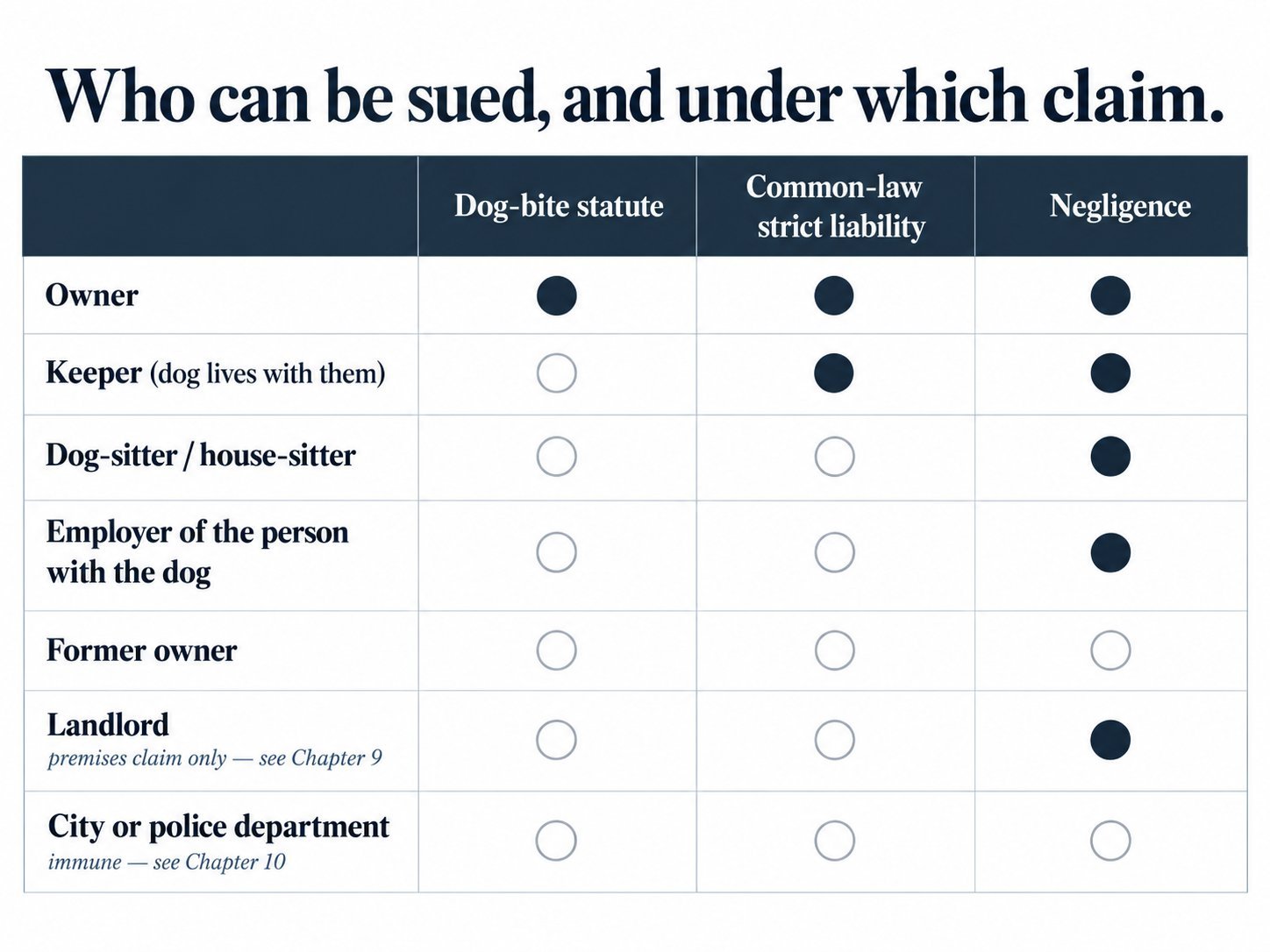
| Defendant | Dog-bite statute | Common-law strict liability | Negligence |
|---|---|---|---|
| Owner (including each adult in the household who owns the dog) | Yes. No proof of fault or knowledge. Nicholes; Thelen. | Yes, with knowledge of a dangerous propensity. Trager. | Yes. Trager; Hiner. |
| Keeper: the dog lives with and is controlled by a non-owner | No. Trager (COA); Adams. | Yes, with knowledge. Trager at 101–103; Burnham; Wetzel. | Yes. |
| Temporary caretaker: sitter, babysitter, neighbor, relative | No. Trager (COA); Adams; Foster. | No, as a matter of law. Trager at 107–108. | Yes, judged by what the caretaker knew and the situation. Trager at 106–108; Adams. |
| Owner, for the caretaker’s negligence | Yes (as owner). | Yes (as owner, with knowledge). | Yes; the caretaker’s negligence is imputed. Young. |
| Employer of the owner or caretaker | No. | No. | Yes, vicariously, for employees acting in the scope of employment. Ball. |
| Former owner who gave the dog away | No. | No; lack of possession is dispositive. Moore. | No duty to later victims. Moore. |
| Landlord of the dog’s owner | No. Szkodzinski. | No. Szkodzinski. | Premises liability or negligence on the terms in Chapter 9. |
| City, county, police or animal control | Barred by governmental immunity. Tate. | Barred. | Barred against the agency; individual employees on the terms in Chapter 10. |
For lawyers
Practice points
- Establish ownership with documents before the defendant is deposed: the animal-control report, license, rabies certificate, microchip registry, vet records, and the homeowners policy. A sworn denial of ownership shifts the burden to you on summary disposition. Trager, 199 Mich. App. at 231–233.
- Name every adult in the household who owns the dog, and plead the statutory count against each. Thelen.
- Where someone other than the owner had the dog at the time, plead the statute against the owner, negligence against the person in control, and negligence against the owner for the caretaker’s conduct. Trager; Young.
- Build the caretaker’s knowledge: what the owner told the sitter about the dog, written instructions, texts, prior incidents the sitter witnessed. Without it the negligence count fails. Adams.
- For a keeper theory, prove where the dog lived and who made decisions about it; length of custody and control of the premises decided Burnham, Wetzel and Jenkinson.
- If the owner was working when the bite happened, or brought the dog to work, name the employer and plead respondeat superior; resist any allocation of fault to the employer. Ball.
- Do not rely on a post-bite “it’s my dog.” Get it, but prove ownership independently. Wetzel; Robb.
- Do not sue a former owner; possession is dispositive. Moore. Do sue the current possessor if the dog had a known history when it changed hands.
Authorities
Published decisions
| Case | Court / year | Point |
|---|---|---|
| Trager v. Thor, 445 Mich. 95 | Mich. 1994 | Possessor = owner or keeper with proprietary control; temporary caretaker not a keeper as a matter of law; negligence lies against a temporary possessor. |
| Trager v. Thor, 199 Mich. App. 223 | Ct. App. 1993 | Dog Law definition of “owner” does not apply to § 287.351; denial of ownership shifts the burden; negligence not limited to owners or keepers (affirmed). |
| Szkodzinski v. Griffin, 171 Mich. App. 711 | Ct. App. 1988 | Statute applies to the owner; landlord who neither owns, keeps nor controls the dog is not liable under it. |
| Thelen v. Thelen, 174 Mich. App. 380 | Ct. App. 1989 | Statutory claim against father and stepmother as owners of a newly acquired dog. |
| Mulvey v. Stevenson, 138 Mich. 63 | Mich. 1904 | Ownership of the biting dog is a jury question on circumstantial evidence. |
| Burnham v. Strother, 66 Mich. 519 | Mich. 1887 | Keeper is the person with whom the dog “really lived” and who “undertook to control” it. |
| Wetzel v. Bolster, 169 Mich. 43 | Mich. 1912 | Bailee holding the dog for six weeks is the keeper; an owner’s post-incident assumption of responsibility creates no liability. |
| Jenkinson v. Coggins, 123 Mich. 7 | Mich. 1900 | Person who owned and controlled the premises where the dog lived is its keeper. |
| Slater v. Sorge, 166 Mich. 173 | Mich. 1911 | Head of the household can be the keeper of a family member’s dog. |
| Robb v. Shepard, 50 Mich. 189 | Mich. 1883 | Knowing misstatement of ownership relied on by the victim estops the speaker. |
| Fitzpatrick v. Bridgestone Retail Operations, 444 F. Supp. 3d 786 | E.D. Mich. 2020 | Store that admitted a customer’s dog was not its owner or possessor; claim against it sounded in premises liability. |
Unpublished Court of Appeals and federal decisions
Unpublished opinions are not binding precedent under MCR 7.215(C)(1).
| Case | Year | Point |
|---|---|---|
| Adams v. Wooldridge, 2013 WL 1748586 | 2013 | Neighbors minding the dog were not owners; no scienter and no negligence without knowledge of dangerousness. |
| Foster v. Szlaga, 2016 WL 805583 | 2016 | Possessing, keeping and caring for a department K-9 is not ownership under the statute. |
| Fitzpatrick v. Bridgestone Retail Operations, 2019 WL 4866127 | E.D. Mich. 2019 | Amendment to plead the store as a Dog Law “owner” denied. |
| Ball v. Fourment, 2017 WL 694683 | 2017 | Employer vicariously liable in negligence alongside the owners’ statutory liability; no allocation of fault. |
| Young v. Esker, 1998 WL 1991225 | 1998 | House-sitter’s negligence imputed to the owners as their agent. |
| Moore v. Jergovich, 1996 WL 33364395 | 1996 | Former owner who parted with possession not liable for a later attack. |
| Goodyke v. Wolfe, 2004 WL 316425 | 2004 | Identity of the biting dog and its owner is a jury question on circumstantial evidence. |
| Mayle v. Fuller, 1999 WL 33435336 | 1999 | Landowners who did not have temporary control of the dog owed no caretaker duty. |
| Graff v. City of Lincoln Park, 2026 WL 2137815 | E.D. Mich. 2026 | Plaintiff bears the burden of proving a K-9 handler is the “owner”; the city’s ownership controlled. |
Common questions
The dog belongs to my friend’s roommate. Who do I sue?
The roommate who owns the dog, under the statute. If your friend was in charge of the dog when it bit you, your friend can be liable for negligence as well, and the owner can be liable for your friend’s negligence.
I was bitten by a dog a sitter was walking.
The owner is liable under the statute. The sitter is liable if the sitter was careless given what the sitter knew about the dog and the situation, for example letting a dog with a history off leash near children.
The owner says it isn’t his dog.
Ownership is proved by evidence: the license, vet and microchip records, the animal-control report, and who has been keeping the dog. A denial is not the end of the question; a jury decides it.
The bite happened at a business where an employee had brought her dog.
The employee who owns the dog is liable under the statute, and the business can be liable for the employee’s negligence if bringing or handling the dog was part of her work.
Does it matter whether the dog is licensed or registered to someone?
Those records are strong evidence of ownership, but ownership is decided on all the facts: who acquired the dog, where it lives, and who controls it.
Not sure who is responsible for the dog?
Identifying the right defendants, and the insurance behind them, is the first thing JKH Law does in a dog-bite case. Consultations are free, in Grand Rapids and statewide.
This page is part of the Michigan Dog Bite Law Compendium published by JKH Law, PLC. It is legal information about Michigan law, not legal advice about any particular situation, and reading it does not create an attorney-client relationship. Citations were last checked in October 2026. Unpublished opinions are identified as such and are not binding under MCR 7.215(C)(1).

Personal injury litigation for Grand Rapids and West Michigan.
312 Fulton Street EastGrand Rapids, MI 49503 (616) 226-3762
Fax (616) 988-6504
Free consultation