
Chapter 4 · Where the bite happened
Lawful Presence
The dog-bite statute protects a person bitten on public property or “lawfully on private property,” and it defines that phrase to include guests, invitees, people doing their jobs, and anyone the possessor has let in, expressly or by custom. This chapter explains who is lawfully present, who grants the permission, how far an implied license reaches, and what a trespasser can still claim.
In plain terms
Who the statute protects
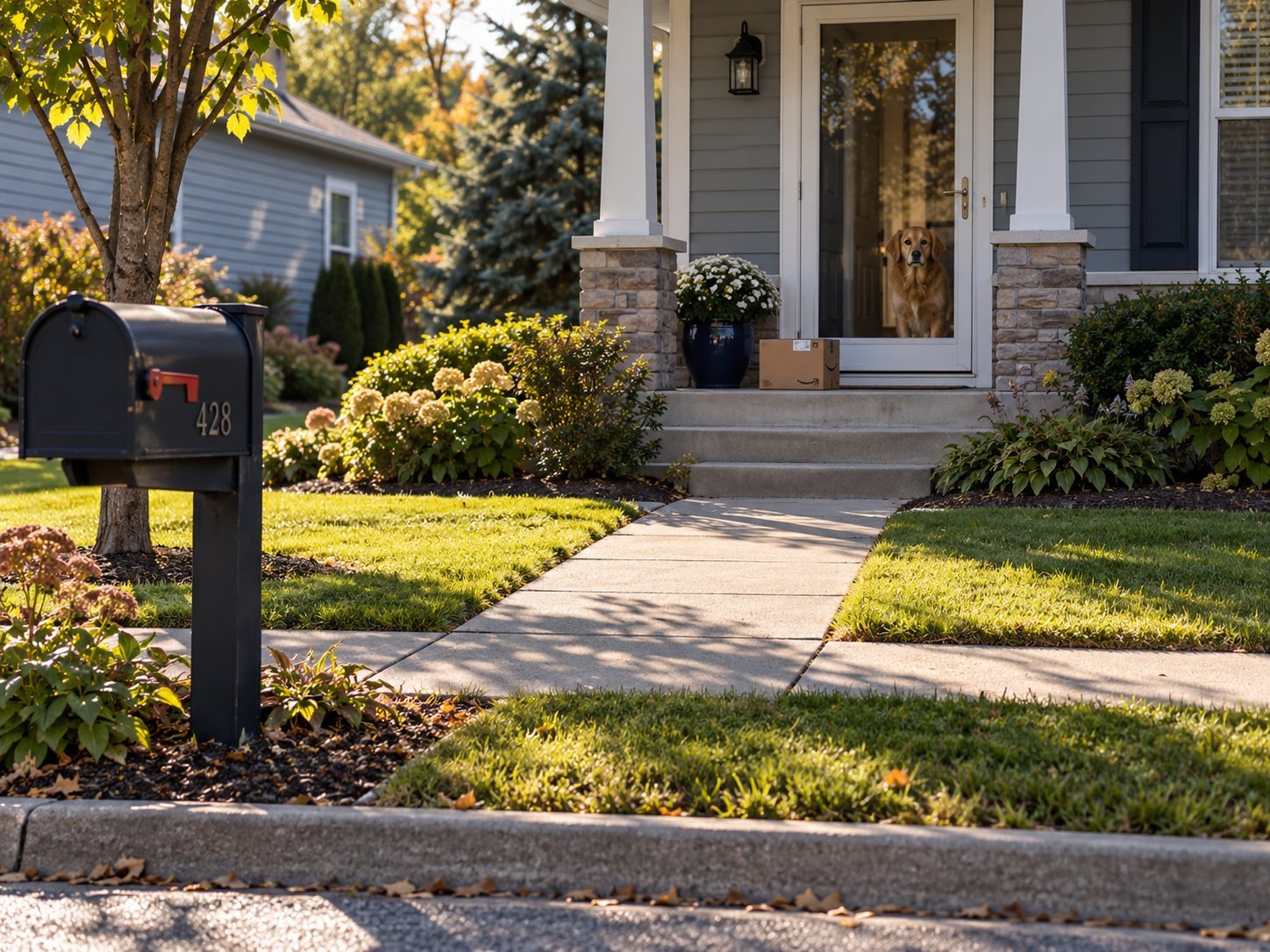
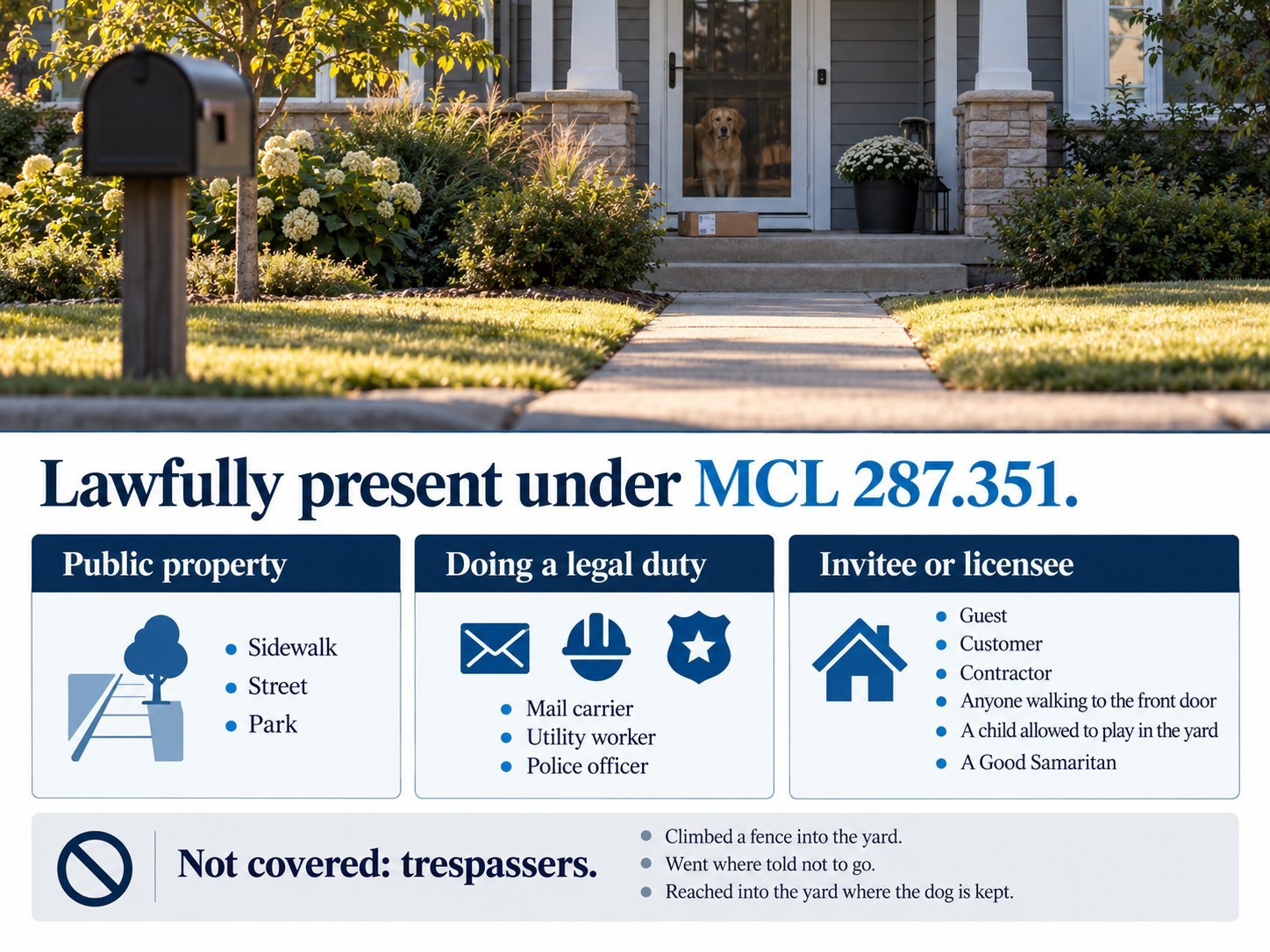
If you were bitten on a sidewalk, a street, a park or any other public place, this element is satisfied. If you were bitten on private property, including the dog owner’s own property, the statute protects you if you had a right to be there. You had a right to be there if you were invited, if you were a guest, if you were doing a job that brought you there (a mail carrier, a meter reader, a delivery driver, a contractor, a police officer), or if the person in charge of the property let you in or let people like you come and go. You do not need a written invitation. Walking up a driveway and a front walk to knock on a door is something Michigan law lets anyone do, and a person bitten while doing it is lawfully present.
The permission does not have to come from the owner of the house. A tenant, a family member, or a teenager home alone can let you in. A child who is allowed to play in a neighbor’s yard is lawfully there. And a person who runs onto property to warn of a fire or help in an emergency is lawfully there too.
The statute does not protect a trespasser, and the courts look at exactly where the bite happened. A worker told to stay out of the garage who walks into the garage, or a neighbor who reaches over a fence into the yard where the dog is kept, is treated as a trespasser at that spot. Someone in that position can still bring a common-law claim, which is explained at the end of this chapter.
The text
“If a dog bites a person, without provocation while the person is on public property, or lawfully on private property, including the property of the owner of the dog, the owner of the dog shall be liable …”
“A person is lawfully on the private property of the owner of the dog within the meaning of this act if the person is on the owner’s property in the performance of any duty imposed upon him or her by the laws of this state or by the laws or postal regulations of the United States, or if the person is on the owner’s property as an invitee or licensee of the person lawfully in possession of the property unless said person has gained lawful entry upon the premises for the purpose of an unlawful or criminal act.”
Subsection (2) was added by 1988 PA 142. It does three things. It confirms that people performing a legal duty are covered. It borrows the common-law entrant categories, invitee and licensee, to define everyone else who is lawfully present, and it ties the permission to “the person lawfully in possession of the property,” not the title holder. And it carves out the person who gets in lawfully but for a criminal purpose. Public property needs no definition: a person on a sidewalk or street is covered without more. Nicholes v. Lorenz, 49 Mich. App. 86, 88 (1973) (statute applies “irrespective of the place where the dog bites a person”), aff’d, 396 Mich. 53 (1976).
Analysis
Invitees, licensees, and the implied license
The Court of Appeals reads subsection (2) through the common-law categories it names. An invitee is on the land for the possessor’s commercial benefit; a licensee is there with the possessor’s consent, express or implied; a trespasser is there without consent. “[I]nvitees and licensees are ‘lawfully’ on the property, but a trespasser cannot maintain a statutory dog-bite claim.” Kelsey v. Lint, 322 Mich. App. 364, 371 (2017). Three rules decide most cases.
Implied licensees are covered. The statute does not use the words “express” or “implied,” and the court refused to read them in: “it would be a contortion of the plain meaning of this statute to exclude the subclass of implied invitees and licensees from their generic group. Rather, the plain meaning and application of the statute requires plaintiff to prove that she was either an invitee or licensee, expressed or implied.” Cox v. Hayes, 34 Mich. App. 527, 531 (1971); accord Alvin v. Simpson, 195 Mich. App. 418, 420 (1992). “Permission may be implied where the owner acquiesces in the known, customary use of property by the public.” Alvin, 195 Mich. App. at 420; Kelsey, 322 Mich. App. at 371. Silence and tolerance are enough to create a license; “[t]he infancy of the party injured does not change the situation.” Cox, 34 Mich. App. at 532.
Anyone may approach a house by the ordinary route. In Kelsey, a woman who had attended a garage sale returned the next evening, after the sale ended, to ask about an item; as she got out of her car in the open driveway the dog came from behind the house and bit her. The trial court held her a trespasser as a matter of law. The Court of Appeals reversed: “as a general proposition, the established customs in Michigan grant anyone, including Kelsey, an implied license to approach a house and knock on the front door.” 322 Mich. App. at 373. A small “no soliciting” sign on the garage did not revoke it: “‘[n]o soliciting’ is not synonymous with ‘no trespassing’ or ‘do not enter,'” and whether a sign revokes the license “depends on the context in which a member of the public would have encountered the signs and the message that those signs would have conveyed to an objective member of the public.” Id. at 374–375. Nor did the end of the sale: “the end of a garage sale—and the loss of invitee status—did not eliminate the implied license that normally exists.” Id. at 376. The license comes from Michigan’s “established customs,” the same body of law that governs police “knock and talk” entries, and it belongs to everyone. Id. at 373 & n.2. A neighbor who pulls into a driveway and calls out to an occupant she has just seen outside is within the same license, or a jury may so find. Puninske v. Goldsmith (2026) (unpublished) (reversing summary disposition; “the trial court read the implied license to approach a house too narrowly”).
The person “lawfully in possession” grants the license, and that is not only the owner. In Cox the owners’ seventeen-year-old daughter had let a three-year-old neighbor play in the yard; the trial court held only the owners could grant a license, and the Court of Appeals reversed: “One need not be required to own property to be in lawful possession of it. … defendants’ teenage daughter, although not the owner of the property in question, had a lawful possessory interest in that land. Her control, the crux of possession, was enhanced at those times she was home alone.” 34 Mich. App. at 531. A tenant’s guest is lawfully present as against the tenant’s dog, and a household member’s invitation is the household’s invitation.
Emergencies and good deeds create a license. A passer-by who ran onto a property to warn the occupants of what he thought was a fire in their garage, and was bitten before they told him the fire was next door, was a licensee: “Volunteer helpers who enter without first being asked to do so to render assistance are generally considered licensees,” and the owners’ failure to send him away at once was itself implied consent. Durecki v. Alcock (2005) (unpublished).
People doing their jobs are covered twice. A mail carrier, utility worker or police officer on the property “in the performance of any duty imposed upon him or her by the laws of this state or by the laws or postal regulations of the United States” is covered by the first clause of subsection (2); a contractor, delivery driver or service technician on the property at the possessor’s request is an invitee under the second. The limit is the scope of the invitation, discussed next.
Trespassers, and the spot where the bite happened
The statute does not reach a person who is on private property without consent. The clearest case is Alvin: a ten-year-old climbed the fence into an enclosed backyard to retrieve a ball, admitted in deposition that he knew he was trespassing, and was bitten climbing out. “Under the circumstances herein, permission cannot be implied.” 195 Mich. App. at 421. A neighbor’s affidavit that her own children had permission to retrieve balls did not help him; permission given to others is not permission given to the plaintiff.
The courts assess lawful presence at the place of the bite, not at the property line. A glass installer whose work order read “GO TO FRONT OFFICE NOT GARAGE (DOGS IN GARAGE)” was an invitee when he arrived but, “when Arnett ventured into the garage without permission or invitation, he exceeded the scope of his invitation and became a trespasser in that particular area.” Arnett v. Benton (1999) (unpublished). A man standing in his niece’s yard who put his hand over the dividing fence into the neighbors’ yard, where their dog had been running the fence line barking at him, was bitten on that hand: “the dog bite occurred when plaintiff, albeit only his hand, was on defendants’ private property,” and the owner’s earlier remark that the dog had never bitten anyone was not consent to reach in while the dog was agitated. Cummings v. Girtman (2017) (unpublished). And in the published premises case Tripp v. Baker, 346 Mich. App. 257, 264–265 (2023), a man trimming bushes who rested his hand on a chain-link fence that a survey placed entirely on the neighboring rental lot was a trespasser as a matter of law when the tenant’s dog bit the hand through a gap in the privacy fence; his unsupported assertion that the fence was an acquiesced boundary did not answer the survey.
A first-time entry by a child onto an unfenced yard is not an implied license either. In Lieding v. Blackledge (2004) (unpublished), a seven-year-old who had never been on the defendants’ property and had never met them wandered into their yard with friends and was bitten by their tethered German shepherd; with no evidence of customary use acquiesced in by the owners, the statutory claim failed on this element before the court reached provocation. The difference from Cox is the history: the child in Cox had played in the yard often, with the household’s knowledge, and no one had told her to stay out.
One older unpublished decision, Tieman v. Grinsteiner (2011), held that a stranger who drove up a farm driveway to ask about buying straw was a trespasser because he could not show how often the public used the driveway. Kelsey considered Tieman and called it “unpersuasive” because it ignored the implied-license authority. 322 Mich. App. at 373 n.3. After Kelsey, a person approaching a residence by its driveway and walk is lawfully present unless the possessor has revoked the license with a fence, a closed gate, or signage that an objective member of the public would read as “keep out.”
The criminal-purpose exception in subsection (2) is narrow. It removes protection from a person who “gained lawful entry upon the premises for the purpose of an unlawful or criminal act,” a burglar admitted as a guest, for example. It does not reach a guest who does something wrong after arriving for a lawful purpose, and it has not been the basis of any reported decision in the library.
Who decides, and how it is tried
Status on the land is a jury question whenever the evidence permits more than one inference. Kelsey, 322 Mich. App. at 377 (reasonable minds could find a licensee; summary disposition for the owner reversed, but the plaintiff was not entitled to judgment either); Puninske (same). It is decided as a matter of law when the plaintiff admits the trespass (Alvin), when the entry violated an express instruction (Arnett), or when the possessor’s evidence of the boundary goes unrebutted (Tripp).
When status is contested at trial, the jury will be told what the words mean. The standard dog-bite instructions do not define “lawfully on,” and the Court of Appeals approved reading the premises-liability definitions of licensee and trespasser (now M Civ JI 19.01) alongside them: “Because plaintiff’s legal status upon entering the property was a contested issue in this case, the trial court did not abuse its discretion in giving the jury the information it needed to make a determination on the issue.” McAuliffe v. Harris (2003) (unpublished).
What a trespasser can still claim
Losing the statutory claim is not losing the case. The common-law counts do not contain a lawful-presence element, and Kelsey holds that a claim against the dog’s owner for failing to control the dog is judged by the ordinary-negligence standard of Trager v. Thor, 445 Mich. 95 (1994), and Hiner v. Mojica, 271 Mich. App. 604 (2006), not by the duties a landowner owes to categories of entrants; applying the willful-and-wanton trespasser standard to that claim was error. 322 Mich. App. at 377–378. Common-law strict liability likewise turns on possession, knowledge of a dangerous propensity and causation, not on where the plaintiff stood. See Chapter 6 and Chapter 7.
The entrant categories do govern a premises-liability claim against the possessor of the land, where the dog is treated as a condition on the land. There a trespasser is owed only the duty to refrain from willful and wanton misconduct, Tripp, 346 Mich. App. at 264, a licensee is owed a warning of known hidden dangers, and an invitee is owed reasonable care. Blaylock v. MacIntyre (2025) (unpublished). Those claims are the subject of Chapter 9; the point here is that a person bitten where he had no right to be should plead the owner’s negligence in controlling the dog, which does not depend on his status, rather than a premises claim, which does.
Trespass is a defense to the statutory claim only. It is not comparative fault, and it does not reduce a licensee’s or invitee’s recovery. Hill v. Sacka, 256 Mich. App. 443, 451 (2003).
For lawyers
Practice points
- Plead lawful presence with the facts that establish it: the purpose of the visit, who let the plaintiff in or knew she was coming, the route she took, and the custom of the neighborhood or household. Where the plaintiff was approaching the house, cite Kelsey at 373 and the absence of any gate, fence or “keep out” sign.
- Identify every person “lawfully in possession” who could have granted permission: tenants, adult children, a house-sitter. Cox. Depose them on what they allowed and tolerated.
- Fix the precise location of the bite early, with photographs and, where a boundary is disputed, a survey. Tripp was lost on an unanswered survey; Cummings and Arnett on the plaintiff’s own account of where his hand or body was.
- For a child plaintiff, build the Cox record: how often the child had been on the property, who knew, and that no one told the child or the parents to stay away. The absence of that history decided Lieding.
- Where the entry was to help, warn or rescue, develop the purpose and the owner’s reaction; the owner’s concession that the plaintiff was a “Good Samaritan” decided Durecki.
- Treat “no soliciting” and similar signs as a context question for the jury, not a revocation as a matter of law. Kelsey at 374–375.
- Always plead the Trager negligence count alongside the statute. If status is lost, the negligence count survives on its own standard. Kelsey at 377–378. The statutory count in Cummings and Arnett was dismissed; the negligence count in Cummings was abandoned and never tested.
- Request M Civ JI 19.01 definitions with the dog-bite instructions whenever status is disputed, and object contemporaneously to any argument that misuses them. McAuliffe.
Authorities
Published decisions
| Case | Court / year | Point |
|---|---|---|
| Kelsey v. Lint, 322 Mich. App. 364 | Ct. App. 2017 | Implied license to approach a house and knock; “no soliciting” is not “no trespassing”; status for the jury; common-law count judged by Trager/Hiner, not entrant duties. |
| Cox v. Hayes, 34 Mich. App. 527 | Ct. App. 1971 | Implied licensees covered; the person in lawful possession (a teenage household member) can grant the license; a child’s tolerated presence suffices. |
| Alvin v. Simpson, 195 Mich. App. 418 | Ct. App. 1992 | Child who climbed a fence into an enclosed yard and admitted trespass is not an implied licensee; permission to others is not permission to the plaintiff. |
| Tripp v. Baker, 346 Mich. App. 257 | Ct. App. 2023 | Hand on a fence located by survey on the neighbor’s land: trespasser as a matter of law; willful-and-wanton duty only in a premises claim. |
| Nicholes v. Lorenz, 49 Mich. App. 86 | Ct. App. 1973 | Statute applies irrespective of where the bite occurs, subject to lawful presence on private property. |
| Hill v. Sacka, 256 Mich. App. 443 | Ct. App. 2003 | No comparative fault under the statute; the elements are all-or-nothing. |
Unpublished Court of Appeals decisions
Unpublished opinions are not binding precedent under MCR 7.215(C)(1).
| Case | Year | Point |
|---|---|---|
| Puninske v. Goldsmith, 2026 WL 97841 | 2026 | Neighbor who pulled into the driveway and called out to the occupant may be within the implied license; jury question. |
| Durecki v. Alcock, 2005 WL 3078188 | 2005 | Good Samaritan who entered to warn of a fire was a licensee; owners’ failure to send him away implied consent. |
| Arnett v. Benton, 1999 WL 33434970 | 1999 | Invitee who entered a garage he was told to stay out of became a trespasser “in that particular area.” |
| Cummings v. Girtman, 2017 WL 6346059 | 2017 | Hand reached over the fence into the dog’s yard: trespasser as to that spot; owner’s reassurance not consent. |
| Lieding v. Blackledge, 2004 WL 1078981 | 2004 | Child’s first-time entry onto an unfenced yard with no history of tolerated use is not an implied license. |
| Tieman v. Grinsteiner, 2011 WL 5108506 | 2011 | Stranger on a farm driveway held a trespasser; reasoning rejected as “unpersuasive” in Kelsey. |
| McAuliffe v. Harris, 2003 WL 22717889 | 2003 | Licensee and trespasser definitions may be read to the jury with the dog-bite instructions when status is disputed. |
| Blaylock v. MacIntyre, 2025 WL 2155386 | 2025 | Licensee is owed only a warning of known hidden dangers in a premises claim; no duty to investigate a dog. |
Common questions
I was bitten walking up to someone’s front door. Was I trespassing?
No. Michigan law gives anyone an implied license to approach a house by the ordinary route and knock. A “no soliciting” sign does not change that; a locked gate or a “no trespassing” sign can.
The dog’s owner wasn’t home. The owner’s teenager let me in.
That is enough. Permission comes from the person lawfully in possession of the property, which includes household members, tenants and anyone else in control at the time.
My child was bitten in a neighbor’s yard where she often played.
A child who is allowed, or tolerated, in a yard is a licensee and is protected by the statute. What matters is whether the household knew children played there and never told them to stay out.
I was bitten on the sidewalk by a dog that came out of a yard.
A sidewalk is public property. The lawful-presence element is satisfied, and the owner is liable for an unprovoked bite.
I was somewhere I probably shouldn’t have been. Is my case over?
The statutory claim may be, but a claim that the owner was negligent in controlling the dog does not depend on where you were standing, and neither does common-law strict liability for a dog the owner knew was dangerous.
Told you were “trespassing” when the dog bit you?
Most people bitten on someone else’s property were lawfully there. JKH Law handles dog-bite claims in Grand Rapids, across West Michigan and statewide. Consultations are free.
This page is part of the Michigan Dog Bite Law Compendium published by JKH Law, PLC. It is legal information about Michigan law, not legal advice about any particular situation, and reading it does not create an attorney-client relationship. Citations were last checked in October 2026. Unpublished opinions are identified as such and are not binding under MCR 7.215(C)(1).

Personal injury litigation for Grand Rapids and West Michigan.
312 Fulton Street EastGrand Rapids, MI 49503 (616) 226-3762
Fax (616) 988-6504
Free consultation