
Chapter 12 · Proving and valuing the case
Damages, Evidence and Procedure
A dog-bite case is won or lost on a handful of recurring questions: what the statute lets the victim recover, what the jury is allowed to hear about the dog, how prior incidents are proved, and how the three claims are pleaded, tried and put on a verdict form. The Michigan decisions answer most of them, and the ones they answer badly for plaintiffs were almost always lost on evidence that could have been gathered in admissible form. This chapter collects those rules.

In plain terms
What a dog-bite case pays for, and what it takes to prove
Under the dog-bite statute the owner is liable for “any damages suffered by the person bitten.” That means the medical bills, past and future, including the scar-revision surgery that a child may not have for years; lost wages; and the noneconomic harm: pain, the fright and shock of the attack itself, disfigurement, embarrassment, and the loss of the ordinary pleasures of life that a facial scar or a lasting fear of dogs takes away. A parent recovers the child’s medical expenses in the parent’s own name. There is no cap on these damages in a dog-bite case and no reduction for the victim’s own carelessness under the statute. There are no punitive damages; Michigan compensates, it does not punish, and the double-damages rule of the 1800s is long gone.
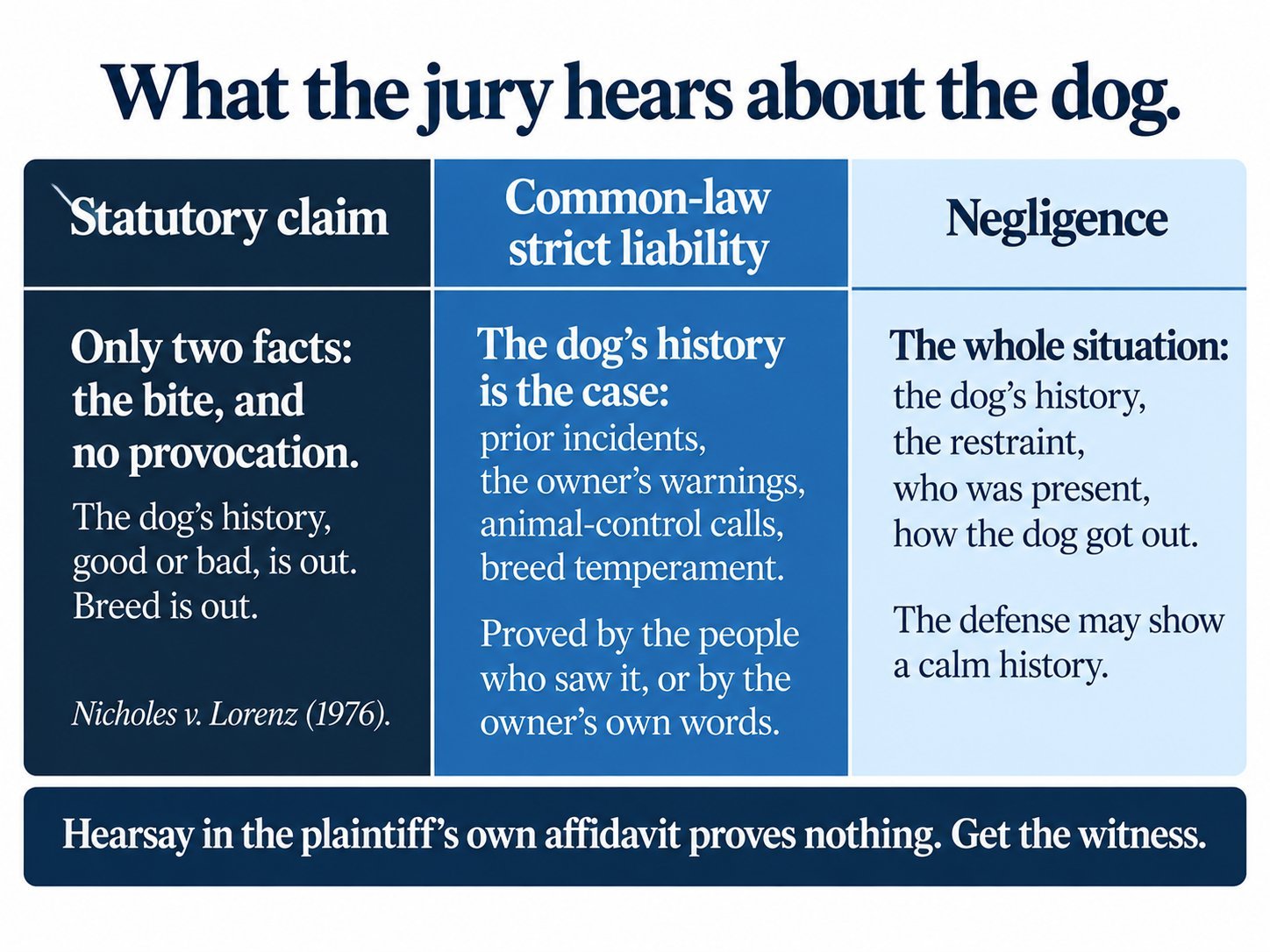
What the jury hears is tightly controlled. In a statutory case the dog’s history, good or bad, is irrelevant: it does not matter that the dog “never bit anyone” or that the breed has a reputation. In a common-law case the dog’s history is the whole case, and it has to be proved the right way. Michigan courts have thrown out one dog claim after another because the plaintiff’s proof of what the dog had done before was something a neighbor said to a relative, repeated in the plaintiff’s own affidavit. The neighbor’s own affidavit, or the owner’s own admission, would have carried the day.
And the case has to be organized correctly from the complaint forward. The three claims carry different rules on fault and on evidence; they are pleaded as separate counts, instructed separately, and answered separately on the verdict form. A verdict form that asks the wrong question, or asks it conditionally, can cost a plaintiff the noneconomic damages entirely, and the Court of Appeals has let such verdicts stand.
Analysis
Damages
“Any damages.” The statute makes the owner “liable for any damages suffered by the person bitten,” MCL 287.351(1), and “[l]iability under the statute extends to ‘any’ damages incurred by the plaintiff, which by definition includes all damages suffered.” Hill v. Sacka, 256 Mich. App. 443, 451 (2003). No reduction is made for the victim’s fault or a third party’s, and the allocation statutes do not apply. Id. at 451–452, 462. See Chapter 11. The recoverable elements are those of any personal-injury case: economic loss (medical and surgical expense, past and future, and lost earnings) and noneconomic loss (physical pain and suffering, mental anguish, fright and shock, denial of social pleasure and enjoyments, embarrassment, humiliation or mortification, and disfigurement), as set out in the model damages instructions, M Civ JI 50.01–50.02. Future noneconomic damages in a scar case are substantial because the scar is permanent; a jury’s award of future noneconomic damages for a two-year-old only for the years after he turned eighteen was questioned as “at least explainable, if not legally sound,” and left standing because the jury had asked whether the parents would control the money. Hill v. Sacka, 256 Mich. App. at 461–462.
No punitive or exemplary damages. The statute “does not provide for punitive damages,” and evidence of the dog’s prior conduct is irrelevant to compensatory damages as well as to liability. Nicholes v. Lorenz, 396 Mich. 53, 62–63 (1976). Michigan’s first dog statute doubled the verdict, and the Supreme Court sustained a doubled $10,000 award in 1899 only on remittitur; that provision died with the 1850 act in 1929. Fye v. Chapin, 121 Mich. 675, 678–682 (1899); see Chapter 1.
A zero noneconomic verdict can stand. In Taylor v. Mobley, 279 Mich. App. 309 (2008), the owners admitted liability under the statute for a pit bull’s bite to a sixteen-year-old’s abdomen and thigh; the jury awarded her past medical expenses and nothing for pain and suffering, and the Court of Appeals affirmed the denial of a new trial. “[T]he jury is free to credit or discredit any testimony. It may evaluate the evidence on pain and suffering differently from the proof of other damages. No legal principle requires the jury to award one item of damages merely because it has awarded another item.” Id. at 314 (quoting Kelly v. Builders Square, Inc., 465 Mich. 29 (2001)). Two things drove the result: the plaintiff waited three days to seek treatment, needed no stitches and consulted a plastic surgeon eighteen months later, and her own verdict form asked the noneconomic question conditionally. Id. at 312–315. Judge Gleicher dissented on the ground that uncontroverted evidence of pain, fright and shock, conceded in the defense opening, made a zero award against the great weight of the evidence. Id. at 316–323. The lesson is in the practice points below.
Minors and parents. The child’s claim for pain, suffering and disfigurement and the parent’s claim for the child’s medical expenses are separate. The parent’s own negligence does not touch the child’s statutory claim, Hill v. Sacka, 256 Mich. App. at 451–452; Fye, 121 Mich. at 679, but it can be weighed against the parent’s individual claim on a negligence theory, which is how a mother’s claim was lost in Veal v. Spencer, 53 Mich. App. 560, 565–566 (1974), after her three-year-old recovered on a directed verdict.
Death and property. A fatal attack is brought under the wrongful-death act, MCL 600.2922, on the same liability theories. Papke v. Tribbey, 68 Mich. App. 130 (1976) (goat; death months later; causation disputed). An attack on another animal is a property claim for the veterinary expense and the animal’s value, and it is litigated as such. Morgan v. Nickowski (2017) (unpublished) (about $8,000 in veterinary bills).
What the reported cases paid. The Michigan decisions in the library report, among others: $50,000 in noneconomic damages for a two-year-old’s facial injuries on the statutory count, Hill v. Sacka; $8,000 in negligence for a hand bite after the jury found provocation, Hill v. Hoig, 258 Mich. App. 538 (2003); $6,500 by directed verdict for a three-year-old’s facial bites in 1974, Veal; a $274,000 verdict against a mobile-home park, vacated for want of a duty, Braun v. York Properties, Inc., 230 Mich. App. 138 (1998); a $160,000 premises verdict vacated for want of knowledge, Mayle v. Fuller (1999) (unpublished); judgments of $435,900 against a park operator and $290,600 against the owner, affirmed, Skiver v. Durga (2022) (unpublished); a $30,000 case-evaluation settlement by a landlord with notice, Wendzel v. Feldstein (2015) (unpublished); and a $1,000,000 default judgment against absentee title-holders after a mauling that cost the plaintiff the use of her hand, McKissack v. Mitchell (2026) (unpublished). The figures say less about value than about the defendant: the cases with real money in them were the ones with an insured owner or a solvent non-owner, which is why Chapter 13 matters.
Evidence
The dog’s history: irrelevant under the statute, essential at common law. In a statutory case “the only facts necessary to sustain plaintiff’s case are (1) that the dog bit the girl … and (2) the biting was ‘without provocation.’ Nothing else had to be proved and nothing else was relevant—not his prior gentleness or roughness nor the sensitivities of his breed.” Nicholes, 396 Mich. at 60. Fifty-five transcript pages of neighbors describing the dog’s past conduct were prejudicial error requiring a new trial. Id. at 64–65. The rule cuts both ways: the owner may not prove the dog’s gentle history to the jury either. In a common-law strict-liability case the dog’s history is the scienter element, and the plaintiff proves it with prior incidents, the owner’s own warnings and complaints, animal-control records, and the dog’s manifested disposition. Massengile v. Piper, 294 Mich. 653 (1940); Kennett v. Engle, 105 Mich. 693, 695 (1895); see Chapter 6. In a negligence case the history is part of the “total situation,” and the defense is entitled to put a benign history before the jury. Mitchell v. Cunningham (2006) (unpublished); Knapp v. Card (2004) (unpublished) (neighbors’ testimony that the dogs had never jumped the fence admissible under MRE 401).
Breed. Breed is irrelevant to statutory liability. Nicholes, 396 Mich. at 60. On damages, a trial court’s exclusion of the word “pit bull” under MRE 403, while admitting the dog’s size and the details of the attack, was “a close question” and within the range of principled outcomes; the Court of Appeals added that “there is a difference between being attacked by a pit bull and a chihuahua” and that it might have ruled differently. Taylor, 279 Mich. App. at 315–316. Admission is therefore equally within a trial court’s discretion, and the plaintiff’s argument is the one the Taylor dissent made: the breed substantiates fright and shock. Id. at 322–323 (Gleicher, J., dissenting). On common-law scienter, breed temperament is part of the mix. Massengile.
Prior incidents must be in admissible form. On a motion under MCR 2.116(C)(10) the court considers only evidence whose content would be admissible at trial, MCR 2.116(G)(6), and the single most common reason a dog claim is lost at summary disposition is that the proof of a prior incident was hearsay in the plaintiff’s own affidavit. Hightower v. Nuyen (2018) (unpublished) (plaintiff’s testimony that a named woman told him she saw the dog jump on someone; no affidavit from her and no showing it could be made admissible); James v. Gutherie (2014) (unpublished) (double hearsay about a property manager’s knowledge); Kirkman v. Ellis (2014) (unpublished); Morgan v. Nickowski (2017) (unpublished); Blaylock v. MacIntyre (2025) (unpublished). The cure is simple: an affidavit or deposition from the person who saw the incident or made the complaint. The owner’s own statement is a party admission under MRE 801(d)(2) and is admissible through anyone who heard it; a trial court’s refusal to consider the owner’s remark that the dog had knocked him down “twice in our driveway” was reversed on that ground. Radcliffe v. Herdman (2023) (unpublished). Animal-control and police reports that describe the dog as “aggressive” at the time of the attack do not prove a prior vicious nature, Burling v. Skief (2020) (unpublished), but a report of a prior call about the same dog does, and the responding officer is a witness. Skiver; Burnett v. Clarke (2013) (unpublished).
Proving the bite. Whether the injury was a bite is for the jury when contested, and a treating diagnosis of “dog bite” that rests on the patient’s history is not conclusive. Knapp; Cull v. Nielsen (2000) (unpublished) (owner’s deposition admission that the dog bit the child neutralized at trial by her testimony that she had not seen it; clinic record repeated the mother’s account). Photographs of the wound taken promptly, the treating provider’s description of puncture pattern and depth, and an eyewitness are the proof.
What happened afterward. One panel sustained the exclusion, under MRE 407, of evidence that the dog bit its own owner immediately after the disputed contact with the plaintiff. Danison v. Velazquez (1996) (unpublished). MRE 407 governs subsequent remedial measures, not a dog’s conduct seconds later, and the ruling should be contested when the issue arises; the better ground for admission is that the dog’s immediately subsequent behavior is part of the same event.
Deemed admissions. Requests for admission that go unanswered are admitted, and have both won and nearly lost dog cases: unanswered requests established that the dog had bitten other children to the owners’ knowledge in Veal, 53 Mich. App. at 562–563, and a landlord nearly obtained summary disposition on a pro se plaintiff’s deemed admissions in Evers v. Medallion Management, Inc. (2024) (unpublished), where the Court of Appeals held that an oral motion at the hearing sufficed to seek leave to answer late and remanded for the Janczyk analysis.
Procedure
Pleading. The statutory count, the common-law strict-liability count and the negligence count are pleaded separately and may be pleaded in the alternative. Nicholes, 396 Mich. at 59 & n.2; Veal, 53 Mich. App. at 566. The leash law, MCL 287.262, need not be pleaded by number, because courts take judicial notice of statutes and an amendment to add it is “procedural ‘housekeeping,'” but a local ordinance must be pleaded and proved. Cassibo v. Bodwin, 149 Mich. App. 474, 477 (1986). Denying leave to add the leash-law count after summary disposition on the negligence count was plain error. Radcliffe. Each defendant’s role is pleaded specifically; a complaint that lumped a unit owner, a landlord and an association together as “defendants” who “knew” of the dog’s viciousness was dismissed. Shaw v. Wilson (2002) (unpublished). Against a governmental defendant, plead in avoidance of immunity from the outset (Chapter 10).
Affirmative defenses. Provocation and unlawful presence are the owner’s to raise. Defenses that attack the prima facie case, such as “scratch, not bite” or fabrication, are not affirmative defenses and need not be pleaded under MCR 2.111(F); a JNOV granted on the theory that they were waived was reversed. Knapp.
Summary disposition. Duty is a question of law, and the defense decisions in the common-law cases were nearly all entered under MCR 2.116(C)(10) on the knowledge or foreseeability element. The plaintiff opposing such a motion must produce admissible evidence (above) and, if discovery is incomplete, an affidavit under MCR 2.116(H) identifying the witnesses and the testimony expected; an affidavit restating the complaint does not make the motion premature. Richardson v. Oakland County Animal Shelter (2020) (unpublished). “This Court is liberal in finding genuine issues of material fact,” and the owner’s admission plus the dog’s known character was enough in Radcliffe. On a trespass defense, answer a survey with a survey; an unsupported assertion of an acquiesced boundary lost Tripp v. Baker, 346 Mich. App. 257, 264–265 (2023).
Default. A defendant who is served and does not answer is defaulted, and lay ignorance of the process is not good cause to set the default aside; a $1,000,000 default judgment against non-occupant title-holders of the house where the dogs were kept was affirmed on that ground. McKissack. The case decides nothing about such owners’ liability on the merits.
Jury instructions. The model dog-bite instructions (M Civ JI chapter 80) are given on the statutory count. When lawful presence is disputed, the court may add the premises-status definitions of licensee and trespasser from M Civ JI 19.01, because the statute’s “lawfully on” refers to those categories and the standard instructions do not define it. McAuliffe v. Harris (2003) (unpublished). Instructions on the statutory count may not mention reasonable care, the owner’s precautions or the plaintiff’s negligence. Hill v. Sacka, 256 Mich. App. at 459. The common-law counts take separate instructions on fault. Veal, 53 Mich. App. at 566; Rickrode v. Wistinghausen, 128 Mich. App. 240, 247–248 (1983).
The verdict form. Ask each claim’s questions separately, with the fault allocation attached only to the negligence count. Do not make the noneconomic-damages question conditional (“If you find …”); the plaintiff’s own form in Taylor did, and the zero award survived. 279 Mich. App. at 312–315. When the jury sends a note about who will control a child’s money, answer it with an instruction, not silence; the unanswered note in Hill v. Sacka explained an award that began at age eighteen. 256 Mich. App. at 461–462.
Post-trial and appeal. JNOV is reviewed de novo with the evidence viewed in the nonmovant’s favor; a verdict that reflects a rational view of the testimony stands, Knapp; Cull, and a jury “is free to credit or discredit any testimony” on damages. Taylor, 279 Mich. App. at 314. A great-weight motion under MCR 2.611(A)(1)(e) is the vehicle for an inadequate award. Costs may be made joint and several against multiple defendants in the court’s discretion, MCR 2.625. Skiver. Case-evaluation sanctions and timing are governed by MCR 2.403 and have been litigated in dog cases on both sides. Braun, 230 Mich. App. at 149–150; Tripp; Cull. A claim of appeal runs from the order that disposes of the claim as to that defendant, and a mislabeled order does not defeat jurisdiction. Lynum v. Detroit Police Department (2023) (unpublished).
For lawyers
Practice points
- Photograph the wounds on day one and at intervals; obtain the treating records and a plastic surgeon’s opinion on scar revision early. Future surgical expense and permanent disfigurement are the value in a facial-bite case.
- In a statutory case, move in limine to exclude the dog’s history and the owner’s precautions; Nicholes at 60–65 and Hill v. Sacka at 459. Decide before trial whether the breed is worth the fight under Taylor.
- In a common-law case, convert every prior incident into an affidavit from the person who saw it, within weeks. Canvass the neighbors, the carriers, the delivery drivers and animal control. Take the owner’s deposition on the dog’s history before the defense motion is filed.
- Serve requests for admission early on the bite, ownership, the dog’s prior incidents and the owner’s knowledge; unanswered requests are admitted. Veal.
- Treat the plaintiff’s own affidavit as useless for anything the plaintiff did not personally witness. Hightower; James; Morgan; Blaylock.
- If discovery is incomplete when the (C)(10) motion arrives, file the MCR 2.116(H) affidavit naming the witnesses and the expected testimony. Richardson.
- Draft the verdict form claim by claim; never condition the noneconomic question; attach fault percentages to the negligence count only. Taylor; Veal; Rickrode.
- Request M Civ JI 19.01 definitions only when status is disputed; otherwise object to them as injecting premises concepts into a statutory claim. McAuliffe.
- Preserve the objection to any MRE 407 exclusion of the dog’s immediately subsequent conduct. Danison.
- Identify the paying defendant before investing in the case: an insured owner, a landlord with notice and a policy, or an employer. The reported verdicts against uninsured owners were collected rarely if at all.
Authorities
Published decisions
| Case | Court / year | Point |
|---|---|---|
| Hill v. Sacka, 256 Mich. App. 443 | Ct. App. 2003 | “Any damages” means all; no fault reduction or allocation; reasonable-care instructions improper; additur and the jury’s note on a minor’s award. |
| Nicholes v. Lorenz, 396 Mich. 53 | Mich. 1976 | Dog’s history and breed irrelevant to statutory liability and to damages; no punitive damages; admission of history was prejudicial error. |
| Taylor v. Mobley, 279 Mich. App. 309 | Ct. App. 2008 | Zero noneconomic award upheld on an admitted-liability statutory claim; exclusion of breed under MRE 403 within discretion (Gleicher, J., dissenting). |
| Veal v. Spencer, 53 Mich. App. 560 | Ct. App. 1974 | Counts pleaded together take separate fault instructions; parent’s individual claim; deemed admissions established prior bites. |
| Cassibo v. Bodwin, 149 Mich. App. 474 | Ct. App. 1986 | Statute need not be pleaded by number; ordinance must be pleaded and proved. |
| Massengile v. Piper, 294 Mich. 653 | Mich. 1940 | Scienter proved by manifested disposition, owner’s statements and breed temperament; no prior bite required. |
| Kennett v. Engle, 105 Mich. 693 | Mich. 1895 | Prior manifestation of a disposition to bite plus the owner’s knowledge; general good disposition then immaterial. |
| Rickrode v. Wistinghausen, 128 Mich. App. 240 | Ct. App. 1983 | Instructions on remand: no plaintiff fault on strict liability; comparative negligence on the negligence count. |
| Fye v. Chapin, 121 Mich. 675 | Mich. 1899 | Double damages under the 1850 act; remittitur of an excessive verdict; parents’ negligence not imputed to the child. |
| Papke v. Tribbey, 68 Mich. App. 130 | Ct. App. 1976 | Wrongful-death action on animal-liability theories. |
| Tripp v. Baker, 346 Mich. App. 257 | Ct. App. 2023 | (C)(10) burden on a trespass defense: a survey must be met with evidence, not assertion. |
| Braun v. York Properties, Inc., 230 Mich. App. 138 | Ct. App. 1998 | Verdict vacated for want of duty; case-evaluation sanctions timing. |
Unpublished Court of Appeals decisions
Unpublished opinions are not binding precedent under MCR 7.215(C)(1).
| Case | Year | Point |
|---|---|---|
| Knapp v. Card, 2004 WL 1621711 | 2004 | “Scratch, not bite” not an affirmative defense; burden of proving a bite stays with plaintiff; treating diagnosis not dispositive; fence-history testimony admissible. |
| Cull v. Nielsen, 2000 WL 33534002 | 2000 | Bite is a jury question; owner’s out-of-court admission neutralized; medical record repeating parent’s history. |
| Danison v. Velazquez, 1996 WL 33348816 | 1996 | Accidental-bump defense goes to the jury; dog’s immediately subsequent bite excluded under MRE 407 (contestable). |
| Radcliffe v. Herdman, 2023 WL 327860 | 2023 | Owner’s statement is a party admission; amendment to add the leash law required; liberal fact-question standard. |
| Hightower v. Nuyen, 2018 WL 6004469 | 2018 | Hearsay of a prior incident with no showing of admissible form disregarded at (C)(10). |
| James v. Gutherie, 2014 WL 4214949 | 2014 | Double hearsay in plaintiff’s affidavit insufficient on the merits and on prematurity. |
| Kirkman v. Ellis, 2014 WL 7217557 | 2014 | Relayed statement about a prior incident inadmissible; no exception identified. |
| Morgan v. Nickowski, 2017 WL 5759789 | 2017 | Neighbor opinions, hearsay and unrelated police reports do not show knowledge; dog-on-dog attack litigated as property damage. |
| Blaylock v. MacIntyre, 2025 WL 2155386 | 2025 | Same-day bites and hearsay do not show prior knowledge; MCR 2.116(G)(6). |
| Mitchell v. Cunningham, 2006 WL 659465 | 2006 | Dogs’ benign history and the escape route admissible on the negligence count; directed verdict reversed. |
| Burling v. Skief, 2020 WL 6236650 | 2020 | Animal-control “aggressive” notation at the time of the bite does not prove a prior vicious nature. |
| Skiver v. Durga, 2022 WL 7724061 | 2022 | Notice proved by escapes, complaints and a police response; agents’ knowledge imputed; costs joint and several. |
| Evers v. Medallion Management, Inc., 2024 WL 4100005 | 2024 | Deemed admissions; oral motion for leave to answer late suffices; Janczyk factors. |
| Richardson v. Oakland County Animal Shelter, 2020 WL 5496077 | 2020 | MCR 2.116(H) affidavit required to claim summary disposition is premature. |
| McKissack v. Mitchell, 2026 WL 979410 | 2026 | $1,000,000 default judgment affirmed; lay ignorance is not good cause under MCR 2.603(D). |
| McAuliffe v. Harris, 2003 WL 22717889 | 2003 | Licensee and trespasser definitions may be read with the dog-bite instructions when lawful presence is disputed. |
| Shaw v. Wilson, 2002 WL 737795 | 2002 | Undifferentiated pleading against multiple non-owner defendants. |
| Lynum v. Detroit Police Department, 2023 WL 8292585 | 2023 | Claim of appeal from a mislabeled final order; jurisdiction upheld. |
| Mayle v. Fuller, 1999 WL 33435336 | 1999 | $160,000 premises verdict vacated for want of knowledge. |
| Wendzel v. Feldstein, 2015 WL 7288057 | 2015 | $30,000 landlord settlement at case evaluation; indemnity against tenant enforced. |
Common questions
What can I recover for a dog bite in Michigan?
All of your medical and surgical expenses, past and future (including scar revision), lost wages, and compensation for pain, the fright of the attack, disfigurement, embarrassment and the loss of normal activities. There is no cap. Michigan does not award punitive damages for a dog bite.
Does it matter that the dog had never bitten anyone before?
Not under the dog-bite statute. The dog’s history, good or bad, is not even admissible in a statutory case. It matters in a common-law claim, where the owner’s knowledge of the dog’s tendencies is what has to be proved.
My neighbor told me the dog attacked someone else last year. Is that enough?
Not in that form. What your neighbor told you is hearsay. What your neighbor says in a sworn statement, or testifies to in person, is evidence. Get the name and the account early.
Will the jury hear that it was a pit bull?
In a statutory case the breed is irrelevant to liability. On damages the judge decides; the Court of Appeals has approved both excluding the breed and, in substance, admitting it. The size of the dog and the details of the attack always come in.
My child was bitten. Whose claim is it?
Two claims: the child’s, for pain, scarring and future harm, brought through a parent as next friend, and the parent’s own claim for the medical bills. Settlement of the child’s claim requires court approval.
Building a dog-bite case?
The evidence that wins these cases is gone within weeks: the wounds heal, the neighbors move, the animal-control file is purged. JKH Law starts the investigation at the first call. Consultations are free, in Grand Rapids and statewide.
This page is part of the Michigan Dog Bite Law Compendium published by JKH Law, PLC. It is legal information about Michigan law, not legal advice about any particular situation, and reading it does not create an attorney-client relationship. Citations were last checked in October 2026. Unpublished opinions are identified as such and are not binding under MCR 7.215(C)(1).

Personal injury litigation for Grand Rapids and West Michigan.
312 Fulton Street EastGrand Rapids, MI 49503 (616) 226-3762
Fax (616) 988-6504
Free consultation