
Chapter 3 · The only defense
Provocation
An owner escapes liability under MCL 287.351 only if the dog bit “without provocation” is untrue, meaning the person bitten did something that would make a normal dog bite. This chapter explains what counts, what does not, how the courts treat children, and why a dog that is already attacking cannot be provoked.
In plain terms
What provocation means
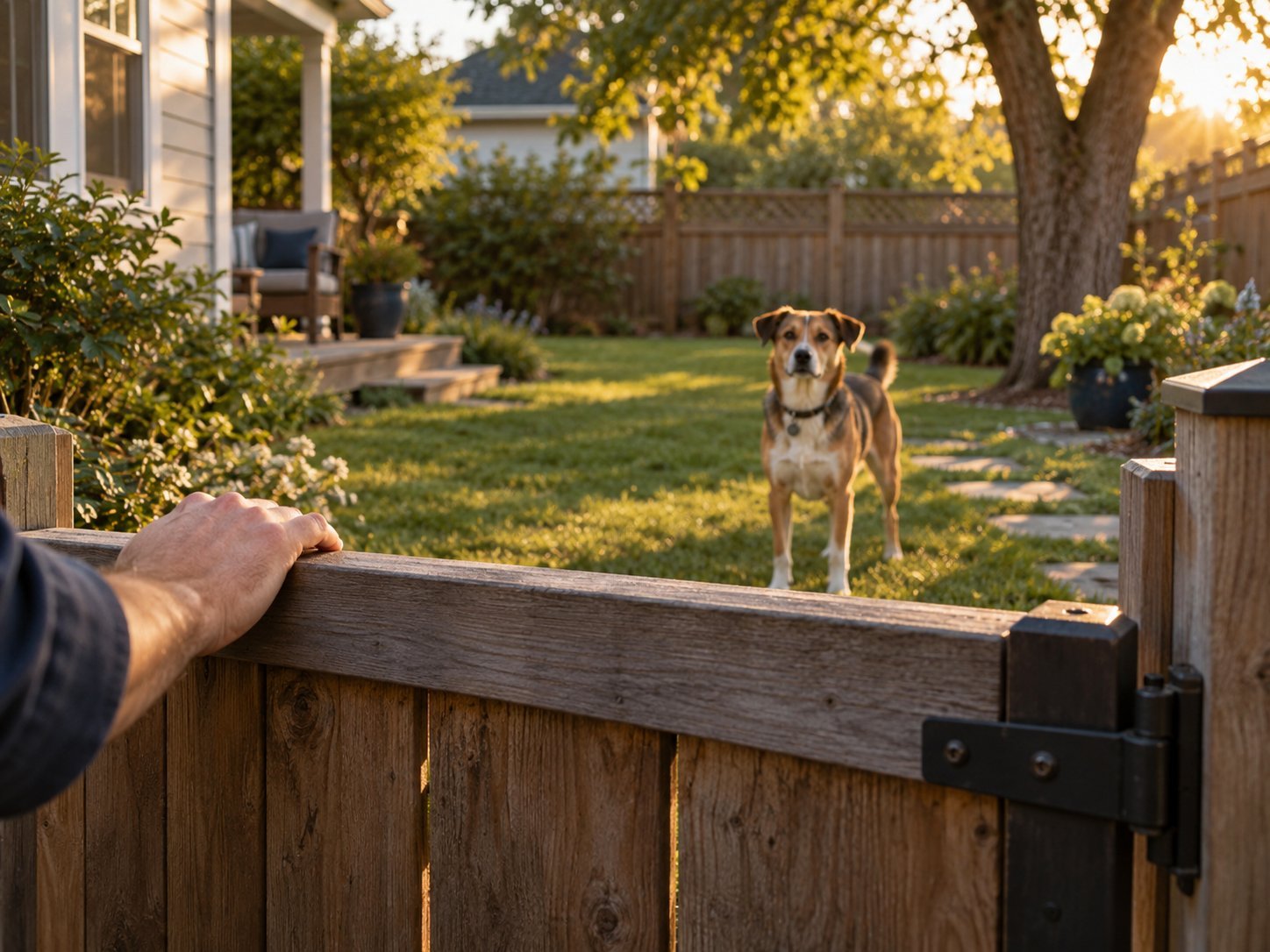
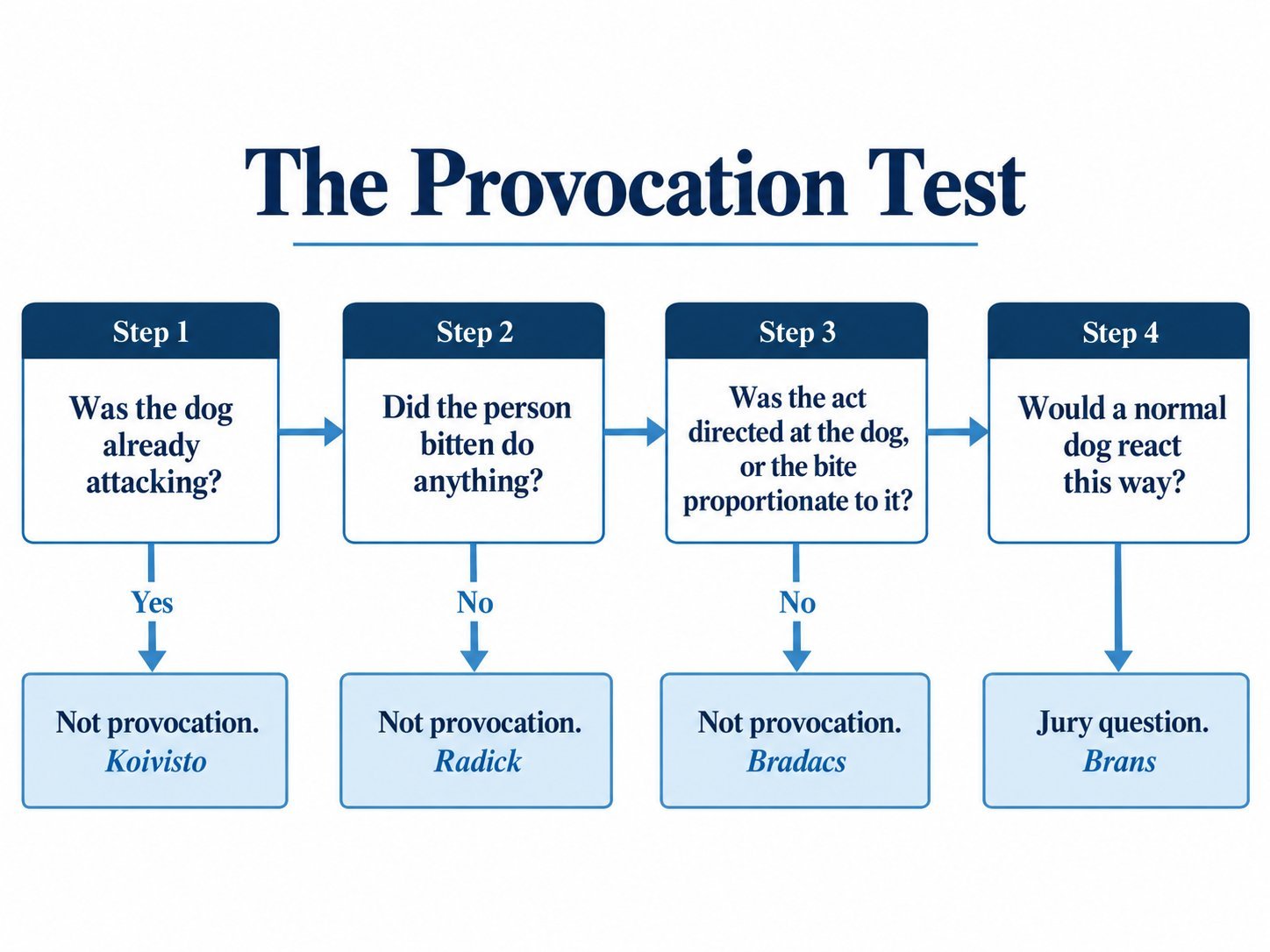
Insurers use the word “provocation” loosely. The statute does not. A dog is provoked when the person bitten does something that would make a normal dog react the way this dog did. The person’s intentions do not matter; stepping on a dog’s tail by accident can be provocation. But the act has to be directed at the dog, or the bite has to be a proportionate response to it. Bending down to pick up a dropped ball a foot from a dog is not provocation. Resting your arm on top of a fence is not provocation. Offering the back of your hand for a dog to sniff is not provocation.
Two things never count. A dog that is already attacking cannot be “provoked” by what you do to defend yourself, your child, your pet or your property; the law does not require you to retreat or submit. And provocation is about what the person bitten did, not about a noise, a shock from the owner’s electric fence, or anything else that may have set the dog off.
Whether a particular act was provocation is usually decided by a jury, which is why the moments before a bite get investigated so closely, and why a recorded statement to an insurer about “what you were doing” matters. The owner has to plead provocation and prove it. An owner who claims it with no evidence loses on liability and can be ordered to pay the victim’s attorney fees.
Analysis
The rule
The statute makes the owner liable when a dog bites “without provocation.” It does not define the word. The Court of Appeals supplied the working definition in Brans v. Extrom, 266 Mich. App. 216 (2005), approving a jury instruction that provocation “means any action or activity, whether intentional or unintentional, which would reasonably be expected to cause a normal dog in similar circumstances to react in a manner similar to that shown by the evidence.” Id. at 218 n.4. The court explained: “The definition of ‘provocation’ does not take into account the intent of the actor; rather, the definition focuses on the nature of the act itself and the relationship between that act and an outcome. … The intent of the victim is immaterial.” Id. at 219. That settled a question the Supreme Court had left implicit in Nicholes v. Lorenz, 396 Mich. 53 (1976), where a seven-year-old pushed from behind stepped on a chained dog’s tail and the Court treated whether that was provocation as the jury’s question.
Four limits give the rule its shape.
The act must be aimed at the dog, or the bite must be proportionate to it. “[T]here must be some action directed toward the animal or, if not, the animal’s response must be proportional to the victim’s action.” Bradacs v. Jiacobone, 244 Mich. App. 263, 276 (2001). In Bradacs a twelve-year-old juggling a football near a Labrador that had begun to eat dropped the ball a foot away and was bitten on the leg when she bent to pick it up. The Court of Appeals held there was “insufficient evidence of provocation by plaintiff to submit this issue to the jury” and directed a verdict for her on provocation. Id. Reading provocation to include any “external stimulus” by the victim “would render M.C.L. § 287.351 … meaningless and would be contrary to the strict liability nature of the statute.” Id. at 275.
A dog already attacking cannot be provoked. “[R]esponding to or reacting to a dog’s vicious and aggressive behavior does not constitute provocation under MCL 287.351(1) because a dog behaving in that manner is already in a provoked state.” Koivisto v. Davis, 277 Mich. App. 492, 499 (2008). The plaintiff in Koivisto fought two escaped huskies that were killing her cats, gouging at their eyes and kicking them, and suffered 28 puncture wounds. The court held she was entitled to summary disposition on liability. “It is irrelevant that plaintiff’s response may have been in defense of her cats. She could have been defending a neighbor’s baby, the newspaper, or a rose bush and she still would be entitled to a recovery,” and “[w]e discern no requirement that plaintiff had to retreat from or submit to the will of these dogs.” Id. at 498. The statute says “without provocation,” not “without justified provocation.” Id. at 499.
Provocation is the victim’s conduct, not something else that set the dog off. The defense “assumes that the offending dog was not already in a provoked state or, as in this case, a state of attack, and that the victim did something to provoke the dog.” Koivisto, 277 Mich. App. at 497. Applying that holding, the Court of Appeals rejected an owner’s argument that the dog had been “provoked” by a shock from the owners’ own invisible fence when it mauled a five-year-old who had done nothing: because “there is no dispute that Luke did nothing to provoke Buddy, plaintiff was entitled to summary disposition on the issue of liability.” Radick v. Rouse (2021) (unpublished). A startling noise, another animal, or the owner’s own handling of the dog is not provocation by the person bitten.
It is a jury question only when the evidence permits it. “The question of provocation is a question of fact to be determined by the jury on the basis of the circumstances of each case,” Brans, 266 Mich. App. at 222, but Bradacs and Koivisto both took the issue from the jury in the plaintiff’s favor, and the Court of Appeals has said that nothing in Brans “supports plaintiff’s suggestion that summary disposition is inappropriate in cases in which there are no genuine issues of material fact.” Costanza v. Limon (2021) (unpublished). The defense goes to the jury when the evidence shows an act directed at the dog, or an act to which a bite was a proportionate response; otherwise the plaintiff is entitled to judgment on liability.
Children
Young children are the most frequent victims of serious bites, and the defense is raised in nearly every case involving one. The decisions do not create a separate standard for children, and they do not need to: a small child’s affectionate or clumsy approach is almost never an act “directed toward the animal” in the sense the cases require, and a bite to the face is almost never a proportionate response to it.
In Nicholes the child was seven and was pushed onto the dog’s tail; the jury decided provocation. In Hill v. Sacka, 256 Mich. App. 443 (2003), a two-year-old waving his arms and making noise walked within reach of a chained German shepherd; the jury found the owners liable, and the Court of Appeals affirmed, noting that provocation was the only avenue through which the child’s conduct could matter at all. Id. at 451, 458. In Palloni v. Smith, 167 Mich. App. 393 (1988), a two-year-old let go of his mother’s hand, walked toward an unleashed cocker spaniel and bent to hug it; the dog bit his face before he touched it. The jury found provocation; the trial judge ordered a new trial because that verdict was against the great weight of the evidence; the Court of Appeals reinstated the verdict; and the Supreme Court reversed the Court of Appeals and reinstated the new-trial order, finding “no abuse of discretion on the part of the trial judge in determining that the verdict in this case was contrary to the great weight of the evidence.” 431 Mich. 871 (1988). The most recent Court of Appeals decision on the pattern, Costanza v. Limon (2021) (unpublished), reversed a summary disposition for the owner where the only evidence of provocation was secondhand accounts that a visiting child “went to give him a hug”: “Viewed in a light most favorable to plaintiff, these statements do not definitively establish provocation.”
The position this compendium takes, and the one the cases support, is that a toddler’s hug, a child’s approach, or a child’s noise is not provocation. Where the evidence of what the child did is thin or secondhand, the owner cannot obtain summary disposition; where the act was not aimed at the dog, Bradacs entitles the child to judgment on the defense.
How the courts have treated common fact patterns
| What the person did | Result | Authority |
|---|---|---|
| Stepped on the dog’s tail after being pushed (child, age 7) | Jury question | Nicholes, 396 Mich. 53 (1976) |
| Stepped on an elderly dog while walking backward carrying wire | Jury question; defense verdict upheld | Brans, 266 Mich. App. 216 (2005) |
| Bent to pick up a dropped football a foot from a feeding dog | Not provocation as a matter of law; verdict directed for plaintiff | Bradacs, 244 Mich. App. 263 (2001) |
| Fought dogs that were attacking her cats on her own property | Not provocation; summary disposition for plaintiff | Koivisto, 277 Mich. App. 492 (2008) |
| Toddler waving arms and making noise near a chained dog | Jury found liability; affirmed | Hill v. Sacka, 256 Mich. App. 443 (2003) |
| Toddler bent to hug an unleashed dog | New trial after defense verdict on provocation; affirmed by the Supreme Court | Palloni, 431 Mich. 871 (1988) |
| Rested a magazine and arm on top of a gate, dog inside the yard | Not provocation; directed verdict for plaintiff after defense verdict | Fagan v. Lomupo (2007) (unpub.) |
| Dog shocked by the owners’ electric fence, then bit a child who did nothing | Not provocation; summary disposition for plaintiff | Radick v. Rouse (2021) (unpub.) |
| Visiting child hugged a household dog (secondhand accounts only) | Jury question; summary disposition for owner reversed | Costanza v. Limon (2021) (unpub.) |
| Called “hello” toward the yard, spoke to the dog, offered the back of a hand | Jury question; summary disposition for owner reversed | Puninske v. Goldsmith (2026) (unpub.) |
| Extended a hand within a foot of a leashed, unfamiliar dog to let it sniff | Fact question; plaintiff’s motion denied | Fitzpatrick v. Bridgestone, 444 F. Supp. 3d 786 (E.D. Mich. 2020) |
| Grabbed an attacking dog by the scruff to rescue its owner, with his own admission the act could provoke a bite | Provocation as a matter of law (federal court, decided before Koivisto) | Wiitanen v. Dworatschek (E.D. Mich. 2005) (unpub.) |
Wiitanen deserves a note. A federal judge held that a trainer who grabbed a German shepherd that was biting its owner had provoked it, reasoning that the statute “makes no exceptions based on the aroused and aggressive condition of the dog.” Three years later the Court of Appeals held the opposite in Koivisto: a dog in a state of attack is already provoked and cannot be provoked further. Koivisto is a published Michigan decision and controls; Wiitanen is an unreported federal prediction of Michigan law that the Michigan courts have since rejected. A rescuer who intervenes in an attack is protected by Koivisto.
Where the defense came from
Under the 1850 statute the only conduct-based defense was the victim’s knowing, voluntary exposure: “the owner cannot be released from liability by any act of the person injured unless it can be affirmed that he caused the injury himself with a full knowledge of its possible consequences.” Fye v. Chapin, 121 Mich. 675, 679–680 (1899). Accidental contact was no defense at all: “The law of canine self-defense does not relieve the owner of liability for damages because the injured person inadvertently stepped on the dog.” Wojewoda v. Rybarczyk, 246 Mich. 641, 643–644 (1929). At common law, by contrast, willful provocation or gross negligence in approaching a known-vicious animal defeated the claim, Brooks v. Taylor, 65 Mich. 208, 211 (1887); Grummel v. Decker, 294 Mich. 71, 77 (1940), and the victim’s ordinary contributory negligence was a defense to the common-law count. Grummel, 294 Mich. at 77.
The 1939 act wrote “without provocation” into the statute itself, and Brans read those words according to their ordinary meaning rather than the 1850 act’s gloss, which is why an inadvertent step can now be provocation when it would not have been under Wojewoda. On the common-law counts, contributory negligence has given way to comparative fault, which reduces rather than bars recovery. Hill v. Hoig, 258 Mich. App. 538 (2003); see Chapter 11. On the statutory count there is no comparative fault; provocation is all-or-nothing. Hill v. Sacka, 256 Mich. App. at 451, 454.
A different “provocation” in dangerous-animal proceedings
Michigan has a second provocation standard that is sometimes confused with this one. When animal control petitions to have a dog destroyed as a “dangerous animal” under MCL 287.322, the dog is excluded from that definition if it bit “a person who provokes or torments the animal,” and that statute defines “provoke” as “a willful act or omission that an ordinary and reasonable person would conclude is likely to precipitate the bite or attack by an ordinary dog or animal.” MCL 287.321(a)(ii), (d). The Court of Appeals construed that definition for the first time in In re Chance, 2026 WL 2355046 (Mich. Ct. App. Aug. 13, 2026), holding that it is a wholly objective reasonable-person standard, and vacating a euthanasia order because the district court had weighed the bitten guest’s subjective comfort with the dog.
That definition requires a willful act. The civil statute does not. Brans drew exactly that contrast in holding that intent is immaterial under § 287.351: “Had the Legislature intended only an intentional act to bar recovery it could have so specified. See, e.g., MCL 287.321(1)(d).” 266 Mich. App. at 219. Chance in turn said of Brans only that it “is not useful here.” A dangerous-animal ruling that the dog was or was not “provoked” under § 287.321 therefore does not decide provocation in the civil case, though the testimony from the hearing is often the best early record of what happened. See Chapter 14.
For lawyers
Practice points
- Treat provocation as the owner’s burden. Demand in discovery that the defendant identify every fact and witness supporting it; a defense pleaded without evidence produced a directed verdict and mandatory fees under MCL 600.2591 in Wilkinson v. Merrill (2002) (unpublished).
- Move for partial summary disposition on liability under MCR 2.116(I)(2) whenever the victim’s conduct is undisputed and was not directed at the dog. Koivisto; Radick; Bradacs.
- Build the proportionality record: the dog’s size, the distance, the absence of any growl or warning, the location of the bite, and that the plaintiff never entered the dog’s enclosure. Those facts decided Bradacs and Fagan.
- Where the dog was reacting to something else (another animal, a shock collar, a slammed door, the owner’s own discipline), plead and argue Koivisto and Radick: that is not provocation by the victim.
- Request the Brans definition verbatim as the jury instruction, 266 Mich. App. at 218 n.4, together with the Bradacs directed-at-the-dog-or-proportionate limitation. The standard instruction does not define the term. Bradacs, 244 Mich. App. at 266 n.5.
- Warn clients early that a recorded statement describing “what you were doing” before the bite is a statement about provocation.
- Where the common-law counts are also pleaded, remember Brans n.7: a jury that finds provocation may also find the bite was caused by the victim’s act rather than the dog’s known propensity. Decide whether joining the counts helps or hurts.
- If a dangerous-animal hearing has been held, obtain the transcript; the ruling does not bind the civil case, but the sworn testimony about the moments before the bite does.
Authorities
Published decisions
| Case | Court / year | Point |
|---|---|---|
| Nicholes v. Lorenz, 396 Mich. 53 | Mich. 1976 | Provocation is the statute’s one exception; stepping on a tail submitted to the jury. |
| Nicholes v. Lorenz, 49 Mich. App. 86 | Ct. App. 1973 | Provocation “the only defense”; contributory negligence not a defense except as it bears on provocation. |
| Brans v. Extrom, 266 Mich. App. 216 | Ct. App. 2005 | Definition; intent immaterial; unintentional acts can provoke; jury question on a proper record. |
| Bradacs v. Jiacobone, 244 Mich. App. 263 | Ct. App. 2001 | Act must be directed at the dog or the response proportionate; verdict directed for plaintiff. |
| Koivisto v. Davis, 277 Mich. App. 492 | Ct. App. 2008 | An attacking dog cannot be provoked; no duty to retreat; defense of property irrelevant; summary disposition for plaintiff. |
| Hill v. Sacka, 256 Mich. App. 443 | Ct. App. 2003 | Provocation all-or-nothing; no comparative fault; toddler’s conduct relevant only through provocation. |
| Palloni v. Smith, 167 Mich. App. 393, rev’d 431 Mich. 871 | 1988 | New trial after a provocation verdict against a toddler who tried to hug the dog; Supreme Court reinstated the new-trial order. |
| Thelen v. Thelen, 174 Mich. App. 380 | Ct. App. 1989 | Legislature intended provocation to be the only defense to the statutory claim. |
| Fye v. Chapin, 121 Mich. 675 | Mich. 1899 | Under the 1850 act, only knowing, voluntary exposure was a defense. |
| Wojewoda v. Rybarczyk, 246 Mich. 641 | Mich. 1929 | Inadvertently stepping on a dog was no defense under the 1850 act. |
| Brooks v. Taylor, 65 Mich. 208 | Mich. 1887 | Common law: willful provocation or gross negligence near a known-vicious animal is an affirmative defense. |
| Grummel v. Decker, 294 Mich. 71 | Mich. 1940 | Common law: provocation and contributory negligence as defenses. |
| In re Chance, 2026 WL 2355046 | Ct. App. 2026 | Objective, willful-act definition of “provoke” under the dangerous-animal statute; does not govern § 287.351. |
Unpublished Court of Appeals and federal decisions
Unpublished opinions are not binding precedent under MCR 7.215(C)(1).
| Case | Year | Point |
|---|---|---|
| Radick v. Rouse, 2021 WL 219221 | 2021 | Provocation is the victim’s conduct; electric-fence shock is not provocation; judgment for plaintiff on liability. |
| Fagan v. Lomupo, 2007 WL 778047 | 2007 | Arm and magazine over a gate not directed at the dog; bite disproportionate; directed verdict for plaintiff. |
| Costanza v. Limon, 2021 WL 941569 | 2021 | Child’s hug on secondhand accounts does not establish provocation; jury question. |
| Puninske v. Goldsmith, 2026 WL 97841 | 2026 | Speaking to a dog and offering a hand to sniff could reasonably be found not provocation. |
| Wilkinson v. Merrill, 2002 WL 31930791 | 2002 | Provocation pleaded without evidence: directed verdict and fees under MCL 600.2591. |
| Lieding v. Blackledge, 2004 WL 1078981 | 2004 | Court did not reach provocation where the child was not lawfully on the property. |
| Fitzpatrick v. Bridgestone Retail Operations, 444 F. Supp. 3d 786 | E.D. Mich. 2020 | Extending a hand to an unfamiliar dog treated as a fact question on provocation. |
| Wiitanen v. Dworatschek, 2005 WL 8155432 | E.D. Mich. 2005 | Rescuer who grabbed an attacking dog held to have provoked it; superseded in reasoning by Koivisto. |
Common questions
I didn’t mean to bother the dog. Can the owner still say I provoked it?
Yes, the owner can say it, because intent does not matter under the statute. But the act has to be one that would make a normal dog bite, it has to have been aimed at the dog or the bite has to be in proportion to it, and the owner has to prove it. Walking past, reaching for something nearby, or speaking to a dog is not provocation.
The dog was attacking my child and I pulled it off. The owner says I provoked it.
A dog that is already attacking cannot be provoked. Michigan law does not require you to retreat or submit, and it does not matter what you were defending.
My toddler tried to pet the dog. Does that end the case?
No. Courts have repeatedly refused to treat a young child’s approach or hug as provocation as a matter of law, and the owner cannot win on that defense without real evidence of what the child did.
Animal control decided the dog was “provoked.” Does that decide my claim?
No. Dangerous-animal proceedings use a different statute with a different definition that requires a willful act. Your civil claim is decided under MCL 287.351 and the cases in this chapter.
Being told you “provoked” the dog?
That is the owner’s burden, not yours. JKH Law handles dog-bite claims in Grand Rapids, across West Michigan and statewide. Consultations are free.
This page is part of the Michigan Dog Bite Law Compendium published by JKH Law, PLC. It is legal information about Michigan law, not legal advice about any particular situation, and reading it does not create an attorney-client relationship. Citations were last checked in October 2026. Unpublished opinions are identified as such and are not binding under MCR 7.215(C)(1).

Personal injury litigation for Grand Rapids and West Michigan.
312 Fulton Street EastGrand Rapids, MI 49503 (616) 226-3762
Fax (616) 988-6504
Free consultation