
Chapter 13 · Who pays
Insurance Coverage for Dog Bites
Nearly every dog-bite recovery in Michigan is paid by an insurer, usually the owner’s homeowners or renters carrier. Whether a policy responds turns on a short list of questions: who is an insured, where the bite happened, whether the victim is a member of the insured’s own household, whether a vehicle or a business was involved, and whether the carrier handled the claim properly. This chapter sets out the Michigan decisions on each and the coverage sources a victim’s lawyer should run down before the case is valued.
In plain terms
The owner is liable; the insurer pays
The dog-bite statute makes the owner liable for all of the victim’s damages, but most owners cannot pay a serious claim themselves. What makes the claim worth pursuing is the owner’s homeowners or renters insurance, which covers the owner’s legal liability for bodily injury to others, including injury caused by the family dog, up to the policy limit, and pays for the owner’s defense. A typical policy carries $100,000 to $500,000 in liability coverage and a small medical-payments benefit that pays a visitor’s medical bills regardless of fault.
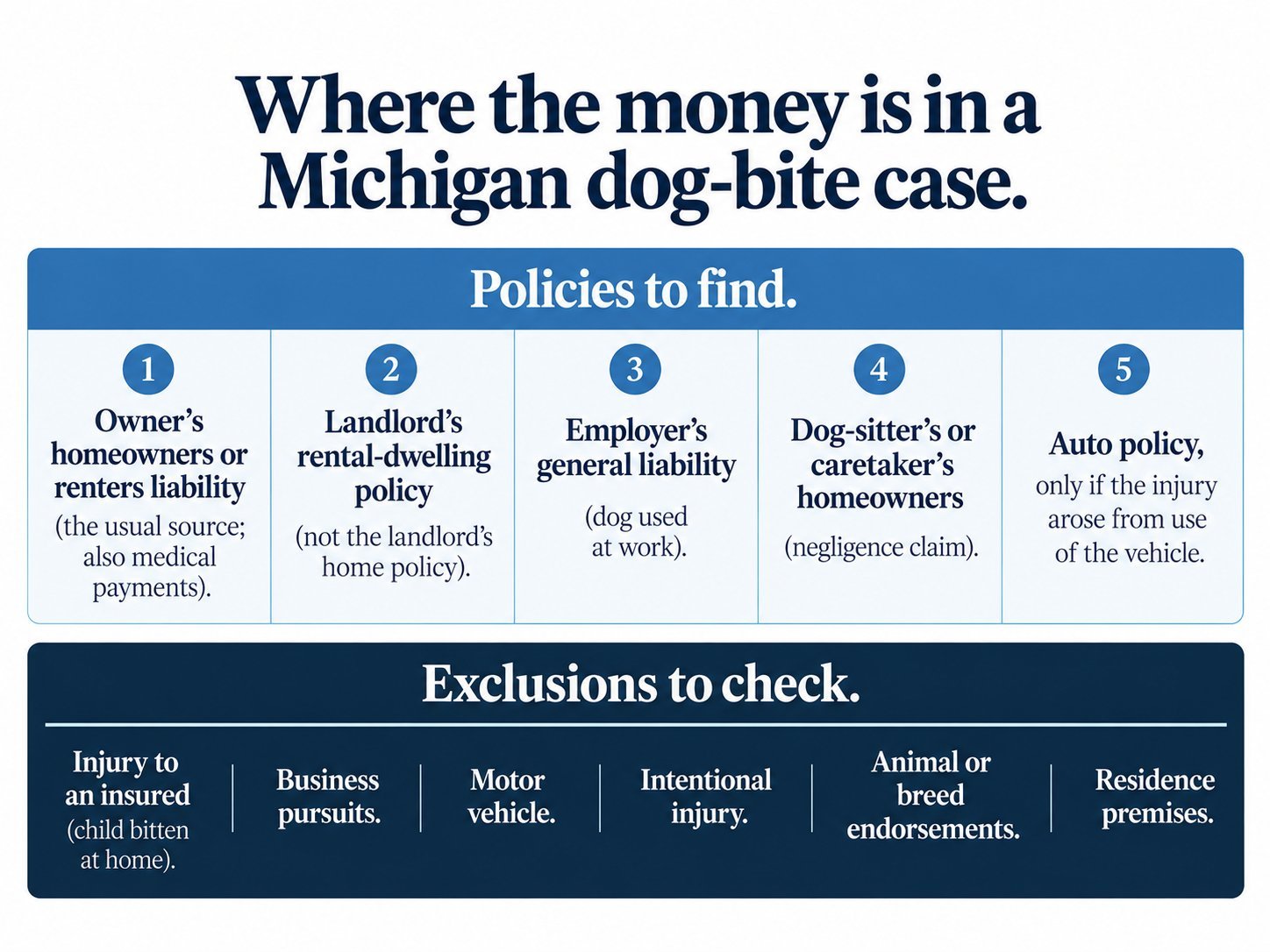
Coverage is not automatic. The person who owned the dog has to be an insured under the policy, which usually means the named insured or a relative living in the household. A child bitten by the family’s own dog in the family’s own home is usually not covered, because policies exclude injury to insureds and the child is one. A bite at a rental house is not covered by the landlord’s policy on the landlord’s own home. A bite inflicted while the owner was using the dog in a business may fall under a business-pursuits exclusion. A bite at a car is a homeowners claim, not an auto claim, unless the injury had something to do with using the vehicle. And a growing number of policies exclude liability for dogs altogether, or for certain breeds, or for a dog that has bitten before.
Two rules protect the victim. The insurer that defends the owner without promptly reserving its right to deny coverage can be barred from denying it later. And a victim who obtains a judgment against the owner can enforce it directly against the owner’s insurer. The practical lesson is that the coverage investigation starts with the first phone call: identify every policy that could respond, including the landlord’s, the employer’s and the dog-sitter’s, and get the policy language, not the adjuster’s summary of it.
Analysis
Who is an insured, and where
Resident relatives. Homeowners policies insure the named insured and, if residents of the household, relatives and dependents in the insured’s care. Whether the dog’s keeper resided in the named insured’s household is a question of fact when the indicia point both ways. In Fremont Mutual Insurance Co. v. Stinnett (2001) (unpublished), a five-year-old was killed by a dog in the care of the named insured’s adult son at a house the mother owned and the son partly occupied; the son’s license and tax records bore his mother’s address, his fiancée paid the utilities and rent at the house where the dog was kept, and he kept clothes and received mail at both. The conflict in the son’s own sworn examination was enough to defeat summary disposition for either side and send residence to trial. Kinship alone is not residence: tenants who were the landlords’ relatives but lived under a different roof were not members of the landlords’ “household.” Fremont Mutual Insurance Co. v. Wisniewski (1997) (unpublished).
The insured-person exclusion. The standard policy excludes bodily injury to an insured, and a resident minor is an insured. In Allstate Insurance Co. v. Tomaszewski, 180 Mich. App. 616 (1989), an eight-year-old who lived with his mother and stepfather was bitten by the household dog and sued them. The Court of Appeals held that his status must be uniform under the policy, that “any relative and any dependent person in your care” describes two groups rather than two conditions, that “dependent” means factual rather than legal dependency, and that a stepchild is a “relative” of the stepfather; the child was an insured person and “the exclusion is controlling and coverage is unavailable.” Id. at 619–621. The intra-family claim the statute permits, Thelen v. Thelen, 174 Mich. App. 380 (1989) (Chapter 11), is therefore usually uncollectable against the household’s own carrier; the coverage inquiry is whether the child in fact resided elsewhere or whether a non-resident parent’s policy is implicated.
The premises. Liability coverage follows the insured, not the location, for most bites, but the policy’s definition of insured premises matters where a landlord or an absent owner is the target. A landlord’s policy on his own residence does not reach a bite at a separate rental house: the rental premises were not “insured premises,” the rental-property exclusion applied, and the tenant-relatives were not insureds. Wisniewski. The policy to find is the one covering the rental dwelling itself.
Organizations and events. An organization’s commercial general liability policy covers the organization and its officers acting as such, not the individual members. When greyhounds running at a field-trial club’s event attacked a man in a residential area, the club’s CGL carrier owed no defense to the member-owners; their homeowners policies were primary. Citizens Insurance Co. of America v. North Pointe Insurance Co. (2000) (unpublished). Sue both the organization and the owner, and tender to both carriers.
Exclusions and the auto policy
Bite at a car: homeowners, not auto. The homeowners policy excludes liability arising out of the use of a motor vehicle, and the auto policy covers it; the Court of Appeals holds that “the automobile liability coverage provision and the homeowners’ insurance exclusion are the corollary of each other,” so that one of the two policies applies and the only question is which. Century Mutual Insurance Co. v. League General Insurance Co., 213 Mich. App. 114, 117 (1995). A woman who leaned into the insureds’ car and was bitten by their dog had a homeowners claim, because the injury did not “arise out of” the use of the vehicle under the three-part test the court adopted: the accident must arise out of the inherent nature of the automobile as such; it must arise within the natural territorial limits of the automobile while its use has not terminated; and the automobile must not merely contribute to the condition that produces the injury but must itself produce it. Id. at 121. The car “was the mere situs of the injury,” and the only theory pleaded was the dog-bite statute. Id. at 121–122. The same result followed where a dog lunged through a partly open car window. Acea v. Automobile Club Insurance Ass’n (1997) (unpublished). The Court of Appeals treats Century Mutual as binding under MCR 7.215(J)(1) and applies its test to every “arising out of use” dispute. Grange Insurance Co. of Michigan v. MS Escort Truck Services, LLC (2018) (unpublished). For the victim, the holding cuts both ways: the homeowners carrier cannot invoke the vehicle exclusion for a bite that merely happened at a car, and a plaintiff who wants the auto policy (because the owner rents and has no homeowners coverage) must plead and prove a theory of negligent vehicle use, not just a bite.
Business pursuits. A bite inflicted while the owner was using a personal dog in the course of employment invites the business-pursuits and business-premises exclusions. In Home-Owners Insurance Co. v. Fourment (2017) (unpublished), the insureds’ dog bit a customer at the pet store where they worked, during a product demonstration; the carrier asserted both exclusions but was estopped (below), so their application was never decided. The employer’s CGL policy is the second target in that scenario, through the employer’s vicarious liability for its employees’ negligence. Ball v. Fourment (2017) (unpublished); see Chapter 5.
Intentional acts. The intentional-act exclusion requires an intent to cause the injury, not merely an intentional act, and intent is ordinarily a question of fact. The Supreme Court so held where an insured shot toward an approaching hunting dog intending to stop it, not to kill it: “it remained a question of fact as to whether in so doing he intended to destroy it.” Putman v. Zeluff, 372 Mich. 553, 556 (1964). The distinction matters when the defense is that the owner commanded or released the dog; coverage turns on what the owner intended to happen to the victim.
Animal and breed exclusions. Policies increasingly exclude or limit liability for animals, for listed breeds, or for a dog with a bite history, by endorsement. Michigan courts read animal exclusions literally; a first-party exclusion for loss caused by “animals owned or kept by any insured or tenant” applied regardless of the insured’s knowledge that the animals were there. Nolan v. Auto Owners Insurance Co. (2011) (unpublished). The endorsement, not the declarations page, answers the question, and the policy form in effect on the date of the bite is the one that governs.
Reservation of rights, estoppel and the judgment creditor
A late reservation of rights forfeits the coverage defense. In Fourment, the homeowners carrier learned the facts of the pet-store bite within two weeks, offered the victim its $1,000 medical-payments coverage, defended its insureds for ten months without reserving rights, advised them of their $300,000 limits and their exposure above them, and only after an adverse case-evaluation award issued a coverage-position letter invoking the business-pursuits and premises exclusions. The Court of Appeals held that the carrier “failed to provide timely notice of its reservation of rights,” that its conduct “strikes us as unusually egregious,” that a presumption of prejudice arose which the carrier did not rebut, and that it was estopped from asserting its coverage defenses; summary disposition was ordered declaring a duty to defend and indemnify. The victim, as the insureds’ judgment creditor, “has the right to recover against Home-Owners to the same extent that the Fourments could recover” and may assert the estoppel herself. Fourment. The claim file, the date the carrier learned the operative facts, and every letter to the insured are discoverable and should be obtained in any case where coverage is denied after a defense has begun.
The victim’s rights against the insurer. Michigan does not permit the injured person to sue the liability insurer directly or to mention insurance in the action against the owner, MCL 500.3030, but a liability policy must provide that the insured’s insolvency does not release the insurer and that the judgment creditor may proceed against the insurer once judgment is entered. MCL 500.3006. The route is judgment against the owner, then an action or garnishment against the carrier for the amount within limits, and a declaratory action if coverage is disputed, in which the victim is a proper party. Fourment; Stinnett (estate as party to the insurer’s declaratory action); Wisniewski.
Landlord and tenant. A pet addendum under which the tenant indemnifies the landlord for “any and all claims arising out of” the pet’s presence is enforceable and is not an unlawful exculpatory clause under the Truth in Renting Act; a landlord that settled a common-area bite claim for $30,000 at case evaluation recovered it from the tenant, who had no renters insurance. Wendzel v. Feldstein (2015) (unpublished). For the victim, the clause explains why the landlord’s and tenant’s interests diverge in settlement, and the renters-insurance affirmation in a pet addendum does not create coverage that the tenant never bought.
Governmental dogs. A municipal self-insurance fund or liability pool does not waive the agency’s immunity; the coverage question does not arise unless a claim survives Chapter 10’s analysis.
For lawyers
Practice points
- Identify every potential policy at intake: the owner’s homeowners or renters policy; the policy on the premises where the bite occurred if different; the landlord’s rental-dwelling policy; the employer’s CGL; the caretaker’s or dog-sitter’s homeowners policy; any umbrella. Request the declarations, the policy form and every endorsement, and confirm the form in effect on the bite date.
- Tender promptly to each carrier and demand medical-payments coverage, which pays without regard to liability and does not reduce the liability claim unless the policy so provides.
- Where the owner is a resident adult child, document residence from the household’s side (license, tax filings, mail, vehicle registration, the insured’s own statements to the agent) before the carrier takes the keeper’s examination under oath. Stinnett.
- Where the victim is a resident minor bitten at home, determine whether the child in fact resided with a non-resident parent for part of the time and whether that parent’s policy covers the child as a claimant rather than an insured. Tomaszewski.
- For a bite at a vehicle, plead the homeowners claim; plead vehicle use only if the facts support it, and expect Century Mutual‘s three-part test.
- Where the carrier defends, watch the reservation-of-rights letter: its timing and content. A denial issued after case evaluation or verdict is estopped under Fourment, and the victim may raise the estoppel as judgment creditor.
- Do not mention insurance before the jury, MCL 500.3030; after judgment, proceed against the carrier under MCL 500.3006 and the policy’s judgment-creditor clause.
- Where a breed or animal endorsement is asserted, obtain the signed application and the endorsement itself; an exclusion not actually attached to the policy in force is not an exclusion.
- Where the owner is uninsured, evaluate the landlord, employer and caretaker claims in Chapter 9 and Chapter 5 before investing in the case.
Authorities
Published decisions
| Case | Court / year | Point |
|---|---|---|
| Century Mutual Insurance Co. v. League General Insurance Co., 213 Mich. App. 114 | Ct. App. 1995 | Bite at a car is a homeowners claim; auto grant and homeowners exclusion are corollaries; three-part “arising out of use” test adopted. |
| Allstate Insurance Co. v. Tomaszewski, 180 Mich. App. 616 | Ct. App. 1989 | Resident stepchild is an “insured person”; intra-household bodily-injury exclusion bars coverage. |
| Putman v. Zeluff, 372 Mich. 553 | Mich. 1964 | Intentional-act exclusion requires intent to cause the harm; intent is a fact question. |
| Thelen v. Thelen, 174 Mich. App. 380 | Ct. App. 1989 | Statutory claim by a child against a parent or stepparent is permitted (coverage separately governed by the policy). |
Unpublished Court of Appeals decisions
Unpublished opinions are not binding precedent under MCR 7.215(C)(1).
| Case | Year | Point |
|---|---|---|
| Home-Owners Insurance Co. v. Fourment, 2017 WL 781596 | 2017 | Carrier that defended ten months without reserving rights estopped from coverage defenses; victim as judgment creditor may assert the estoppel. |
| Fremont Mutual Insurance Co. v. Stinnett, 2001 WL 717449 | 2001 | Whether the dog’s keeper resided in the named insured’s household was a fact question for trial. |
| Fremont Mutual Insurance Co. v. Wisniewski, 1997 WL 33344886 | 1997 | Landlord’s policy on his own residence does not cover a bite at a rental house; tenant-relatives not household insureds. |
| Acea v. Automobile Club Insurance Ass’n, 1997 WL 33343680 | 1997 | Dog lunging through a car window: auto carrier owes no defense or indemnity; vehicle was mere situs. |
| Citizens Insurance Co. of America v. North Pointe Insurance Co., 2000 WL 33415010 | 2000 | Club’s CGL policy does not cover member-owners for an attack by their dogs at a club event. |
| Nolan v. Auto Owners Insurance Co., 2011 WL 5865522 | 2011 | Animal exclusion read literally; no knowledge requirement (first-party property loss). |
| Wendzel v. Feldstein, 2015 WL 7288057 | 2015 | Pet-addendum indemnity enforceable against tenant; landlord’s $30,000 settlement recovered. |
| Grange Insurance Co. of Michigan v. MS Escort Truck Services, LLC, 2018 WL 3186230 | 2018 | Century Mutual binding; its test governs all “arising out of use” disputes. |
| Ball v. Fourment, 2017 WL 694683 | 2017 | Employer vicariously liable for employees’ negligence with their dog at work; the underlying case to Home-Owners v. Fourment. |
Common questions
Will the dog owner’s insurance pay for my injuries?
Usually, if the owner has homeowners or renters insurance and the policy does not exclude the dog. The insurer pays the owner’s liability up to the policy limit and often a small medical-payments amount regardless of fault. The policy language decides; we obtain it.
The owner is a renter. Is there any insurance?
Renters policies include liability coverage and respond to dog bites the same way. If there is none, the landlord’s policy on the rental property and the owner’s employer, if the dog was at work, are the next places to look.
My child was bitten by our own dog. Can we claim on our policy?
Ordinarily not. Policies exclude injury to members of the insured’s own household, and a resident child is one. Medical-payments coverage usually excludes household members as well.
I was bitten while leaning into the owner’s car. Is that an auto claim?
No. Michigan treats that as a homeowners claim; the car was only where it happened. It becomes an auto claim only if the injury was caused by the use of the vehicle itself.
The insurer defended the owner for months and then denied coverage.
An insurer that defends without promptly reserving its right to deny can lose that right, and a victim who has a judgment against the owner can enforce it against the insurer directly. The timing of the insurer’s letters matters, and we obtain them.
Not sure whether there is coverage?
JKH Law has spent twelve years litigating insurance coverage as well as injury claims. We identify every policy that should respond and hold the carrier to it. Consultations are free, in Grand Rapids and statewide.
This page is part of the Michigan Dog Bite Law Compendium published by JKH Law, PLC. It is legal information about Michigan law, not legal advice about any particular situation, and reading it does not create an attorney-client relationship. Citations were last checked in October 2026. Unpublished opinions are identified as such and are not binding under MCR 7.215(C)(1).

Personal injury litigation for Grand Rapids and West Michigan.
312 Fulton Street EastGrand Rapids, MI 49503 (616) 226-3762
Fax (616) 988-6504
Free consultation