
Chapter 7 · Reasonable control
Negligence, the Leash Law and Local Ordinances
A dog owner who fails to use reasonable care in controlling a dog is liable for the harm that follows, whether or not the dog had ever shown a dangerous side. Michigan’s leash law makes that case easier: a dog that strays off its owner’s property unleashed raises a presumption of negligence the owner must rebut. This chapter sets out the negligence standard, the leash law, the role of local ordinances, and how fault is divided.

In plain terms
The careless owner
The third claim Michigan law gives a person hurt by a dog is ordinary negligence. It does not require a bite, it does not require proof that the dog was known to be dangerous, and it reaches anyone who had the dog in their care. It asks one question: did the person in control of the dog use the care a reasonable person would have used, given everything they knew about the dog and the situation?
Because most dogs are harmless most of the time, the law does not require an owner to keep a dog under constant control. The duty to take precautions arises when the owner knows something that makes harm foreseeable: the dog’s past behavior, or a situation that would put a reasonable person on alert, such as a worker in the yard the dog has already gone after, a dog with a known habit of bolting, or a large, excitable dog let loose near small children. When that duty exists, leaving a door propped open, using a leash that cannot hold the dog, or letting the dog run toward people can be negligence.
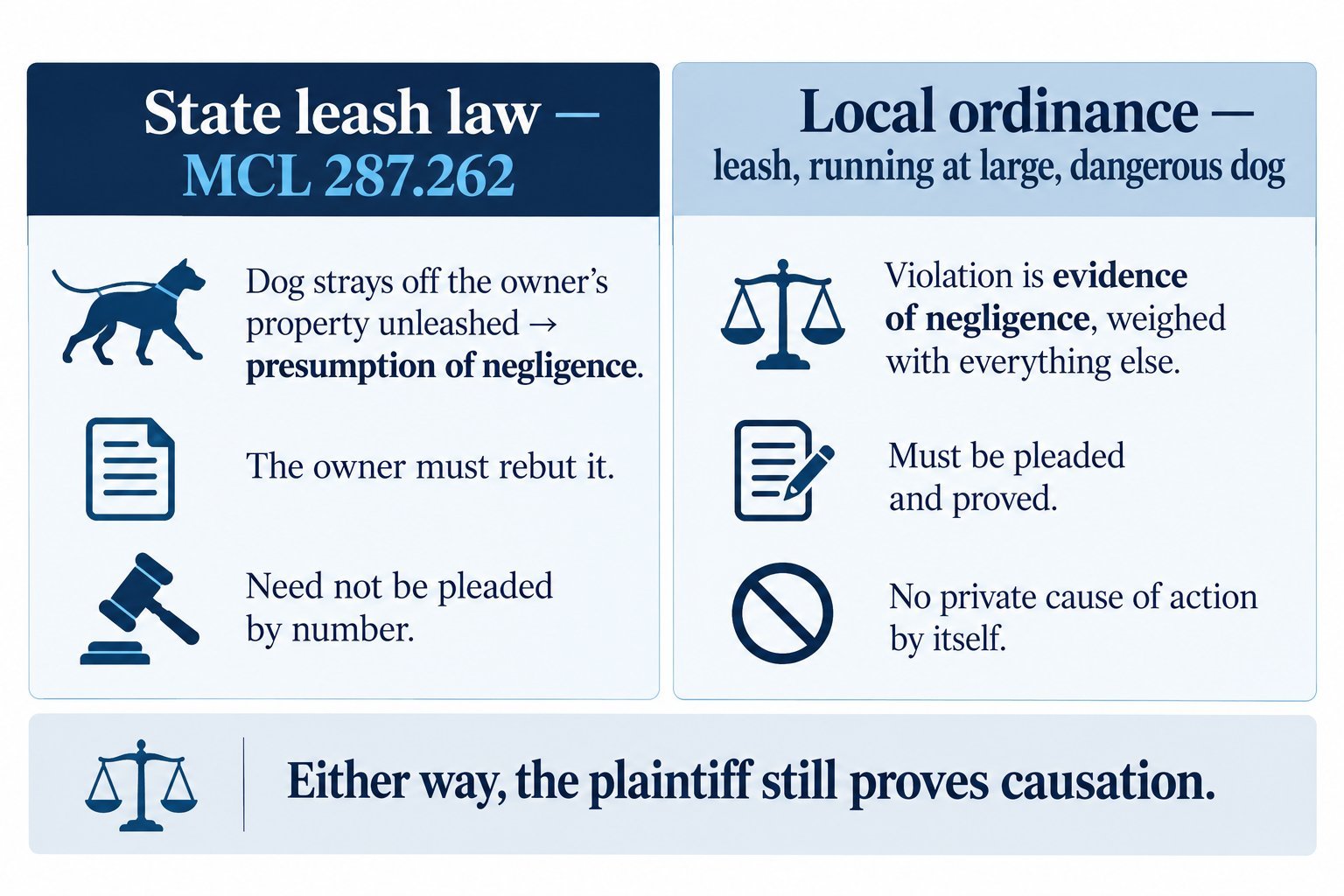
Michigan’s leash law adds a shortcut. The statute makes it unlawful for an owner to allow a dog to stray off the owner’s property unless it is on a leash. A dog that gets loose and hurts someone is presumed to have been negligently kept, and the owner has to explain why not. Local leash and running-at-large ordinances are weaker: breaking one is evidence of negligence, but not a presumption. In a negligence case, unlike a statutory bite case, your own carelessness can reduce your recovery.
Analysis
The negligence standard
The Supreme Court recognized the negligence claim in Trager v. Thor, 445 Mich. 95 (1994), and adopted its standard from a Washington decision: “[A] negligence cause of action arises when there is ineffective control of an animal in a situation where it would reasonably be expected that injury could occur, and injury does proximately result from the negligence. The amount of control required is that which would be exercised by a reasonable person based upon the total situation at the time, including the past behavior of the animal and the injuries that could have been reasonably foreseen.” Id. at 106. The claim lies against anyone in possession of the dog, including a temporary caretaker, id. at 107–108, and “[t]here is no logical reason to limit negligence liability to owners or keepers of animals.” Trager v. Thor, 199 Mich. App. 223, 237 (1993), aff’d in relevant part, 445 Mich. 95. “To make a prima facie case of ordinary negligence, plaintiff need only show that defendant failed to exercise ordinary care under the circumstances to control or restrain.” Rickrode v. Wistinghausen, 128 Mich. App. 240, 247 (1983); Hiner v. Mojica, 271 Mich. App. 604, 613 (2006).
When the duty arises. Dogs are “generally regarded as so unlikely to do substantial harm that their possessors have no duty to keep them under constant control.” Trager, 445 Mich. at 105–106. The duty to control arises in two situations: when the possessor knows of a dangerous propensity in the particular dog, or when the possessor “is aware that the animal is in such a situation that a danger of foreseeable harm might arise.” Hiner, 271 Mich. App. at 613 (quoting Trager). The second trigger is what separates negligence from strict liability. In Hiner the dog had been aggressive toward the cable technician on an earlier service call, lunged at the technicians from its leash as they came up to the porch, and one of them told the owner “the dog doesn’t like us”; she nodded. Id. at 607, 613. The back door of the breezeway was left propped open while they worked in the yard, the dog came at them from behind, and the plaintiff ruptured a tendon running from it. Id. at 607–608. No dangerous propensity was shown, but the owner’s awareness of the situation meant she “had a legally recognized duty to control her dog to the extent reasonable to guard against foreseeable danger,” and whether the propped door and the length of the leash breached it was for the jury. Id. at 613–614. It is not necessary to foresee the exact mechanism of injury, only that some injury could result. Id. at 614 n.3.
The claim does not require a dangerous propensity. That is the point of Hiner, and the Court of Appeals confirmed it in Kelsey v. Lint, 322 Mich. App. 364, 377–378 (2017): a negligence claim for failing to control a dog is judged by the Trager standard, not by the entrant categories of premises law and not by scienter. One unpublished panel, over a dissent, resolved a jumping-dog case by asking whether the owners knew of aggressive behavior, Kinney v. Crane (2014) (unpublished); the dissent, relying on Hiner, correctly observed that propensity “is not central to a negligence claim.” The published rule is Hiner‘s, and the negligence count is pleaded on the situation, not on the dog’s record.
The duty is a question of law; breach is for the jury. Whether the possessor had reason to expect harm is decided by the court, Trager, 445 Mich. at 105; what a reasonable person would have done about it is decided by the jury. Hiner, 271 Mich. App. at 614; Fitzpatrick v. Bridgestone Retail Operations, LLC, 444 F. Supp. 3d 786, 797–798 (E.D. Mich. 2020) (owner on notice of the dog’s history, in unfamiliar surroundings, owed a heightened duty; summary judgment on breach denied where the dog was kept on a short leash at her side). The unpublished decisions turn on what was foreseeable from the possessor’s side: a high-energy dog unhooked from its stake, which sprinted at the neighbor trailing its leash, with the owner’s admission that it had knocked him down twice the same way, reached a jury, Radcliffe v. Herdman (2023); a dog on a cable that could not reach the delivery driver, known only to bark at strangers, did not. Smith v. Conroy (2017).
Premises-liability defenses do not apply. The failure-to-control claim is ordinary negligence, not premises liability, and “the duty owed by a landowner is separate and distinct from the duty owed by the dog’s owner.” Hiner, 271 Mich. App. at 615–616. The owner therefore cannot invoke the entrant categories of premises law, and the once-familiar argument that the plaintiff could see the dog is not a defense at all: the open-and-obvious doctrine never applied to this claim, id., and the Supreme Court has since abolished it as a bar to any claim, leaving the obviousness of a danger as nothing more than a comparative-fault consideration. Kandil-Elsayed v. F & E Oil, Inc., 512 Mich. 95 (2023).
The leash law, MCL 287.262
“It shall be unlawful … for any owner to allow any dog, except working dogs such as leader dogs, guard dogs, farm dogs, hunting dogs, and other such dogs, when accompanied by their owner or his authorized agent, while actively engaged in activities for which such dogs are trained, to stray unless held properly in leash.”
Violation is a misdemeanor, MCL 287.286, and the statute supplies the standard of care in a civil case. “Whereas a violation of an ordinance is only evidence of negligence, violation of a statute creates a rebuttable presumption of negligence.” Cassibo v. Bodwin, 149 Mich. App. 474, 477 (1986). “[V]iolation of a statute is prima facie evidence of negligence, creating a rebuttable presumption of negligence, while violation of an ordinance is merely evidence of negligence.” Hack v. Foster, 89 Mich. App. 254, 256 (1979). The Supreme Court noted the same thing in Trager: “A duty to constantly control an animal may be imposed by statute, such as the obligation to properly hold a dog in leash. M.C.L. § 287.262.” 445 Mich. at 106 n.12.
What the statute requires. It is addressed to the owner and forbids allowing the dog “to stray unless held properly in leash.” “Stray” means to leave the owner’s premises; the statute does not require leashing a dog on its owner’s own land. Tieman v. Grinsteiner (2011) (unpublished). “Allow” does not require intent to let the dog roam: an owner who let two dogs out of the house unleashed violated the statute when one bounded to the road, because “the statute’s mandate that an owner maintain her dog on a leash qualifies as unambiguous and unconditional.” Roesner v. Tyler (2010) (unpublished) (rejecting the trial court’s reading that the statute excuses a dog that strays “without the owner’s permission”). A leashed dog that breaks the leash and gets away is the classic case: the presumption arises, and whether the restraint was adequate is the owner’s rebuttal. Hack (Doberman broke its leash while being walked and attacked a woman walking her schnauzer, 89 Mich. App. at 256); Young v. Esker (1998) (unpublished) (leash hook broke on a large dog; “plaintiff was entitled to a rebuttable presumption of negligence”).
How the presumption works. Under Zeni v. Anderson, 397 Mich. 117, 129–130 (1976), the violation “establishes only a prima facie case of negligence, a presumption which may be rebutted by a showing on the part of the party violating the statute of an adequate excuse under the facts and circumstances of the case.” Hack, 89 Mich. App. at 257–258 (quoting Zeni). The jury weighs the presumption against the excuse; an instruction that the presumption “has no weight as evidence” once challenged is reversible error. Hack, 89 Mich. App. at 259. Where the violation is undisputed and the excuse is thin, the plaintiff is entitled to go to the jury, but not to judgment: “a jury must decide whether the circumstances present evidence rebutting the presumption of negligence arising from [the] apparent violation of the leash law.” Roesner. Causation remains the plaintiff’s burden; in Cassibo the loose dog caused a cyclist to fall into the path of a truck, and the jury found the owners negligent but found that their negligence was not a proximate cause. 149 Mich. App. at 476–478.
Pleading. The statute need not be pleaded by number. Courts take judicial notice of statutes, “it is not a fatal defect to fail to plead a statute if the pleadings set forth sufficient facts to show a claim or defense based on the statute,” and an amendment to add it “is, therefore, in the nature of procedural ‘housekeeping.'” Cassibo, 149 Mich. App. at 477. Denying leave to add the leash-law count after summary disposition on the negligence count was plain error. Radcliffe. Ordinances are different: they must be pleaded and proved. Cassibo, 149 Mich. App. at 477.
Who answers for the violation. The owner. When a house-sitter let the dog out and the leash failed, the sitter’s conduct was imputed to the owners, who had left her in charge; there was no “intervening third party.” Young.
Local ordinances
Nearly every Michigan city and township has a leash, running-at-large or dangerous-dog ordinance, usually adopted under MCL 287.290. Three rules govern their use in a civil case.
Violation is evidence of negligence, not a presumption and not negligence per se. “It is well established that violation of an ordinance is evidence of negligence.” Cassibo, 149 Mich. App. at 477; Rickrode, 128 Mich. App. at 247. A trial court that directed a verdict for the plaintiff because the owners’ dogs had undisputedly escaped in violation of a running-at-large ordinance was reversed: “the existence of the ordinance did not alter the nature and extent of defendants’ common law duty to control their animals,” and Trager “requires the fact-finder to consider all evidence relevant to ‘the total situation’ at the time of the injury,” including the dogs’ history and how they got out. Mitchell v. Cunningham (2006) (unpublished). An ordinance can, by its own terms, declare a violation prima facie evidence of negligence, as Detroit’s did in Hack, 89 Mich. App. at 256–257, and the plaintiff should plead that provision when the ordinance contains one.
An ordinance creates no private cause of action by itself. Even an ordinance that defines “owner” broadly, requires liability insurance for dangerous dogs, or declares that anyone harboring a dog “shall be held accountable” for its acts does not create a civil claim against a person the common law would not reach, such as a non-occupying landlord. Szkodzinski v. Griffin, 171 Mich. App. 711, 713 (1988); Cooper v. Guiterrez (2014) (unpublished). The ordinance is used inside a negligence claim against a person who owed a duty, as evidence of the standard of care.
Running-at-large ordinances are read like the statute. A dog loose on its owner’s own property is not “running at large.” Kibbe v. Richie (2012) (unpublished).
The practical sequence is this: plead negligence under Trager; plead the state leash law whenever the dog left the owner’s property; plead the local ordinance by number as additional evidence; and prove the violation with the animal-control citation, the officer’s report, or the owner’s admission.
Comparative fault and the relationship to the other claims
Negligence is the one dog claim in which the plaintiff’s own conduct reduces recovery. Comparative negligence under MCL 600.2959 applies, and a finding that the plaintiff provoked the dog does not bar the common-law negligence claim; it is weighed as the plaintiff’s fault. Hill v. Hoig, 258 Mich. App. 538, 540–542 (2003) (jury found provocation and rejected the statutory claim, but found for the plaintiff on negligence; refusal to instruct that provocation barred the negligence claim affirmed). The older rule that provocation or contributory negligence was a complete defense, Grummel v. Decker, 294 Mich. 71, 77 (1940), did not survive the adoption of comparative negligence. Hill v. Hoig, 258 Mich. App. at 541–542. By contrast, no fault is allocated on the statutory claim, Hill v. Sacka, 256 Mich. App. 443, 451 (2003), and on common-law strict liability only willful provocation or gross negligence is a defense. Rickrode, 128 Mich. App. at 247–248. The three claims therefore need three different instructions on fault, and a verdict form that keeps them apart. See Chapter 11.
Negligence is also the claim that reaches non-owners. A temporary caretaker (Trager), a house-sitter whose negligence is imputed to the owner (Young), and an employer whose employees’ dog bit a customer in its store (Ball v. Fourment (2017) (unpublished)) all answer in negligence and in nothing else. A landlord’s exposure for a tenant’s dog is a negligence or premises question governed by the authorities in Chapter 9. And negligence is the claim that covers the injury without a bite, the subject of Chapter 8.
For lawyers
Practice points
- Plead the negligence count on the situation, in Trager‘s words: the possessor knew of facts making harm foreseeable and failed to exercise the control a reasonable person would have exercised. Do not plead it as a scienter claim; that invites the Kinney error.
- Whenever the dog left the owner’s property, plead MCL 287.262 and request the Zeni/Hack presumption instruction. Object to any instruction that the presumption has no evidentiary weight once rebutted. Hack at 259.
- Plead the local ordinance by section and prove the violation with the citation or the owner’s admission; it must be pleaded and proved. Cassibo at 477.
- Build the “situation” record: prior visits, warnings the owner received, the dog’s size and energy, the restraint used and why it failed, who was present and how close. Hiner, Radcliffe and Fitzpatrick reached juries on those facts; Smith v. Conroy, Adams and Hudson did not.
- Get the owner’s admissions about the dog’s past into admissible form. The owner’s statement that the dog had “done the same thing to me twice” was the evidence that reversed summary disposition in Radcliffe; the trial court had wrongly disregarded it as hearsay, although it was a party admission under MRE 801(d)(2).
- Where the restraint failed, obtain the leash, collar, clip, tether or gate and have it inspected; the owner’s rebuttal to the presumption is that the restraint was adequate.
- Expect the defense to introduce the dog’s benign history on the negligence count; it is relevant to the “total situation.” Mitchell. Decide whether that evidence helps or hurts before deciding which counts to try.
- Prove causation separately. A leash-law presumption establishes negligence, not that the negligence caused the fall. Cassibo at 477–478.
- Against a non-owner in control of the dog, this is the only claim; plead it against the caretaker and, through agency, against the owner. Young; Ball.
Authorities
Published decisions
| Case | Court / year | Point |
|---|---|---|
| Trager v. Thor, 445 Mich. 95 | Mich. 1994 | Negligence standard (“total situation”); no duty of constant control absent knowledge; claim lies against temporary possessors; leash statute may impose a duty (n.12). |
| Trager v. Thor, 199 Mich. App. 223 | Ct. App. 1993 | Anyone who undertakes to care for an animal must use ordinary care; negligence not limited to owners or keepers. |
| Hiner v. Mojica, 271 Mich. App. 604 | Ct. App. 2006 | Duty from awareness of a situation of foreseeable harm; breach for the jury; premises-liability defenses inapplicable to ordinary negligence. |
| Rickrode v. Wistinghausen, 128 Mich. App. 240 | Ct. App. 1983 | Prima facie negligence is failure to use ordinary care to control or restrain; ordinance violation is evidence of negligence; comparative fault applies. |
| Cassibo v. Bodwin, 149 Mich. App. 474 | Ct. App. 1986 | Statute violation = rebuttable presumption; ordinance violation = evidence; statute need not be pleaded by number; causation still required. |
| Hack v. Foster, 89 Mich. App. 254 | Ct. App. 1979 | Leash-law presumption must be weighed by the jury against the excuse; “bubble-bursting” instruction is reversible error. |
| Hill v. Hoig, 258 Mich. App. 538 | Ct. App. 2003 | Comparative negligence applies to the negligence claim; provocation is not a complete bar. |
| Kelsey v. Lint, 322 Mich. App. 364 | Ct. App. 2017 | Failure-to-control claim judged by Trager/Hiner, not entrant duties. |
| Szkodzinski v. Griffin, 171 Mich. App. 711 | Ct. App. 1988 | Local dog ordinance creates no private cause of action. |
| Grummel v. Decker, 294 Mich. 71 | Mich. 1940 | Pre-comparative-fault rule that provocation/contributory negligence barred the claim; superseded on that point. |
| Fitzpatrick v. Bridgestone Retail Operations, 444 F. Supp. 3d 786 | E.D. Mich. 2020 | Owner on notice owed the Trager duty in unfamiliar surroundings; breach for the jury. |
Unpublished Court of Appeals decisions
Unpublished opinions are not binding precedent under MCR 7.215(C)(1).
| Case | Year | Point |
|---|---|---|
| Radcliffe v. Herdman, 2023 WL 327860 | 2023 | Leash-law presumption under Cassibo; amendment to add the statute not futile; owner’s admission of prior knock-downs created a fact question. |
| Roesner v. Tyler, 2010 WL 5093295 | 2010 | “Allow … to stray” is unconditional; letting dogs out unleashed violates § 262; jury decides the rebuttal. |
| Young v. Esker, 1998 WL 1991225 | 1998 | Broken leash hook; presumption of negligence; house-sitter’s conduct imputed to owners. |
| Tieman v. Grinsteiner, 2011 WL 5108506 | 2011 | “Stray” means off the owner’s premises; no leashing requirement on the owner’s own land. |
| Mitchell v. Cunningham, 2006 WL 659465 | 2006 | Ordinance violation is evidence, not negligence per se; dogs’ history and manner of escape admissible. |
| Kibbe v. Richie, 2012 WL 5854486 | 2012 | Running-at-large ordinance does not reach a dog loose on its owner’s property. |
| Cooper v. Guiterrez, 2014 WL 465713 | 2014 | Dangerous-dog ordinance with broad “owner” definition creates no private claim. |
| Smith v. Conroy, 2017 WL 461263 | 2017 | Dog on a cable that could not reach the plaintiff, known only to bark at strangers: no foreseeable harm, no duty. |
| Kinney v. Crane, 2014 WL 2917803 | 2014 | Majority required knowledge of aggression for a jumping-dog negligence claim; dissent applied Hiner. |
| Adams v. Wooldridge, 2013 WL 1748586 | 2013 | Caretakers without knowledge of dangerousness owed no duty of constant control. |
| Ball v. Fourment, 2017 WL 694683 | 2017 | Employees’ dog bit a customer in the employer’s store; employer vicariously liable for the employees’ negligence though not an “owner” under the statute. |
| Hudson v. Canterbury Health Care, 2013 WL 6670811 | 2013 | Without a prior incident or a known risky situation, no duty (facility birds). |
Common questions
The dog that hurt me got loose from its yard. Is that enough?
Under Michigan’s leash law, a dog that strays off its owner’s property without a leash is presumed to have been negligently kept. The owner has to show the restraint was adequate. You still have to show the escape caused your injury.
The owner says the leash broke and it wasn’t his fault.
That is the owner’s rebuttal, and a jury decides whether a leash that broke on that dog was reasonable. A leash or clip that cannot hold a large dog is itself the negligence.
The dog had never done anything like this before.
Negligence does not require a prior incident. It asks whether the owner used reasonable care in the situation: a propped-open door with workers in the yard, a big excitable dog let loose near people, a restraint that failed.
Does my own carelessness matter?
In a negligence claim, yes; your fault reduces your recovery in proportion. It does not reduce a statutory bite claim at all.
The city’s leash ordinance was violated. Can I sue under the ordinance?
Not by itself. The violation is evidence of negligence in your negligence claim against the owner, and the state leash law gives you a presumption.
Hurt by a loose or uncontrolled dog?
Leash-law and negligence claims turn on evidence that disappears fast: the leash, the gate, the animal-control report. JKH Law preserves it. Consultations are free, in Grand Rapids and statewide.
This page is part of the Michigan Dog Bite Law Compendium published by JKH Law, PLC. It is legal information about Michigan law, not legal advice about any particular situation, and reading it does not create an attorney-client relationship. Citations were last checked in October 2026. Unpublished opinions are identified as such and are not binding under MCR 7.215(C)(1).

Personal injury litigation for Grand Rapids and West Michigan.
312 Fulton Street EastGrand Rapids, MI 49503 (616) 226-3762
Fax (616) 988-6504
Free consultation