
Chapter 11 · What the owner can argue
Defenses and Comparative Fault
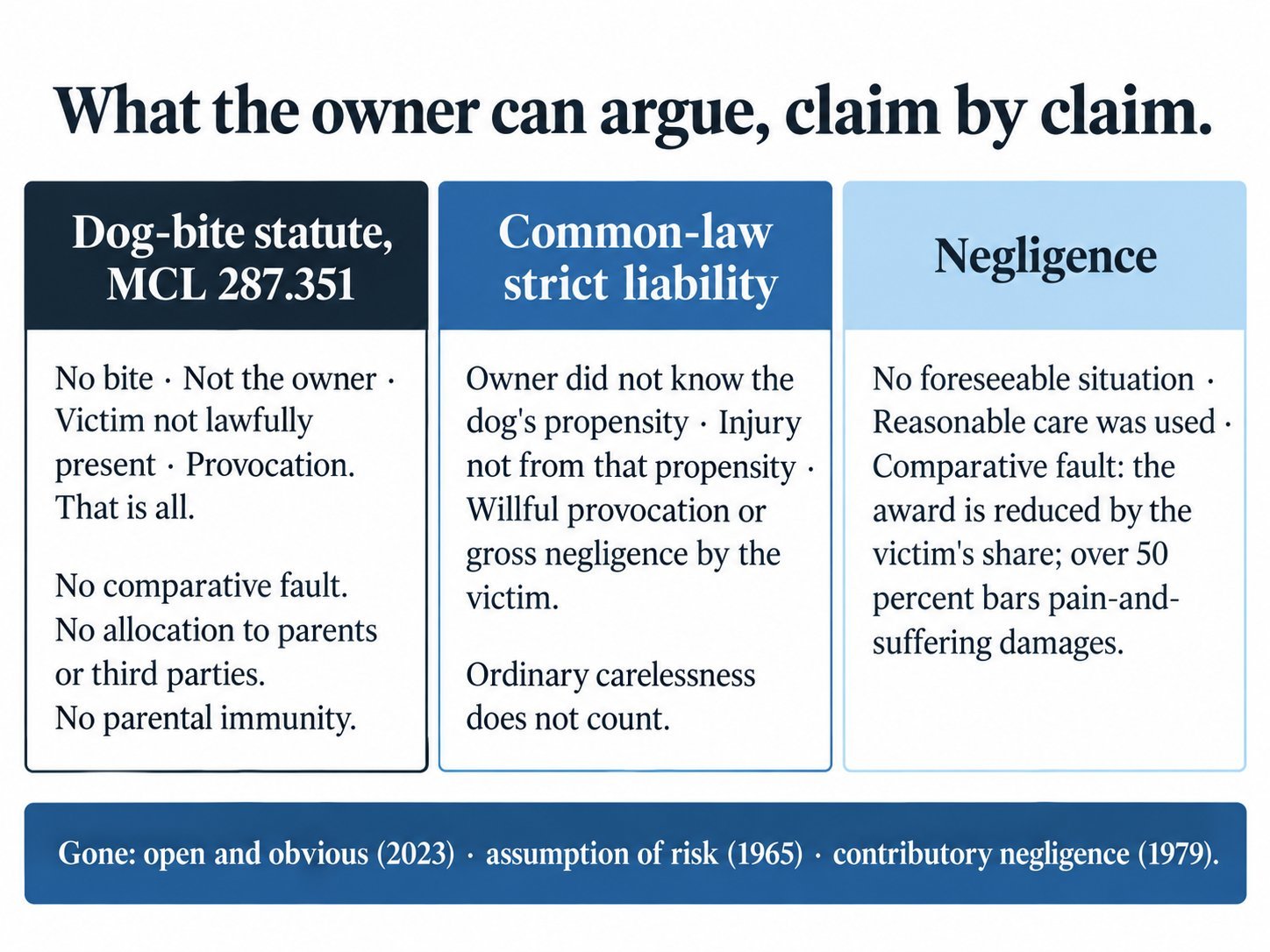
A dog owner sued in Michigan has very few defenses to the statutory claim and a familiar set of defenses to the common-law claims. The victim’s own carelessness does not reduce a statutory recovery at all, reduces a negligence recovery in proportion, and defeats a common-law strict-liability claim only if it amounts to willful provocation or gross negligence. This chapter maps the defenses to the claims, identifies the ones that no longer exist, and explains why the three counts must be instructed separately.

In plain terms
Three claims, three sets of defenses
The defenses available to a dog owner depend on which claim the victim brings, and in most cases the victim brings all three. Under the dog-bite statute the owner’s only real defense is provocation. If the dog bit, the defendant owned it, the victim was somewhere she had a right to be, and the dog was not provoked, the owner pays for all of the harm. It does not matter that the owner was careful, that the dog had never bitten before, that the victim was careless, or that someone else (a parent who looked away, a friend who opened the gate) contributed. None of that reduces the award.
The common-law negligence claim is different. There the victim’s own carelessness counts: a jury assigns percentages of fault, and the award is reduced by the victim’s share. If the victim’s share is more than half, the victim recovers nothing for pain and suffering. The common-law strict-liability claim sits in between: the victim’s ordinary carelessness is no defense, but willful provocation or gross negligence in dealing with a dog the victim knew was dangerous is.
Some arguments that dog owners still make are no longer defenses in Michigan. “She should have seen the dog” was once a complete defense under the open-and-obvious doctrine; the Supreme Court abolished that doctrine in 2023. “He assumed the risk by going near the dog” has not been a defense for sixty years. “Her own carelessness bars the claim” ended when Michigan replaced contributory negligence with comparative fault in 1979. What remains is a short list, and this chapter sets it out claim by claim.
Analysis
Defenses to the statutory claim
The statute makes the owner liable for “any damages suffered by the person bitten,” and “[t]he present statute places absolute liability on the owner, except for provocation.” Nicholes v. Lorenz, 49 Mich. App. 86, 88 (1973), aff’d 396 Mich. 53 (1976). “[U]nder the present statute ‘provocation’ is the only defense in this type of case. Contributory negligence is not a defense, except as the negligence might bear on provocation.” Id.; Veal v. Spencer, 53 Mich. App. 560, 564, 566 (1974); Thelen v. Thelen, 174 Mich. App. 380, 386 (1989). What the defendant can contest is therefore the prima facie case and provocation:
No bite. The statute requires a bite; a knock-down, a scratch or a fall while fleeing is not within it (Chapter 8). Whether the injury was a bite is a jury question, and a defendant may argue “scratch, not bite” and attack the plaintiff’s credibility without having pleaded either as an affirmative defense, because MCR 2.111(F) “applies only to affirmative defenses, and not those defenses that challenge a plaintiff’s prima facie case.” Knapp v. Card (2004) (unpublished) (reversing JNOV; the burden stays with the plaintiff to prove a bite).
Not the owner. The statute reaches “the owner of the dog” and no one else; a landlord, dog-sitter, employer or municipality is not liable under it (Chapter 5).
Unlawful presence. The victim must have been on public property or lawfully on private property. A trespasser, or a person on the owner’s land for an unlawful purpose, is outside the statute, but a person with implied license, including a solicitor on an ordinary residential approach, is within it (Chapter 4).
Provocation. The one true defense. It is judged objectively by the dog’s reaction to the victim’s act, it need not be intentional, it is all-or-nothing, and the owner bears the burden of raising it (Chapter 3).
Governmental immunity. A city or county that owns a dog is immune from the statutory claim, because the statute does not state an exception to the Governmental Tort Liability Act (Chapter 10).
That is the list. The defenses that do not exist are as important as the ones that do.
No comparative fault. “[T]he dog-bite statute does not allow for consideration of any comparative negligence on the part of the dog-bite victim, excluding possibly where the negligence may relate to the defense of provocation.” Hill v. Sacka, 256 Mich. App. 443, 451 (2003). The owner’s care is equally irrelevant: “Whether defendants exercised reasonable care is irrelevant in establishing liability under the dog-bite statute because liability is absolute absent provocation,” and instructions injecting reasonable care or “greater vigilance around children” were error. Id. at 459. “Liability under the statute extends to ‘any’ damages incurred by the plaintiff, which by definition includes all damages suffered.” Id. at 451.
No allocation to third parties and no nonparty-fault notice. In Hill v. Sacka the owners filed a notice naming the child’s father as an at-fault nondefendant for failing to stop his son from approaching a chained German shepherd. The Court of Appeals held that “the fault or negligence of a third person, i.e., not the dog owner or the direct victim of the dog bite, is likewise not relevant,” id. at 451–452, and that “the statutes concerning allocation of fault, M.C.L. § 600.2957 and M.C.L. § 600.6304, are not applicable in an action brought pursuant to the dog-bite statute, M.C.L. § 287.351, which provides for absolute liability absent provocation.” Id. at 462. The reasoning: the allocation statutes govern actions “predicated on concepts of fault,” and under the dog-bite statute “there is no ‘conduct’ that gives rise to liability. The dog owner need not do anything for there to be liability; the owner simply owns a dog that bites another person.” Id. at 454–455. The 1995 reference to “strict liability” in § 6304(8) was written for products cases and omits the “absolute liability” Michigan has always imposed on keepers of dangerous animals, id. at 455–456, and in any event the dog-bite statute is the more specific enactment and controls. Id. at 457. A parent’s negligent supervision therefore neither reduces the child’s statutory recovery nor supports a notice under MCR 2.112(K).
No parental immunity. A child bitten by a parent’s or stepparent’s dog may sue under the statute. “[P]arental immunity does not bar dog bite suits based on M.C.L. § 287.351,” because the Legislature made owners liable to persons lawfully on the owner’s own property and “we see no sound reason to deny recovery on the basis of the parties’ familial relationship.” Thelen, 174 Mich. App. at 386–387. The negligence counts in the same case were barred, because the decision to bring a dog into the home is a matter of parental discretion. Id. at 385. The statutory count is the intra-family claim.
No contributory negligence. The pre-1939 common-law rule that a plaintiff’s contributory negligence or provocation barred the claim, Grummel v. Decker, 294 Mich. 71, 77 (1940), never applied to the statute, Veal, 53 Mich. App. at 566, and has been displaced on the common-law counts by comparative fault. Hill v. Hoig, 258 Mich. App. 538, 541–542 (2003).
Defenses to the common-law claims
Strict liability: willful provocation or gross negligence only. Once the plaintiff proves possession, scienter and harm from the known propensity, the owner is liable “regardless of fault,” and an escape beyond the owner’s control is no defense. Papke v. Tribbey, 68 Mich. App. 130, 134–136 (1976). On this theory the plaintiff’s “negligence … or for that matter any fault, is not at issue”; “[o]nly the defenses of willful provocation or gross negligence” by the plaintiff preclude recovery. Rickrode v. Wistinghausen, 128 Mich. App. 240, 247–248 (1983); Papke, 68 Mich. App. at 135; Brooks v. Taylor, 65 Mich. 208 (1887). Ordinary carelessness, such as petting a dog one did not know to be dangerous, is not gross negligence. See Chapter 6.
Negligence: comparative fault. The negligence claim is governed by MCL 600.2959, under which the court reduces the damages by the plaintiff’s percentage of fault, and if the plaintiff’s fault exceeds the combined fault of everyone else, economic damages are reduced and noneconomic damages are barred. Provocation is not a complete defense to the negligence count; it is weighed as the plaintiff’s fault. Hill v. Hoig, 258 Mich. App. at 540–542 (jury found provocation, rejected the statutory claim, found for the plaintiff in negligence with no fault on her part; refusal to instruct that provocation barred the claim affirmed); Rickrode, 128 Mich. App. at 248. The allocation statutes that Hill v. Sacka held inapplicable to the statutory count apply to the negligence count in the ordinary way: fault is allocated among parties and properly noticed nonparties, MCL 600.2957, 600.6304, and the jury in Skiver v. Durga (2022) (unpublished) allocated 60 percent to the park operator and 40 percent to the dog’s owner. The practical consequence is that a defense that is worthless against the statute (the parent looked away; the friend opened the gate; the victim walked up to the dog) is live against the negligence count, and the plaintiff who has a statutory claim should try the case on it.
Premises liability (non-owner defendants). Against a landlord or other possessor of land, the defenses are the elements: no knowledge of this dog’s dangerousness, no possession or control of the place of attack, an attack off the premises or within the tenant’s leasehold, and the entrant categories, which survive. Kandil-Elsayed v. F & E Oil, Inc., 512 Mich. 95 (2023); Chapter 9. A trespasser is owed only the duty to refrain from willful and wanton misconduct. Tripp v. Baker, 346 Mich. App. 257, 264 (2023).
Defenses that no longer exist
Open and obvious. The doctrine that a possessor of land owed no duty to protect against a danger the visitor could see was abolished by the Supreme Court in Kandil-Elsayed v. F & E Oil, Inc., 512 Mich. 95 (2023). The obviousness of a danger is now at most a consideration in allocating comparative fault, and the elements of a premises claim are otherwise unchanged. Leiendecker v. Ascension Genesys Hospital, ___ Mich. App. ___, 2026 WL 97441, at *4 n.3 (Jan. 13, 2026). The doctrine never applied to the dog owner’s negligence claim in any event, because the owner’s duty to control the dog is “separate and distinct from the duty owed by” a landowner. Hiner v. Mojica, 271 Mich. App. 604, 615–616 (2006). Pre-2023 dog decisions resolved on open-and-obvious grounds (Tripp at 270; Allen v. A & M Properties (2011); Stoll v. Stobby (2008); Tosa v. Yono (2008), all unpublished but Tripp) are superseded on that point.
Assumption of risk. The Supreme Court confined the doctrine to the employment relationship and, “perhaps,” express contractual assumption of risk, and directed that it “should not again be used in this State as a substitute for, or as a supplement to, or as a corollary of, contributory negligence.” Felgner v. Anderson, 375 Mich. 23, 55–57 (1965) (overruling the cases that had used it otherwise). An argument that the victim “assumed the risk” by approaching a dog is, on the negligence count, an argument about comparative fault and nothing more; on the statutory count it is an argument about provocation or it is nothing.
Contributory negligence. “[T]he doctrine of comparative negligence hereby replaces the doctrine of contributory negligence.” Placek v. City of Sterling Heights, 405 Mich. 638, 650 (1979), now codified at MCL 600.2959. Grummel‘s complete-bar rule is gone. Hill v. Hoig, 258 Mich. App. at 541–542.
“The dog never bit anyone before.” Not a defense to the statute, which requires no scienter, and not a defense to negligence, which requires only a foreseeable situation. It is a defense to common-law strict liability only in the sense that the plaintiff must prove the owner knew of the propensity, and a prior bite is not required to prove it. Massengile v. Piper, 294 Mich. 653 (1940); Rickrode, 128 Mich. App. at 245–246.
Time limits
All three claims are actions “to recover damages … for injury to a person” and must be commenced within three years of the injury. MCL 600.5805(1), (2). A victim who was under eighteen when bitten has until one year after turning eighteen if the three years have already run, MCL 600.5851(1); the parents’ own claim for the child’s medical expenses is subject to the ordinary three-year period. A first-party claim against the victim’s own insurer may carry a shorter contractual or statutory period (Chapter 13). Claims against a governmental agency have their own notice and immunity rules (Chapter 10).
Instructing the jury on three fault regimes
The courts have been warning about this since 1974. In Veal the jury was told that the mother’s contributory negligence barred recovery unless the dog was known to be vicious, an instruction that was wrong as to the statutory count; the issue was unpreserved, but the court wrote that “[m]embers of the bench and bar should be aware of this problem, and proceed accordingly,” and that “a proper approach … would involve a jury instruction which distinguishes between the two counts and the application of the defense … to the same.” 53 Mich. App. at 566. Hill v. Sacka reversed nothing only because the error was harmless, and Rickrode directed the trial court on remand to instruct that the plaintiff’s fault “is not at issue” if the jury finds scienter and to apply comparative negligence only if it does not. 128 Mich. App. at 247–248. The verdict form must therefore ask the statutory questions (bite, owner, lawful presence, provocation) with no fault percentage; the strict-liability questions (scienter, causation, willful provocation or gross negligence) with no fault percentage; and the negligence questions with the comparative-fault allocation. A general verdict that blends them is an invitation to a new trial.
For lawyers
Practice points
- Move to strike a notice of nonparty fault directed at the statutory count, citing Hill v. Sacka at 451–452 and 462; MCR 2.112(K) has no application to a claim in which fault is not an element.
- Object to any instruction on the statutory count that mentions reasonable care, the owner’s precautions, the dog’s history or the plaintiff’s negligence; Hill v. Sacka at 459 holds them improper.
- Expect “scratch, not bite” and credibility attacks without a pleaded affirmative defense; Knapp. Prove the bite with the treating records, photographs of the wound pattern and the animal-control report, not the diagnosis alone.
- Where the victim is a child and a parent was present, the parent’s supervision is irrelevant to the child’s statutory claim and to the strict-liability claim; it is relevant to the negligence claim and to the parent’s own claim for medical expenses. Decide which counts to try with that in mind.
- Against a family-member owner, plead the statutory count; parental immunity bars negligence but not the statute. Thelen.
- On the negligence count, prepare the comparative-fault case affirmatively: the plaintiff’s conduct was ordinary, the owner’s knowledge was superior, and the victim had no way to appreciate the risk. The 50-percent threshold of MCL 600.2959 is the number that matters.
- Do not let “assumption of risk” or “open and obvious” into the instructions under any label; both are gone, and either is reversible error if it operates as a bar.
- Draft the verdict form claim by claim with separate fault questions; cite Veal at 566 and Rickrode at 247–248 in the request.
- Calendar the three-year period from the date of the bite, and the one-year post-majority period for a minor, separately from any first-party insurance deadline.
Authorities
Published decisions
| Case | Court / year | Point |
|---|---|---|
| Hill v. Sacka, 256 Mich. App. 443 | Ct. App. 2003 | No comparative fault, no third-party fault, no allocation under MCL 600.2957/600.6304 on the statutory claim; “any damages” means all; reasonable-care instructions improper. |
| Nicholes v. Lorenz, 49 Mich. App. 86, aff’d 396 Mich. 53 | Ct. App. 1973 / Mich. 1976 | Provocation the only statutory defense; contributory negligence irrelevant except as it bears on provocation; prior behavior irrelevant. |
| Veal v. Spencer, 53 Mich. App. 560 | Ct. App. 1974 | Fault defenses differ between the statutory and common-law counts; instruct separately. |
| Thelen v. Thelen, 174 Mich. App. 380 | Ct. App. 1989 | Parental immunity bars negligence but not the statutory claim; provocation the only statutory defense. |
| Hill v. Hoig, 258 Mich. App. 538 | Ct. App. 2003 | Comparative negligence applies to the negligence count; provocation not a complete bar there. |
| Rickrode v. Wistinghausen, 128 Mich. App. 240 | Ct. App. 1983 | On strict liability only willful provocation or gross negligence is a defense; comparative negligence on the negligence count; separate instructions. |
| Papke v. Tribbey, 68 Mich. App. 130 | Ct. App. 1976 | Escape beyond the owner’s control is no defense once scienter is shown; willful provocation or gross negligence only. |
| Grummel v. Decker, 294 Mich. 71 | Mich. 1940 | Pre-comparative-fault contributory-negligence bar at common law; superseded. |
| Kandil-Elsayed v. F & E Oil, Inc., 512 Mich. 95 | Mich. 2023 | Open-and-obvious doctrine abolished; obviousness goes only to comparative fault. |
| Hiner v. Mojica, 271 Mich. App. 604 | Ct. App. 2006 | Premises-liability defenses do not apply to the owner’s failure-to-control claim. |
| Tripp v. Baker, 346 Mich. App. 257 | Ct. App. 2023 | Trespasser owed only willful-and-wanton duty on a premises claim. |
| Felgner v. Anderson, 375 Mich. 23 | Mich. 1965 | Assumption of risk confined to employment and express contractual cases; not to be used as a substitute for or supplement to contributory negligence. |
| Placek v. City of Sterling Heights, 405 Mich. 638 | Mich. 1979 | Comparative negligence replaces contributory negligence. |
Unpublished Court of Appeals decisions
Unpublished opinions are not binding precedent under MCR 7.215(C)(1).
| Case | Year | Point |
|---|---|---|
| Knapp v. Card, 2004 WL 1621711 | 2004 | “Scratch, not bite” and credibility theories attack the prima facie case and need not be pleaded as affirmative defenses; burden of proving a bite stays with the plaintiff. |
| Skiver v. Durga, 2022 WL 7724061 | 2022 | Fault allocated 60/40 between park operator and owner on negligence and premises counts. |
| Michalek v. Estate of Malik, 2022 WL 128109 | 2022 | Panel extended Hill v. Sacka to bar a premises claim against a non-owner; an outlier inconsistent with Tripp, Feister and Szkodzinski. |
| Danison v. Velazquez, 1996 WL 33348816 | 1996 | “Accidental bumping” rather than a bite is a legitimate factual defense for the jury. |
Common questions
The owner says it was partly my fault. Does that reduce what I can recover?
Not under the dog-bite statute. The statute does not reduce the award for the victim’s carelessness; the only question about your conduct is whether you provoked the dog. Under a negligence claim, your share of fault reduces the award.
My child was bitten and the owner is blaming me for not watching her.
A parent’s supervision is irrelevant to the child’s claim under the statute; the Court of Appeals rejected exactly that argument in 2003. It can matter to a negligence claim and to a parent’s separate claim for medical bills.
The owner says I should have seen the dog and stayed away.
That used to be called the open-and-obvious defense. The Michigan Supreme Court abolished it in 2023. It was never a defense to a claim that the owner failed to control the dog.
My own parent’s (or stepparent’s) dog bit me. Can I sue?
Yes, under the dog-bite statute. Family relationship is not a defense to the statutory claim, though it bars a negligence claim against a parent. In practice these claims are paid by the homeowner’s insurer.
How long do I have?
Three years from the bite. A child has until one year after turning eighteen if the three years have already passed. Insurance deadlines can be shorter.
Being told the bite was your fault?
Under Michigan’s statute, the victim’s carelessness is not a defense. JKH Law holds owners and insurers to the statute. Consultations are free, in Grand Rapids and statewide.
This page is part of the Michigan Dog Bite Law Compendium published by JKH Law, PLC. It is legal information about Michigan law, not legal advice about any particular situation, and reading it does not create an attorney-client relationship. Citations were last checked in October 2026. Unpublished opinions are identified as such and are not binding under MCR 7.215(C)(1).

Personal injury litigation for Grand Rapids and West Michigan.
312 Fulton Street EastGrand Rapids, MI 49503 (616) 226-3762
Fax (616) 988-6504
Free consultation