
Chapter 9 · Someone else’s dog, someone else’s land
Landlords, Premises Liability and the Dog as a Condition on the Land
The dog-bite statute reaches the owner and no one else. When the owner is a tenant with no insurance, the question becomes whether the landlord, the property manager, the mobile-home park or the host who controlled the land where the attack happened can be held to answer. Michigan law says yes, in a defined set of circumstances: the possessor of the land knew the particular dog was dangerous, had the power to do something about it, and the attack occurred on land it controlled. This chapter sets out that law and the premises-liability theory on which it now rests.
In plain terms
When the dog’s owner is not the only defendant
Most dog attacks happen on someone’s property, and the person who owns the dog is often not the person who owns the property. A tenant’s pit bull gets through a hole in the landlord’s fence. A dog in a mobile-home park escapes for the fifth time and attacks a resident on the park road. A guest at a party is bitten by the host’s roommate’s dog. In each of these the victim can sue the dog’s owner under the statute, but the owner may be a renter with no homeowner’s policy and no assets, and the only solvent defendant is the one who controlled the land.
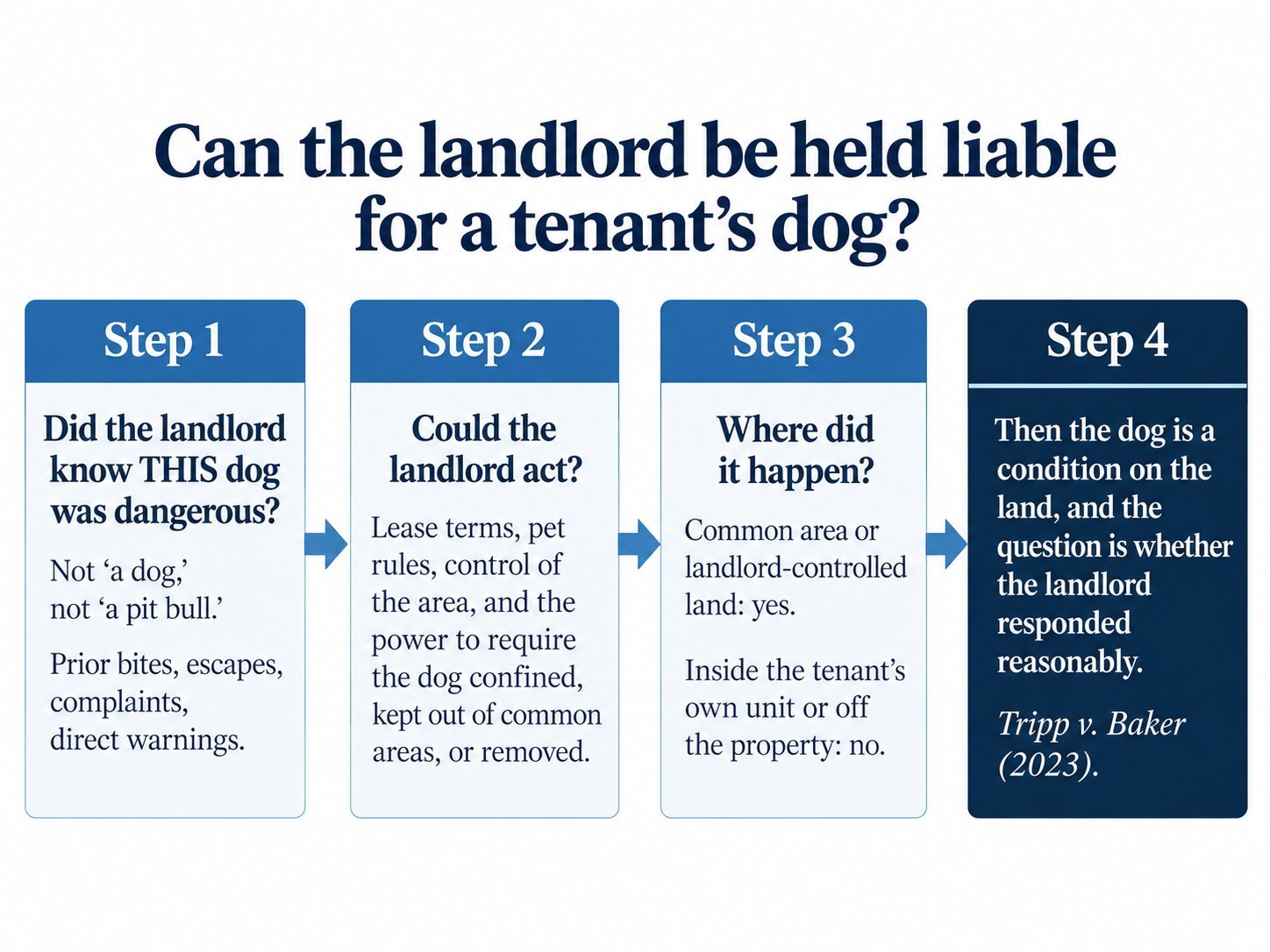
A landlord does not answer for a tenant’s dog simply because it is the landlord. Michigan law requires three things. First, the landlord (or park operator, or property manager, or host) must have known that this particular dog was dangerous; knowing that a tenant has a dog, or even that the dog is a pit bull, is not enough. Second, the landlord must have had some power to deal with the dog: a lease term, pet rules, or control of the common area where the attack occurred, which carries with it the power to require the dog confined, barred from the area or removed. Third, the attack must have happened on land the landlord controlled; a landlord is not responsible for what a tenant’s dog does down the street, and is not responsible for what happens inside the tenant’s own leased space.
When those things are present, the claim is a premises-liability claim: the dangerous dog is treated as a dangerous condition on the land, like a broken stair, and the possessor of the land who knew about it and did nothing is liable to the people it had a duty to protect. That is now settled Michigan law, and it has produced real recoveries, including a verdict against a mobile-home community that was affirmed on appeal. It has also produced many defense judgments, almost all for the same reason: the plaintiff could not prove the landlord knew.
Analysis
The three published rules
The statute never reaches the landlord. MCL 287.351 imposes liability on “the owner of the dog.” A landlord who knows a tenant keeps a dog is not its owner, keeper or harborer, and “[t]here is no basis for imposing strict liability on a landlord who neither owns, keeps nor controls the dog.” Szkodzinski v. Griffin, 171 Mich. App. 711, 713–714 (1988). A local ordinance that holds anyone “harboring” a dog “accountable for any and all acts” of the dog creates no private cause of action against the landlord either. Id. at 713. The landlord is reached, if at all, at common law, and “the only possible way that defendant could be held liable on a common law theory would be if he knew of the dog’s vicious nature.” Id. at 714. See Chapter 5.
Knowledge plus control; nothing for off-premises attacks. Feister v. Bosack, 198 Mich. App. 19 (1993), added the second element and drew the geographic line. “A landlord has no duty to protect third parties from injuries inflicted by a tenant’s pet that occur away from the leased premises.” Id. at 21. Where the tenant acquires the dog after the letting, liability requires that “the landlord had knowledge of the vicious propensities of the dog and had control of the premises or other capability to remove or confine the animal.” Id. at 23 (quoting Strunk v. Zoltanski (N.Y. 1984)). The bare power to evict is not that control; the court rejected the theory that a landlord must evict a tenant with a dangerous dog, because eviction “would merely result in the tenants’ moving off to another location with their still dangerous animals.” Id. at 25. “A landlord has no duty to inspect the premises to discover the existence of a tenant’s dangerous animal.” Id. at 26. As an alternative ground, the court added that the landlord, who had learned of the dog two days before the attack, “had no ability to control the tenants and their dog” in that time because a month-to-month tenant is entitled to thirty days’ notice, and stated that “[i]f a third party is injured before the landlord lawfully could have evicted the tenant, the landlord cannot be liable, even if he knew about the dog’s vicious nature.” Id. at 25–26; MCL 554.134(1). That passage is confined by its premise. It assumes a landlord whose only means of control is eviction, which was true in Feister: the attack was half a mile from the rental, and there was nothing on the leased premises the landlord could have fixed, warned about or barred the dog from. Where the attack occurs on land the landlord possesses, the duty is the premises duty to warn of or make safe a known dangerous condition, and the Feister control element itself is “control of the premises or other capability to remove or confine the animal,” id. at 23; repairing the fence, requiring the dog confined or muzzled, barring it from the common area, or demanding its removal under the pet rules are measures that take days, not thirty, and a landlord who has started an eviction and done nothing else has not discharged that duty. A park operator that ignored years of complaints was held to answer for an attack on its road, Skiver v. Durga (2022) (unpublished); a landlord that obtained a muzzle-and-leash agreement after a prior common-area bite still could not obtain summary disposition after the next one, Wendzel v. Feldstein (2015) (unpublished); and the question for the jury is whether “the landlord’s response to that knowledge was unreasonable.” Hamade v. Garza (2012) (unpublished). The pendency of the eviction period is a fact bearing on reasonableness in that inquiry, not a bar to it. Two further points about Feister bear on how it is used. Its holding is expressly about an attack “off the leased premises where the dog was acquired after the premises were leased,” id. at 26; and only two judges joined the broad rule, Judge Neff concurring in the result solely on the two-day point. Id. at 27. The off-premises rule has been applied to an attack on a neighbor’s own yard two lots away, James v. Gutherie (2014) (unpublished), and to a neighbor attacked in his own yard by dogs housed at the leased property. Johnson v. McComb (2011) (unpublished).
Pet rules alone create no duty. A mobile-home park that prohibits large or dangerous dogs does not, by adopting the rule, undertake a duty to every visitor to enforce it. In Braun v. York Properties, Inc., 230 Mich. App. 138 (1998), a $274,000 verdict for a twelve-year-old bitten inside a neighbor’s mobile home by a Labrador that violated the park’s size limit was vacated: no one, including the park, knew the dog was dangerous, the violated rule was a size restriction unrelated to safety, and the park “did not undertake to render services to another” by adopting rules whose “purpose is primarily to protect against harm to the premises.” Id. at 143, 147–148. Braun is not a holding that pet rules never matter. Its analysis turned on the absence of knowledge and on the mismatch between the rule and the harm, and its footnote 1 acknowledges that a landlord’s rules “would support a finding that they had the power to control their tenants’ harboring of dogs,” which is the Feister control element. The breed-restriction cases apply Braun the same way: a pit-bull ban does not impute knowledge that a particular pit bull is vicious, Stacey v. Colonial Acres Associates (2011) (unpublished); Burnett v. Clarke (2013) (unpublished); Burling v. Skief (2020) (unpublished), and a lease’s no-pet clause creates no duty to a neighbor who is not a party to it. Johnson.
The dog as a condition on the land
The theory that organizes these rules is premises liability. Its Michigan origin is Klimek v. Drzewiecki, 135 Mich. App. 115 (1984), where a four-year-old social guest was bitten in his uncle’s yard by a neighbor’s dog that the uncle knew was loose, unsupervised and had bitten before. The court held “that a loose, unsupervised and dangerous dog either on defendant’s land or in close proximity to defendant’s land without any obstacle to prevent it from entering defendant’s land is a ‘condition on the land'” within Restatement (Second) of Torts § 342, so that the occupier owed his guest the licensee duty to warn of or make safe a known danger. Id. at 119. Klimek was decided before November 1990 and so does not bind later panels under MCR 7.215(J)(1), but it was adopted in a published, binding decision in 2023.
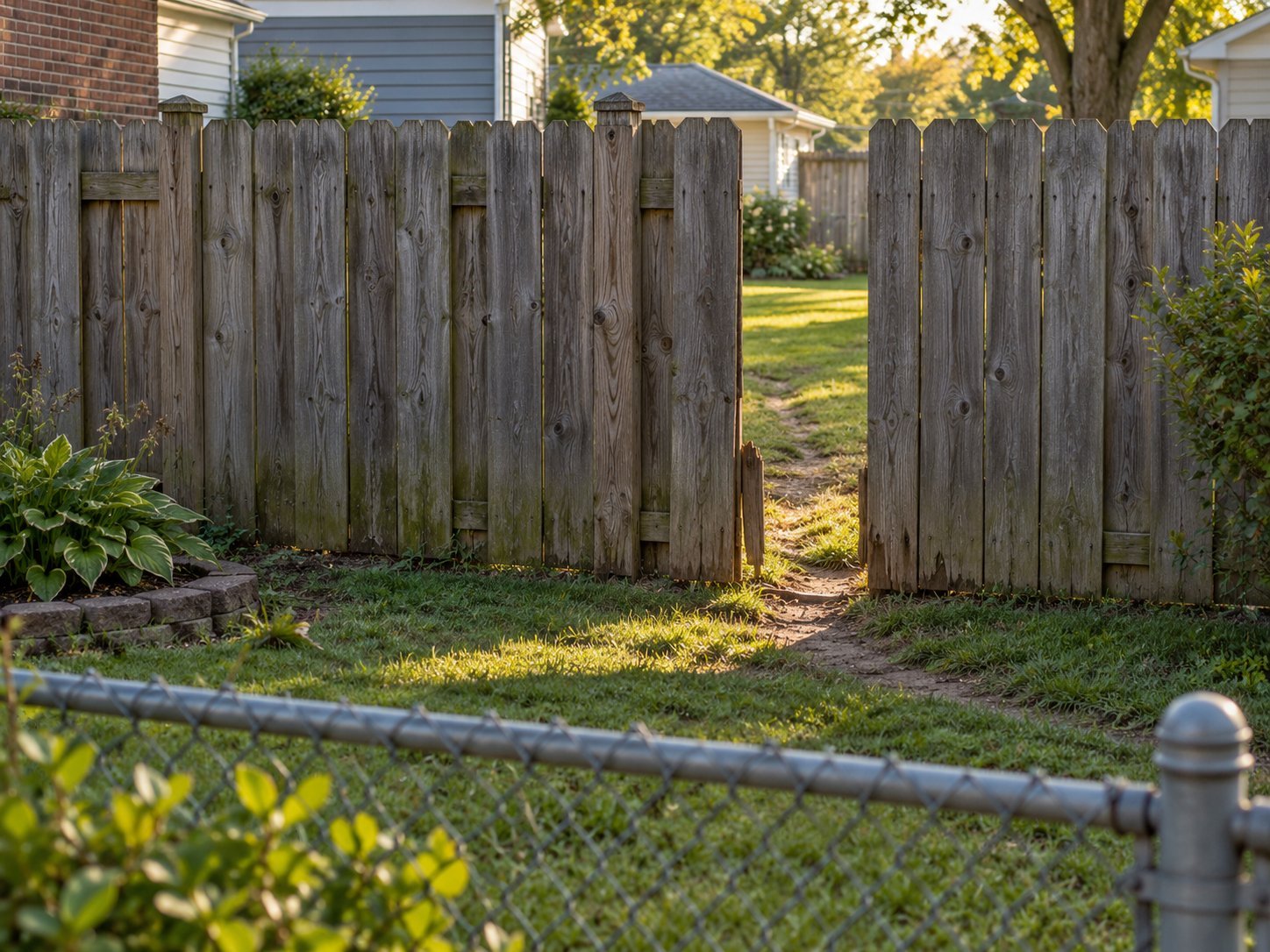
In Tripp v. Baker, 346 Mich. App. 257 (2023), the plaintiff rested his hand on a chain-link fence while trimming his mother’s bushes and the tenant’s dog reached through a broken section of the landlords’ wooden privacy fence and bit him. The Court of Appeals held: “a dog qualifies as a ‘condition on the land’ for purposes of premises liability. A prima facie case of premises liability arising from a dog bite requires a showing that: (a) the dog is the condition on the land and (b) the defendant had knowledge of the dog’s dangerous tendencies.” Id. at 268–269. The second element is Szkodzinski‘s knowledge requirement, now stated as an element of the premises claim rather than as a gloss on it. The plaintiff in Tripp lost on a different ground: a survey placed the chain-link fence entirely on the rental property, his unsupported assertion of an acquiesced boundary did not create a fact question, and as a trespasser he was owed only the duty to refrain from willful and wanton misconduct. Id. at 264–265. The court also held, under the open-and-obvious doctrine as it then stood, that the landlords had not carried their burden on that defense because their motion addressed the fence and not the dog, id. at 270; three months later the Supreme Court abolished the doctrine, so that passage no longer states a defense (below).
The Court of Appeals applied Tripp‘s two-element test as settled law in Leiendecker v. Ascension Genesys Hospital, ___ Mich. App. ___, 2026 WL 97441 (Jan. 13, 2026), a published decision holding that a goose which had nested on hospital grounds for days and attacked several people was a condition on the land for which the hospital could answer to an invitee: “the Tripp decision did not rely on the domesticated nature of the dog, implicitly or explicitly, to determine whether it was ‘of the land.’ And conditions of the land can be natural or artificial and a goose, like a dog, can pose an ‘artificial risk’ to invitees.” Id. at *4. The court added that it was “not expanding our common law, we are applying it,” id. at *4 n.4, and confirmed that Kandil-Elsayed v. F & E Oil, Inc., 512 Mich. 95 (2023), which abolished the open-and-obvious doctrine, “did not otherwise disturb the elements of a premises liability claim.” Id. at *4 n.3. No application for leave to appeal was filed. The unpublished decisions since Tripp apply its test without qualification. Blaylock v. MacIntyre (2025); Skiver v. Durga (2022).
Premises liability runs with possession and control. “Premises liability is conditioned on the presence of both possession and control over the land.” Leiendecker, at *4 n.2 (quoting Scola v. JP Morgan Chase Bank, 506 Mich. 924 (2020)). A security contractor without possession of the hospital grounds owed no premises duty, id., and a landlord who has surrendered the leased space to the tenant has no possession of it. The line therefore runs around the tenant’s leasehold: a landlord owed no duty to a child bitten on the tenant’s porch, “within his leasehold,” Burling; or inside the tenant’s mobile home, Braun; or on the tenant’s front step, Burnett; but a shared porch, Allen v. A & M Properties, Inc. (2011) (unpublished), and a park road, Skiver, are common areas the landlord retains, and a condition there is the landlord’s. Property managers stand in the landlord’s shoes. James.
The premises claim is for the non-owner. Against the dog’s own owner, the premises theory adds nothing and costs something. The owner’s duty to control the dog “is separate and distinct from” the landowner’s duty, Hiner v. Mojica, 271 Mich. App. 604, 615 (2006), it does not depend on the victim’s status as invitee, licensee or trespasser, and the premises-liability defenses were never available against it. Id. at 615–616; Tripp, 346 Mich. App. at 268 n.2. An owner-occupier sued on a premises count toward a social guest has defeated it on licensee status more than once, Stoll v. Stobby (2008) (unpublished); Myers v. Myers (2003) (unpublished), and a plaintiff who dropped the owner’s statutory count and pleaded the landlord in premises liability alone lost under the then-governing open-and-obvious doctrine and the rule that a premises owner need not anticipate a third party’s criminal act, when the tenant deliberately set the dog on him. Allen. The owner is pleaded under the statute, common-law strict liability and negligence (Chapters 2, 6 and 7); the premises count is for the landlord, the park, the manager and the host.
What wins and what loses
The verdict that stood. Skiver v. Durga (2022) (unpublished) is the model. A resident walking her son’s dog on a road inside a mobile-home community was attacked by a tenant’s pit bull that broke free; she suffered a vertebral compression fracture. The park prohibited pit bulls and required registration; the tenant had hidden the dog, but a former manager had seen it at the initial inspection, residents had complained of repeated escapes, a neighbor had reported being cornered in his shed, and sheriff’s deputies had once been unable to subdue the dog with pepper spray. The jury found the park 60 percent at fault and the owner 40 percent and returned judgments of $435,900 and $290,600. The Court of Appeals affirmed on two theories: ordinary negligence for failing to enforce the park’s own pet rules against a dog it knew to be dangerous (the Braun factors satisfied on these facts), which required neither possession of the dog nor knowledge of “viciousness” in the strict-liability sense; and premises liability for a loose dangerous dog as a condition on the land in a common area under Klimek, with notice proved through the escapes and complaints and the staff’s knowledge imputed to the operator. A landlord may have no duty to inspect a tenant’s home for a dangerous animal, but “it could not ignore the evidence” that the tenant was keeping one. The same elements let a plaintiff bitten in an apartment complex’s common area after the landlord had been told of a prior common-area bite defeat summary disposition and settle. Wendzel v. Feldstein (2015) (unpublished). And a commercial landlord or franchisor that solicits the public to a dealer’s premises can answer to a customer bitten by the dealer’s guard dog with a history of attacking customers. Clark v. Texaco, Inc., 55 Mich. App. 100, 101–102 (1974).
The judgments that were lost. The defense decisions are almost uniformly knowledge cases. A single episode of aggressive barking is not knowledge of viciousness. Shaw v. Wilson (2002) (unpublished). Knowledge that the tenant has an unlisted second dog, that the dogs chew furniture and get out a window, or that they are Akitas is not knowledge of dangerousness. James. A prior adjudication of a different dog of the same tenant, police reports that do not mention the dogs, and neighbors’ opinions are not evidence that the landlord knew. Morgan v. Nickowski (2017) (unpublished). An animal-control report calling the dog “aggressive” at the time of the bite does not show a prior vicious nature. Burling. Warning children to stay away from a chained dog is caution, not knowledge, and a six-figure verdict against non-owner landowners was vacated on that ground. Mayle v. Fuller (1999) (unpublished). Same-day bites of other guests at a party do not show that the entity owning the condominium knew anything before the party, and a licensee is owed no duty of inspection, so there was no duty to investigate the dog or demand its veterinary records. Blaylock. And where a child was bitten on the tenant’s own front step, outside any area the park controlled, two weeks’ notice of a chasing incident was held insufficient time to evict under Feister. Burnett. And where the lease was oral and silent on dogs and there were no rules, the landlord had no control even though the dog had bitten another child two months earlier. Stout v. Carver (2002) (unpublished).
Hearsay. In James, Morgan, Blaylock and Hightower v. Nuyen (2018) (unpublished), the plaintiff’s proof of the landlord’s knowledge was what someone had told someone, offered in the plaintiff’s own affidavit with no showing that it could be presented in admissible form at trial. Each was disregarded under MCR 2.116(G)(6). The affidavits that carried Skiver and Hamade v. Garza (2012) (unpublished) came from the neighbors who had warned the landlord themselves.
For lawyers
Practice points
- Plead the landlord in two counts: premises liability under Tripp (dog as condition on the land; knowledge of its dangerous tendencies; possession and control of the place of attack) and ordinary negligence for failure to enforce the landlord’s own pet rules against a known dangerous dog under Braun as applied in Skiver. Keep the owner’s statutory and common-law counts separate.
- Prove knowledge of this dog with first-hand affidavits: the neighbor who called the office, the resident who was cornered, the officer who responded, the former manager who saw the dog at inspection. Knowledge of staff and agents is imputed to the landlord. Hearsay in the plaintiff’s own affidavit will be disregarded.
- Subpoena the landlord’s file: complaints, pet registrations, violation notices, prior write-ups of the same tenant, and the lease and rules. The rules are the Feister control element and the Braun undertaking; a tenant previously written up and made to remove other dogs shows both knowledge and power.
- Fix the location. Common area, shared porch, park road or landlord-maintained fence: within the landlord’s possession. Inside the tenant’s unit or on the tenant’s own porch: not. Off the property: Feister bars the claim.
- Fix the timeline, and meet the eviction-timing argument head-on. The defense will cite Feister at 25–26 and Burnett for the proposition that a landlord who could not have evicted before the attack cannot be liable. The answer is that both were leasehold or off-premises cases in which eviction was the landlord’s only tool. Where the attack was in an area the landlord controlled, plead the measures short of eviction the landlord could have taken at once (a demand to remove or confine the dog under the rules, a fence repair, barring the dog from common areas, a warning to residents) and frame the question as the reasonableness of the landlord’s response to notice, Hamade; Skiver; Wendzel. A pending eviction is evidence on that question, not a defense to it.
- Against a property manager, plead possession and control of the common areas specifically; James treats managers as landlords, and Leiendecker holds that a contractor without possession owes no premises duty.
- Answer a survey with a survey. Tripp was lost on trespass because the plaintiff offered an unsupported boundary assertion against a surveyor’s affidavit.
- The open-and-obvious doctrine is no longer a defense. Kandil-Elsayed abolished it, and the obviousness of a danger is now only a comparative-fault consideration; the elements of the premises claim are otherwise unchanged. Leiendecker, at *4 n.3. Pre-2023 dog-premises opinions that turn on open and obvious (Tripp at 270; Allen; Stoll; Tosa) are superseded on that point.
- Do not plead the dog owner in premises liability. It invites the licensee/trespasser defenses and adds nothing to the statute, strict liability and Trager negligence.
Authorities
Published decisions
| Case | Court / year | Point |
|---|---|---|
| Tripp v. Baker, 346 Mich. App. 257 | Ct. App. 2023 | A dog is a condition on the land; two-element prima facie premises case; trespasser owed only willful-and-wanton duty; open-and-obvious passage superseded by Kandil-Elsayed. |
| Leiendecker v. Ascension Genesys Hospital, 2026 WL 97441 (reporter cite pending) | Ct. App. 2026 | Applies Tripp to any animal the possessor knows to be dangerous; premises liability requires possession and control; Kandil-Elsayed left the elements intact. |
| Szkodzinski v. Griffin, 171 Mich. App. 711 | Ct. App. 1988 | Statute reaches only the owner; ordinance creates no private claim; landlord liable at common law only with knowledge of the dog’s vicious nature. |
| Feister v. Bosack, 198 Mich. App. 19 | Ct. App. 1993 | No duty for off-premises attacks; knowledge plus control of the premises or capability to remove or confine the animal; power to evict is not control; no duty to inspect; alternative ground that a landlord with no time to evict cannot be liable, confined to landlords whose only tool is eviction. |
| Braun v. York Properties, Inc., 230 Mich. App. 138 | Ct. App. 1998 | Pet rules alone create no duty absent knowledge of the particular dog’s dangerousness; duty factors; rules may show power to control (n.1). |
| Klimek v. Drzewiecki, 135 Mich. App. 115 | Ct. App. 1984 | Origin of the dog-as-condition-on-the-land rule; host’s duty to a child social guest regarding a neighbor’s known-dangerous loose dog. |
| Clark v. Texaco, Inc., 55 Mich. App. 100 | Ct. App. 1974 | Commercial landlord/franchisor that solicits invitees may answer for a dealer’s known-dangerous guard dog. |
| Hiner v. Mojica, 271 Mich. App. 604 | Ct. App. 2006 | Owner’s duty to control the dog is distinct from the landowner’s duty; premises-liability defenses inapplicable to the owner’s negligence claim. |
| Kandil-Elsayed v. F & E Oil, Inc., 512 Mich. 95 | Mich. 2023 | Abolished the open-and-obvious doctrine; obviousness of a danger goes only to comparative fault; entrant categories retained. |
Unpublished Court of Appeals decisions
Unpublished opinions are not binding precedent under MCR 7.215(C)(1).
| Case | Year | Point |
|---|---|---|
| Skiver v. Durga, 2022 WL 7724061 | 2022 | Verdict against mobile-home park affirmed: negligent failure to enforce pet rules against a known dangerous dog; loose dog as condition on the land in a common area; notice by repeated escapes and complaints. |
| Blaylock v. MacIntyre, 2025 WL 2155386 | 2025 | Applies Tripp; no duty to investigate a dog toward a licensee; same-day bites and hearsay do not show prior knowledge. |
| Wendzel v. Feldstein, 2015 WL 7288057 | 2015 | Landlord with notice of a prior common-area bite settled; pet-addendum indemnity enforced against tenant. |
| Hamade v. Garza, 2012 WL 6217360 | 2012 | Fact questions on landlord’s knowledge from neighbors’ direct warnings; panel read Feister as permitting liability for an attack on the abutting sidewalk (contrast James, Johnson). |
| Allen v. A & M Properties, Inc., 2011 WL 521325 | 2011 | Shared porch is a common area under landlord’s control; premises claim failed where tenant deliberately set the dog on plaintiff; MCL 554.139 unavailable to non-tenants. |
| Burling v. Skief, 2020 WL 6236650 | 2020 | No duty within the tenant’s leasehold; pet rules and pet fee create no duty; animal-control “aggressive” notation not prior knowledge. |
| Burnett v. Clarke, 2013 WL 1010062 | 2013 | Pit-bull ban creates no duty; no control over tenant’s leasehold; applied Feister‘s eviction-timing passage to a bite on the tenant’s own step (Gleicher, P.J., dissenting). |
| Stacey v. Colonial Acres Associates, 2011 WL 6268235 | 2011 | Breed-restriction rule does not impute knowledge of a particular dog’s viciousness; Braun factors. |
| James v. Gutherie, 2014 WL 4214949 | 2014 | Property manager treated as landlord; knowledge of the dog’s existence is not knowledge of viciousness; attack two lots away is off-premises; double hearsay disregarded. |
| Johnson v. McComb, 2011 WL 1902079 | 2011 | Lease no-pet clause creates no duty to neighbors; off-premises attack outside the landlord’s duty. |
| Morgan v. Nickowski, 2017 WL 5759789 | 2017 | Prior adjudication of a different dog, police reports and neighbor opinions do not show landlord’s knowledge. |
| Mayle v. Fuller, 1999 WL 33435336 | 1999 | Verdict against non-owner landowners vacated; warnings to children not evidence of known viciousness. |
| Shaw v. Wilson, 2002 WL 737795 | 2002 | One episode of aggressive barking is not knowledge of vicious propensities; association and unit owner not liable. |
| Stout v. Carver, 2002 WL 409520 | 2002 | Oral lease silent on dogs and no rules: no control despite alleged knowledge of a prior bite. |
| Williams v. Wolf, 2002 WL 1160379 | 2002 | Attack within weeks of occupancy; no knowledge at letting and no time to evict. |
| Michalek v. Estate of Malik, 2022 WL 128109 | 2022 | Panel held a hospital could not be liable in premises liability for a bite within the statute because the owner is liable for all damages under Hill v. Sacka; an outlier not followed in any published decision and inconsistent with Tripp, Feister and Szkodzinski, which contemplate non-owner liability. |
| Evers v. Medallion Management, Inc., 2024 WL 4100005 | 2024 | Deemed admissions against a landlord claim; oral motion at hearing suffices to seek leave to answer late. |
| Tosa v. Yono, 2008 WL 723979 | 2008 | Landowner has no duty to control stray dogs that wander onto the property. |
Common questions
I was bitten by a renter’s dog. Can I sue the landlord?
Only if the landlord knew that particular dog was dangerous, had some power to deal with it (lease terms, pet rules, control of the area where it happened), and the attack happened on property the landlord controlled, such as a common area, rather than inside the tenant’s own unit or off the property. Prior complaints to the landlord are the key evidence.
The park bans pit bulls and the dog was a pit bull. Isn’t that enough?
No. A breed rule does not by itself make the park responsible. It matters when the park also knew this dog was dangerous and had the power under its rules to make the tenant remove it, as in the mobile-home-park verdict that was affirmed in 2022.
The dog attacked me on the sidewalk in front of the rental house.
Michigan’s published rule is that a landlord is not responsible for a tenant’s dog’s attacks away from the leased premises. The claim against the dog’s owner is unaffected.
I was bitten at a party by the host’s roommate’s dog.
The dog’s owner is liable under the statute. The host or the property owner is liable only if they knew the dog was dangerous before the party; what the dog did to other guests the same night does not show that.
Why does it matter whether the dog is a “condition on the land”?
Because that is the legal label that lets a victim hold the person in control of the land responsible for a known danger there, the same way a landlord answers for a broken stair in a common hallway. Michigan courts confirmed in 2023 that a dangerous dog can be such a condition.
Attacked by a tenant’s dog on rental property?
The landlord’s file and the neighbors’ complaints decide these cases, and both disappear quickly. JKH Law investigates the landlord as well as the owner. Consultations are free, in Grand Rapids and statewide.
This page is part of the Michigan Dog Bite Law Compendium published by JKH Law, PLC. It is legal information about Michigan law, not legal advice about any particular situation, and reading it does not create an attorney-client relationship. Citations were last checked in October 2026. Unpublished opinions are identified as such and are not binding under MCR 7.215(C)(1).

Personal injury litigation for Grand Rapids and West Michigan.
312 Fulton Street EastGrand Rapids, MI 49503 (616) 226-3762
Fax (616) 988-6504
Free consultation